






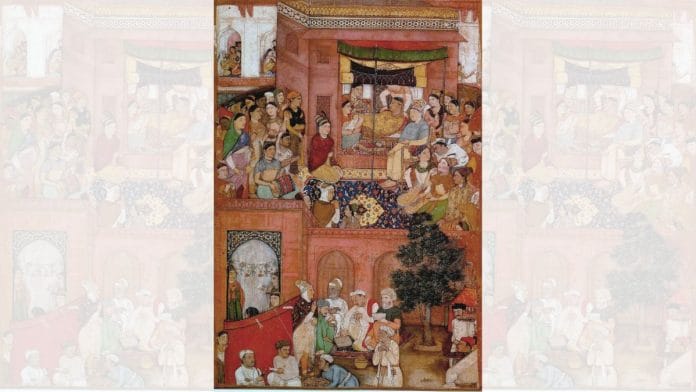


Among the many beautiful paintings commissioned by Mughal Emperor Jahangir is one by the painter Bishan Das, which depicts the birth of Salim—the given name of the emperor. The painting captures the first few moments after the birth. The lower part depicts the scene just outside the birth chamber—an older woman in a tall Chaghtai hat announces the birth to the waiting astrologers. Inside the birth chamber, a similarly dressed but clearly regal lady sits on a chair, surrounded by women engaged in various activities. They are of various ages and appearances—some dressed in the Chaghtai manner and some in an Indian style, wearing short, tight bodices with dupattas covering their heads. The topmost part of the painting depicts the newborn and his mother, who can clearly be identified as an Indian from her features and mode of dress.
The painting brings to life an important aspect of Jahangir’s heritage—the fact that his mother was a Rajput, the daughter of the ruler of Amer. While this is by no means hidden from those who have even a passing familiarity with Mughal history, the implications are not always fully appreciated. The painting by Bishan Das shows us an early moment in the transformation of the Mughal royal family itself. It shows us the contrast between the Mughal lady of an earlier generation and the young Rajput queen, who has just given birth to the heir. The other women in the room give us a hint of the changes that must have been brought into the royal household by the entourage that came with the queen. One woman sitting in the room plays a dholak in celebration.
A study of the domestic sphere in Mughal kingship adds a new dimension to our study of the Mughal court and culture. It is, of course, well known that Akbar’s deliberate move to marry into Rajput families was a political choice, designed to forge kinship ties with important ruling families in the realm. It is also easy to understand how the Mughals came to ‘Indianise’ courtly culture as a matter of statecraft. Akbar believed that a Mughal emperor ruling over a vast multicultural empire in India had to imagine kingship in a way that was very different from how his grandfather, Babur, who ruled over a small territory in Ferghana, imagined it.
Also read: Why Hyderabadis need a history lesson beyond the Mughal court
An inclusive state
It made sense to create a model of kingship from materials that were ready at hand. So, while Akbar married into Rajput families, he also borrowed court etiquette and practices from them. For instance, an important part of the image of the emperor was the projection of him as a semi-divine figure, taking on the title zill-e-ilahi, or reflection of God. While the idea of divine sanction was not unknown within the Mughals’ Turko-Mongol heritage, Akbar sought to embody it in a distinctly Indian form. Thus, the practice of jharokha darshan was adopted, where the emperor would show himself daily to his subjects, framed in a window like a deity. Another practice adopted was that of tula daan, the ceremonial weighing of the emperor on his birthdays—both according to the lunar and solar calendars—against precious metals, rich cloths, grains, etc., that were then distributed in charity.
These cultural and political choices were an important part of Akbar’s policy of sulh-e-kul, perfect peace and harmony, an ideal that aimed at creating an inclusive state that dealt even handedly with its diverse subject population, and in particular, sought to forge ties with the non-Muslim part of that population. Marriages with Rajput princesses were, on the one hand, a part of that strategy, and in turn reinforced it, because these Rajput women did not simply become wives of emperors, but also the mothers of emperors such as Jahangir and Shahjahan. Their important place within the royal household was bound to strongly influence the essential culture of the Mughal family.
Signs of this very specific syncretic culture can be seen in the many accounts of the later Mughals that still survive, such as palace diaries, newspapers, and memoirs of those who had been part of the court and household. Festivals such as Holi, Dussehra and Diwali were celebrated at court with formal durbars, as were festivals like Eid and Nowruz. There were also special practices such as the emperor bathing in the water of seven wells on Holi, and the sacrifice of buffaloes at the gates of the fort on the occasion of Diwali—a distinctly Rajput custom.
Also read: How pragmatic calculations shaped Mughal rule in medieval West Bengal and Tamil Nadu
The Mughal-Rajput women
Equally significant are the celebrations that took place within the confines of the royal family’s residential area, particularly the mahal, where the women of the family lived. Not only were all these religious festivals celebrated, but even some non-religious occasions were celebrated with a mix of Rajput and Indian Muslim traditions. For instance, the anniversary of the emperor’s accession to the throne involved a ratjaga, an all-night celebration on the eve of the anniversary. During this, an important part of the observances was a Rajasthani custom. The chief consort would pour seven double-fistfuls of dal into a pan, to which more dal was added and then soaked. At midnight, this would be ground, and the queen would make seven badas or fritters with her hands, which the emperor then transferred with a spoon into hot oil to fry.
These descriptions of the palace give us a greater insight into the culture of the Mughals beyond performative aspects of court ritual and etiquette. These were not designed to include subjects and courtiers of diverse backgrounds. Instead, they were an integral part of the beliefs and practices of the Mughal royal family itself; a family whose Chaghtai, Rajput and other roots came together to support and nourish a single tree. The Mughals would have been Indian even if they had not married Indian women, simply because they chose to make India their permanent home, but these marriages made them Indian in very specific ways.
To see Mughals as aliens in India is to forget history. It is also an extremely patriarchal lens that completely invisibilises women. By looking only at the male lineage of the Mughals, it willfully blinds us to the indisputable fact that women were active agents, not just vessels for the procreation of heirs. Akbar’s Rajput wife was not only respected for being the emperor Jahangir’s mother. She was an influential and wealthy woman, one of whose properties was the ship Rahimi, the largest Indian ship sailing to the Red Sea at the time. It is time we acknowledge her lineage and her role as a formative influence on the Mughal family.
Swapna Liddle is a historian and author based out of New Delhi. Views are personal.
(Edited by Theres Sudeep)
The more you hide the ugly side and write a biased view in favour of the Mughals, the more chances are hating them when the unsaid truth is revealed. The best is, write both the bright and dark sides of them and leave the judgement to the readers. This article is heavily biased on one side. I must say, a lot of sugar coating has been done to the poison pill. It may not be clever to think that in this era of internet and AI, one can hide ugly truths. Yes, Mughals have some positive aspects of their rule, people will accept them only when an honest account of them is told. For a period, a bygone period at that, it was a fashion to elevate the Mughal rule above all dynasties that ruled Bharat for several millennia since pre-historic times. I advice the writer, for a change, to research the chronicles of Islamic historians, chroniclers, biographers and bring out some unsavoury truths also. After all they are also facts, not the fiction written by Hindi fundamentalists.