





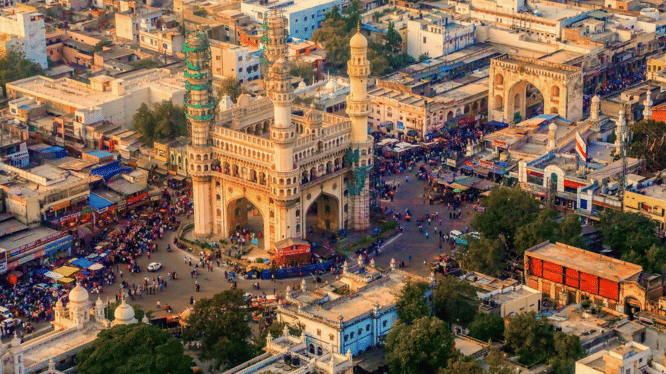


It has been 500 years since the onset of Mughal rule. And that the way we discuss the dynasty in classrooms, and outside of them, is still all distorted. The assumption that the Mughals controlled the entirety of the subcontinent from the beginning really peeves me. This is largely due to the history textbooks in Telangana which, at least during my childhood, focused more on the Mughals than own city, Hyderabad.
I vividly remember reading about Akbar, Shah Jahan, and Mughal trade routes and economics more than the founders of Hyderabad.
On 21 April 1526, Indian history was changed forever after Babur won the First Battle of Panipat and the Mughal Empire began. The BJP-led central government has overlooked the landmark day for obvious reasons.
But what else was overlooked? Eight years ago, the end of the Bahmani empire (1347-1518) in the Deccan also marked its 500th anniversary. Its collapse led to the emergence of governors as independent kingdoms. This also resulted in the rise of Golconda, which was the capital of the Qutb Shahi dynasty from 1518 until 1590, before it was shifted to the newly established city of Hyderabad.
Although there has been some course connection since Telangana was formed in 2014, Hyderabadis and south Indians need to focus more on our own regions when we are taught history in school. This Mughal history obsession, to tell everyone that they ruled the entire country, is not only inaccurate but also unfair.
The story of Hyderabad
Hyderabad was founded by the Qutb Shahi dynasty in 1591, whose founder, Sultan Quli, originally came to Bidar under the Bahmani as a refugee.
He went on to become the governor of Telangana under the Bahmani kingdom and emerged as the king of Telangana/Golconda when the kingdom he saved collapsed. Not just him, but other states under the Bahmani empire, such as Bijapur, Ahmednagar and Berar, also had the same trajectory.
There were no Mughals in the region until 1526, eight years after Golconda came into the picture. This was not taught in school, but something I learned on my own. But what is truly confounding is that most people don’t know that the Mughals almost destroyed Hyderabad in 1687 during Aurangzeb’s southern campaign.
Apart from a few monuments, such as the Charminar or the Golconda Fort, Hyderabadis have no idea of what this city might have looked like, the monuments that might have stood at one point. The city was later rebuilt by the Nizams. While not ethnically Mughals, the Nizams were appointed as governors after their conquest of Hyderabad.
This isn’t a complaint about the Mughals because they destroyed Hyderabad some 400 years ago. It is a call to fellow Hyderabadis to learn our own history first.
Also Read: The Nizam heirs’ endless property disputes are costing Hyderabad its heritage
Branching out
The Mughals are, by all means, a significant part of Indian history. After the 1600s, they began conquering the Deccan and the south, but let’s not forget that they were not as mighty as we’re told, nor did they have all that wealth by default.
When Golconda and Hyderabad were thriving and booming with trade for over a century after the kingdom’s establishment, thanks to diamond mines in Andhra Pradesh, from where the stones were brought to the city for trade, the Mughals in the north were struggling, at least politically.
After Babur, the second Mughal king, Humayun, lost power for 15 years after his seat was captured by Sher Shah Suri. It took decades for his son, Akbar, to stabilise politically, which is why the Mughals from the 1600s onward started branching out to the Deccan and other parts of the country to consolidate power.
Hyderabadis were actually doing great without Mughal interference, and I can only imagine how the city would have been had it not been destroyed by Aurangzeb. But history is history, and if we’re going to laud Mughal contributions, then we also must speak about them from the perspectives of people belonging to cities that were destroyed by them.
Yunus Lasania is a Hyderabad-based journalist whose work primarily focuses on politics, history and culture. He posts on X @YunusLasania. Views are personal.
(Edited by Insha Jalil Waziri)
This is not the correct history. That region’s history is much older than 1591. Please spare us this selective historical whitewashing
The claim that Hyderabadis need a “history lesson” is a bold one, especially when that lesson is a transparent exercise in selective framing designed to rebrand foreign invaders as local heroes. By “starting the clock” in 1591, the blogger doesn’t offer a historical correction; he attempts to sell a structural contradiction that ignores the actual indigenous foundations of the Deccan. From the perspective of the native population, both the Turkish Shahis and the Central Asian Mughals were foreign dynasties that arrived via conquest, displaced the native language (Telugu) with Persian, and imposed external legal and religious tax systems like Jizya.
The contradictions in this narrative are glaring:
The “Refugee” Framing: Calling Sultan Quli a “refugee” is a calculated attempt to manufacture a sympathetic origin story. While he may have arrived under patronage, he consolidated power through the same mechanisms of conquest and displacement as any other imperial ruler. A sympathetic arrival does not sanitize the centuries of foreign extraction that followed.
The “Founding” Fallacy: History did not start in 1591. The region was a strategic powerhouse under the Kakatiya Dynasty centuries before the first Sultan arrived. The “Golkonda” fort wasn’t an original Shahi creation; they occupied a Kakatiya mud-fort and renamed it. Even the name is Telugu (Golla Konda –>Shepherd’s Hill), and the citadel’s masonry still bears the marks of Kakatiya engineering that predates Islamic architecture in the region.
Stolen Infrastructure: The blogger credits the Sultanates for the region’s “habitability.” This is false. The Kakatiyas engineered the massive “chain of tanks” irrigation systems that made the Deccan productive. The Sultanates did not build the foundation; they merely moved into a pre-existing civilization and claimed credit for its wealth.
The Economics of Extraction: The “booming trade” and diamond wealth were produced by the labor and knowledge of the native community. The Shahis didn’t “create” this wealth; they extracted it from the indigenous majority to fund their urban monuments.
The blogger laments the Mughal destruction of Sultanate architecture but remains silent on the cultural and structural erasure that occurred when the Sultanates first arrived. He ignores the Dharma-based legal systems and the 1,500 years of Kakatiya, Chalukya, and Rashtrakuta rule because they expose his “local” narrative as a recent settler-colonial myth. By starting the clock at 1591, the blogger attempts to “grandfather” a foreign dynasty into indigenous status simply because a second wave of invaders (the Mughals) eventually arrived to challenge them.
True regionalism honors the soil and the original people. The history of this land belongs to the civilization that built its tanks and tilled its soil for millennia, not just the last group of outsiders who happened to build a minaret