









Elections in West Bengal have long been the centrepiece of India’s national political theatre. For the better part of fifteen years, the state has stood as a defiant opposition bastion—one of the “final frontiers” the BJP has pursued with relentless vigour. From a mere 4 per cent vote share in 2011 to nearly 40 per cent in 2024, the BJP has leapfrogged from fringes to become the state’s principal Opposition party, thus relegating the Left and Congress to relative ignominy.
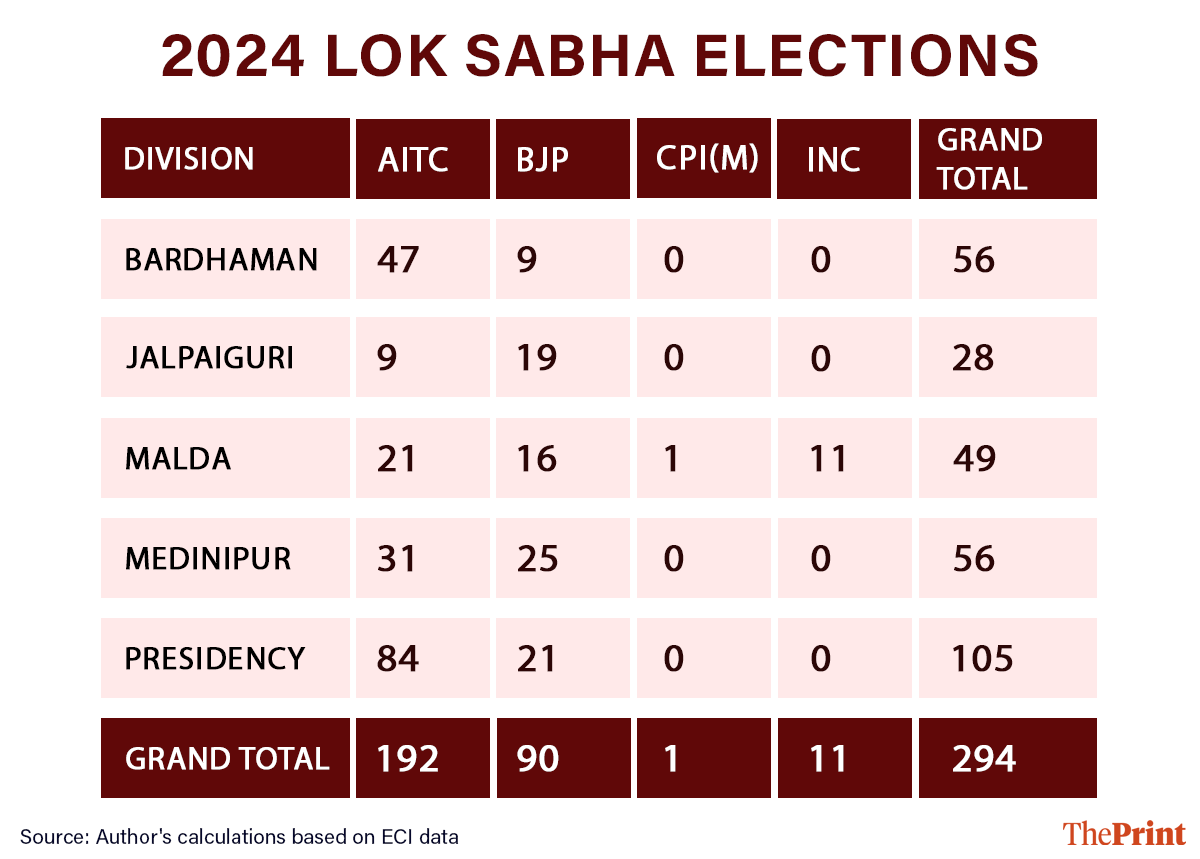
Yet, beneath this rapid surge lies a sobering reality for the BJP. Across the last three major cycles—the 2019 and 2024 Lok Sabha polls and the 2021 State Assembly elections—the Hindutva wave appears to have met its breakwater, plateauing at 40 per cent vote share mark. In fact, if one were to map the 2024 Lok Sabha election results to the state’s 294 Assembly segments, the BJP would win 90 seats, while TMC would still form the government with 192 seats.
BJP’s victory in 90 Assembly segments in 2024 is its biggest return yet, and far better than its actual showing of 77 seats in the 2021 Assembly polls; however, it’s still a far cry from the magic figure of 148 to form the government. As TMC battles a triple anti-incumbency wave, the BJP would still have to bat out of its skin to win the polls.
In 2019, at the height of Prime Minister Narendra Modi’s popularity, the BJP won a whopping 18 out of 42 Lok Sabha seats and bagged 31 Assembly segments more than it did in 2024, giving Mamata Banerjee’s party an almighty scare. The numbers, unfortunately, have declined since, and the BJP’s fortunes face a recurring, frustrating pattern—a nationwide appeal that sparkles during the Lok Sabha contests but fizzles out in hand-to-hand combat in the trenches of state politics.
North Bengal consolidation remains key
The Jalpaiguri division (comprising Darjeeling, Kalimpong, Cooch Behar, Jalpaiguri, and Alipurduars districts) has become the BJP’s crown jewel in Bengal, where it has maintained a stubborn stronghold and won as many as 21 out of the 28 Assembly seats in 2021. This is also the region that handed the BJP its first electoral win in 2009 as Darjeeling sent Jaswant Singh to the Parliament. Ever since, the party has only strengthened itself. Home to the SC and ST community and Bengal’s tea capital, the region had been historically dominated by the Left and Congress. The national party has captured the imagination of the public that was once fervent voters of the opposite end of the BJP’s ideological spectrum. Nisith Pramanik’s 2024 loss may mean there’s still some ground to cover in Cooch Behar, but the BJP would be looking to consolidate further to make sure Pramanik’s debacle was only a blip in the north and not the norm.
Close match-ups in Medinipur & Bardhaman
BJP’s slide in Bardhaman Division is worrying. Out of 56 seats, it won only nine and eight seats in 2024 and 2021, respectively. Compare this with the 24 seats it won in 2019 at the peak of the ‘Modi Wave’. Though all is not lost for the BJP. A deeper look shows that 19 seats in the Bardhaman division were won or lost by a margin of less than 10,000, with the BJP winning the Kulti Assembly seat in 2021 by as few as 700 votes. Forty out of the 58 seats in the division had a winning margin of less than 10 per cent in 2021, which means any party that can swing its vote share by 5 per cent, roughly around 12,500 votes, can end up being a victor. A TMC-BJP score of 48-8 in 2021 can easily look something like 35-21 even if the BJP wins 50 per cent of these 40 seats, provided both parties retain the rest of the seats they won by over 10 per cent.
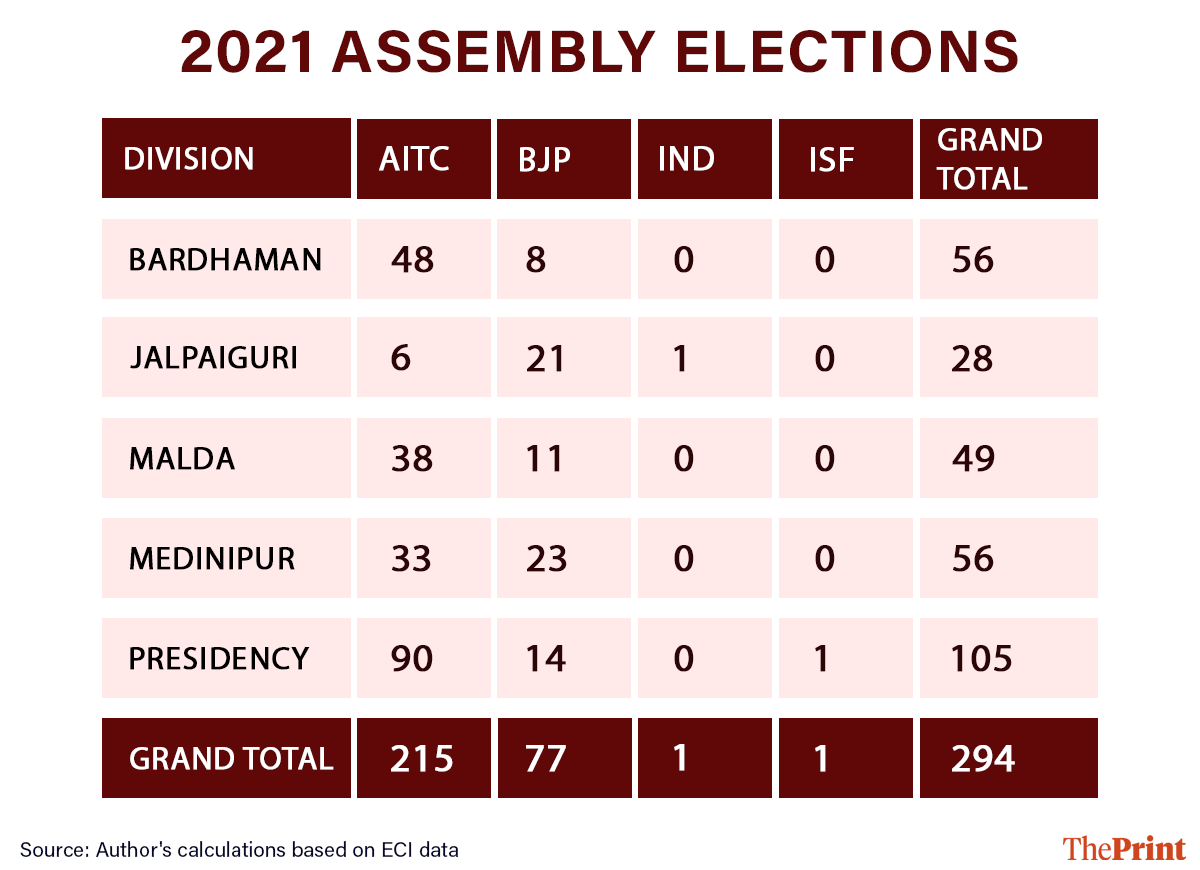
The story is similar yet different in Medinipur, as the margins between the two parties become even thinner. TMC may have wrested control in terms of seat share, winning 33 out of the 56 seats in 2021; however, nearly half of these, 26, saw close contests in 2021, with as many as 16 seats being won or lost by a margin of 5,000 votes. Thirty three out of 56 seats saw a winning margin of less than 5 per cent, meaning a swing of 2.5 per cent or around 7,000 votes can be decisive. Interestingly, even if the BJP wins 50 per cent of these close contests, calculations show that the seat share may not look drastically different from what it did in 2021.
In 2021, it was also here that Mamata Banerjee and Suvendu Adhikari, ex-TMC minister and now the BJP’s leader of Opposition, locked themselves in a high-pitched battle in Nandigram, the influence of which reverberated in polls across the state. The sitting CM might have lost at Adhikari’s home by just 1,956 votes, but Banerjee surely had the last laugh. And if season 1 of this contest was not interesting enough, we are headed for season 2 in 2026, albeit this time in Banerjee’s home turf, Bhabanipur.
Also read: I saw West Bengal’s battle with Naxalism. State’s approach wasn’t limited to police action
Triangular contest in Malda
The Malda division, which has 49 Assembly segments, includes North Dinajpur, South Dinajpur, Malda, and Murshidabad districts. It has usually seen a strong TMC performance where the state’s ruling dispensation won 38 seats in 2021, with 35 of them by a margin of over 20,000 votes.
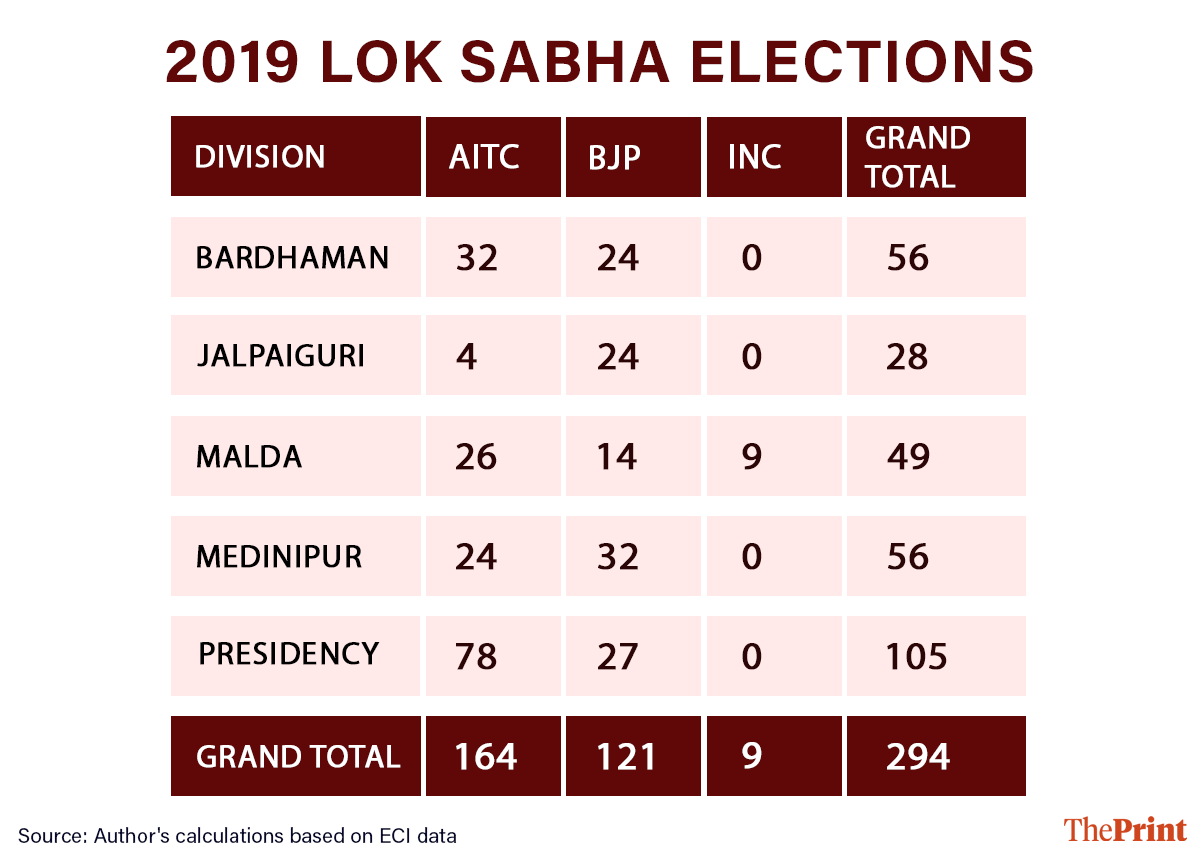
The anomalies in trends arise when Congress’s five-time Parliamentarian Adhir Ranjan Chowdhury enters the fray in the Lok Sabha polls. Chowdhury’s influence lies beyond his home Assembly, Baharampur, and even though he lost to TMC’s Yusuf Pathan in the 2024 Lok Sabha, the Congress led in 11 Assembly segments. Chowdhury has now thrown his hat in the mix, after a gap of 30 years, to fight the state polls.
SIR deletions too will dominate the political discourse here, and impact results the most, as nearly 7 lakh voters have been deleted in Murshidabad and Malda districts alone. Nine out of the top 10 Assemblies with the highest number of deletions are in the Malda division, and TMC held all of them in 2021. In a three-cornered contest in 2026, with the number of SIR deletions exceeding the winning margins in many assemblies, it is anybody’s guess which party is set to gain the most out of this complex equation.
TMC’s home run in Presidency
The largest of all regions with 105 assemblies, comprising Kolkata, Howrah, Hooghly, North and South 24 Pargana districts, is the epicentre of ‘Bhadralok’ politics in Bengal, and this is where TMC’s lead seems insurmountable for the BJP. The numbers are not just lopsided, they are a landslide—the ruling party in the state won 90 seats in 2021 and the BJP, only 14. TMC has not only got used to winning in the Presidency region but winning big—it won 75 of its 90 seats by 20,000 votes or above, while the national party managed to win only five out of its 14 seats by the same margin. The contest in Presidency Division will likely seal the fate of the elections in 2026, too, but the current numbers are stacked heavily against the BJP. It is here that the BJP’s high command needs to weigh in the most to swing the public mood, and hope for the TMC juggernaut to self-combust at some point.
Also read: Mamata Banerjee vs the mighty Establishment. That’s what Bengal election is really about
The SIR variable
Ultimately, electoral arithmetic is a tool to read the complex will of the voters, it’s not a crystal ball. Yet, the newest and most volatile variable in the name of Special Intensive Revision (SIR) deletions has crashed into the equation. When 91 lakh names have been struck down from the rolls, the traditional arithmetic has gone kaput. In this election, the headlines may well be dominated less by the millions who cast their ballots and more by the ones who were told they no longer could, or at least temporarily.
While the latest trends suggest the TMC’s statistical fortress remains sound despite the BJP’s steady gains, the scale of these deletions can no longer be ignored. If the ‘math’ fails this time, it would have less to do with the voters changing their minds, and more to do with the very ground beneath all calculations being swept away.
Note: The analysis has been done using publicly available data on the ECI website. To compare the results of the 2021 Assembly Elections and the 2024 Lok Sabha Elections, the analysis involves mapping assembly seats to parliamentary constituencies and then parliamentary constituencies to administrative divisions.
Shubodeep Datta is a fundraising manager at Peepul, a Delhi-based education NGO. Views are personal.
(Edited by Theres Sudeep)