









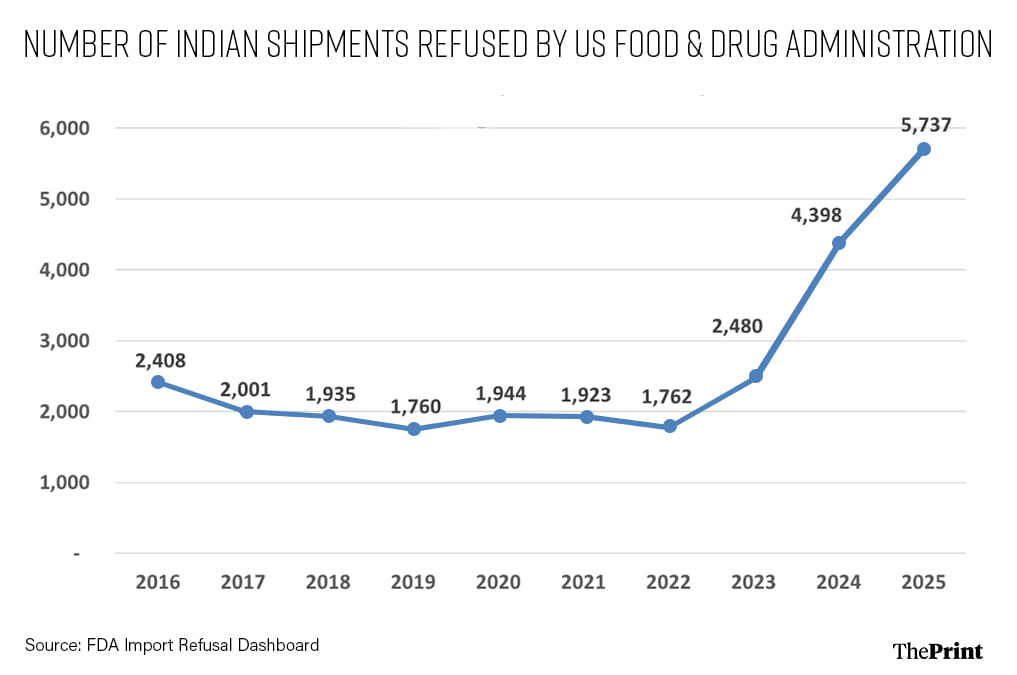
A few days ago, Japan banned Indian mangoes for the first time in 20 years. Since 2010, the European Commission has maintained a continuous emergency measure on every shipment of Indian aquaculture products. According to Commission Decision 2010/381/EU, every Indian seafood product must be tested before leaving port in India, and EU member states must then retest 50 per cent of arriving consignments. Even with this double screening in place, the Commission’s 2018 audit and subsequent rapid alerts flagged the presence of banned antibiotic residues. Across the Atlantic, the United States Food and Drug Administration’s import-refusal records show more than 25,000 rejected Indian consignments over the past decade. For a country that markets itself as the next factory of the world, these numbers are a humiliating revelation.
India has still set a target of $2 trillion in total exports by 2030–31, up from $860 billion in FY 2025–26. Meeting that target requires a compound annual growth rate (CAGR) of more than 18 per cent over the next five years. Last year, India managed 4.22 per cent. Over the past 13 years, the CAGR for merchandise and services exports combined has averaged 4.85 per cent. Some of last year’s underperformance can be attributed to US tariffs and turmoil in the Middle East, but that would not explain the long-term trend.
How can this be? India has 37 statutory and quasi-statutory bodies whose stated purpose is to promote exports. Fourteen export promotion councils sit under the Department of Commerce, covering engineering, gems and jewellery, leather, pharmaceuticals, textiles, plastics, chemicals, services, project exports, sports goods, handicrafts, oilseeds, silk, and apparel. Five commodity boards govern tea, coffee, rubber, tobacco, and spices. Statutory authorities oversee marine products (MPEDA), agricultural and processed foods (APEDA) and coir. The Export Inspection Council (EIC) handles the formidable task of inspecting goods before they leave Indian ports. With decades of promotion, India should have become an export powerhouse before countries like China.
An illusion of ‘promotion’
The pitch is appealing for export promotion entities—they develop markets, certify quality, help small exporters reach global buyers, and protect India’s international reputation. In practice, however, these bodies often add mandatory layers of registration, licensing, inspection, and fees that every exporter must bear before a single container leaves the country’s shores. The time and cost burdens of these requirements fall most heavily on smaller firms exploring new markets, pricing them out before they have sold a single unit abroad.
Before a marine exporter ships a single container of shrimp, the paperwork takes months. First, an Import-Export Code from DGFT, then register at the customs port for an AD Code, and apply for ICEGATE access. After that, apply separately to the Marine Products Export Development Authority for the Registration cum Membership Certificate and exporter status (MT/ME/RTME). Register each processing plant, cold store, handling facility, and conveyance with MPEDA individually; each may require an inspection. Get EIA approval from the Export Inspection Council and secure an FSSAI license. The process is not over yet; registration of every farm, hatchery, and breeding centre must be completed with the Coastal Aquaculture Authority. Every registration is a separate queue, a separate fee, a separate process, and none of them coordinate or share data with the others.
These prerequisites are in addition to other general licensing and formal requirements, such as having a registered firm, PAN, GST, and licences under the Shops and Establishments Acts, as well as other mandatory documentation for some processes, such as a worker hygiene & sanitation plan for aqua farms or cold storage units. These bodies impose real costs on exporters that compound India’s already significant competitiveness disadvantage.
India’s exporters face higher costs, longer dwell times at ports, and additional mandatory documentation due to a complex web of compliance requirements. This effectively makes Indian firms less competitive and efficient than those in competing nations such as Ecuador, Vietnam, and Indonesia. The mandatory registration and inspection regimes of MPEDA, APEDA, and EIC function less as quality guarantees and more as barriers to entry in international markets that protect incumbents and generate revenue, without improving actual export outcomes.
What about quality and national reputation?
Defenders of the export-control architecture justify such competing and contradictory bodies as necessary for the national reputation. Proponents of this claim argue that a cadre of experts is needed to safeguard the quality of “Made in India.” But the EU emergency measure that has run uninterrupted for 15 years, and 25,000+ FDA refusals speak for themselves.
Despite 37 dedicated bodies, the reputation of Indian goods has not improved. What it has done instead is make Indian exporters unreliable partners. Buyers never know which documents will expire, which licences will not be renewed, or whether the product will clear the Indian port at all, leading them to explore other more reliable supply chains.
The quality of Chinese goods was shoddy two decades ago, and the term “Chinese” was used as a synonym for poor-quality products in India. Solar panels, consumer electronics, and auto components that were unreliable in 2005 now dominate the global markets. Export councils did not deliver that upgrade; it came from relentless competition, exposure to demanding global buyers, and the disciplining force of market feedback mechanisms—subpar goods do not get repeat orders.
Quality is a by-product of competitive pressure and learning, not of councils that could improve it by inspecting and licensing. India’s promotion bodies have done a great disservice to exporters; they have insulated Indian businesses from the feedback loops that would force genuine improvement over time and make us more competitive.
Also Read: How Indians can have their gold and curb imports too
Stop ‘promotion’ to export more
The way forward is not another reform committee, a new portal, or a digitised version of the same licences and registrations. India must eliminate all “promotional” bodies that impose any additional cost on exporters. At best, these bodies should become voluntary, member-funded industry associations with no regulatory oversight or authority to delay shipments.
The mandatory certification must be replaced with a voluntary third-party conformity assessment. There is no denying that some country-specific imports require quality certification; the exporter could obtain it from an NABL-accredited laboratory and share the results directly. India is already a full member of the International Laboratory Accreditation Cooperation and other instruments that allow for such mutual recognition. A laboratory report of product quality from an accredited lab in India is accepted in 100+ countries without involving promotional entities. The infrastructure for a credible, market-driven quality signalling already exists, but is bypassed by a system that insists on inspecting and certifying every container.
The taxpayer-funded “promotion” in the form of trade fairs, brochures, market development funds, and gatekeeping done by 37 entities must stop if the government is serious about the $2 trillion annual exports goal. Indian exporters do not need the government to introduce them to foreign buyers in the 21st century. They need the government to get out of the way so they can access markets, learn, improve, and become internationally competitive.
We must remember that a good product does not require a dedicated body to promote it—it sells.
Sudhanshu Neema is a Delhi-based lawyer and economist.
Madhav Chadha, an alumnus of Ashoka University, is a policy research analyst at a prominent Delhi-based think tank.
Views are personal.
(Edited by Insha Jalil Waziri)
pathetic state of affairs