








Prime Minister Narendra Modi’s appeal to citizens to cut back on gold purchases marks a rare instance in which a PM has personally asked the public to curb such spending.
His emotional appeal also included a request to curtail petroleum consumption and refrain from unnecessary foreign travel. It came as the conflict between the US, Israel, and Iran disrupted crude oil supplies and led to a continuous surge in prices. The country’s trade imbalance has become even more acute, and the Indian rupee has depreciated rapidly, currently hovering around Rs 95-96 per US dollar. Several experts have even expressed apprehension that it could breach the 100-rupee-per-dollar mark.
Indian governments have historically imposed various restrictions on gold imports to conserve foreign exchange—ranging from periodic hikes in import duties to quantitative controls—but this appeal was a departure from the norm.
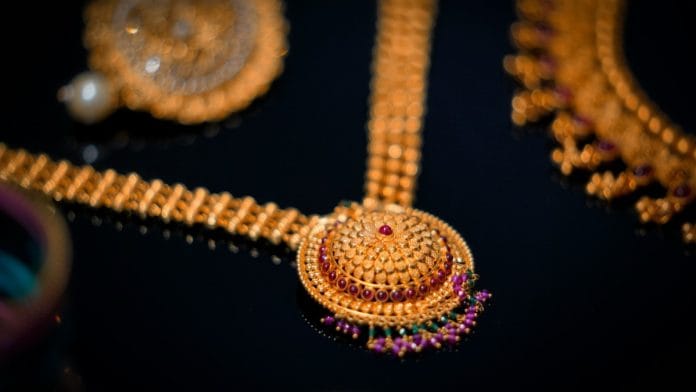
The Indian public’s fascination with purchasing gold is nothing new. For thousands of years, people across the country have made substantial gold purchases, primarily in the form of jewellery. This long association between gold and jewellery led some to read the Prime Minister’s appeal as a call to specifically curb jewellery purchases.
But the question is whether jewellery is still driving India’s demand for gold, and whether new investment options could offer an alternative.
Also Read: Modi’s call to cut fuel use wasn’t just about oil—it was about saving the rupee
New driver of gold demand
Over the past two decades or so, there has been a significant decline in the purchase of gold in the form of jewellery within the country. Yet, gold imports continue to rise steadily.
To unravel this puzzle, we must examine both import and demand data. India’s gold imports rose to $71.98 billion in 2025-26, compared with $58 billion in 2024-25. In volume terms, however, imports declined to 721.03 tonnes from 757.09 tonnes, showing that the higher import bill was driven largely by rising global prices.
Meanwhile, World Gold Council data shows that India’s total gold demand during the first quarter of 2026 amounted to 151 tonnes, while demand for gold jewellery was 66.1 tonnes. Investment demand, at 82 tonnes, surpassed jewellery demand for the first time on record.
In other words, the rising demand for gold is also being driven by the fact that people now seek to hold gold as an investment asset. This is visible globally as well. In 2025, investment demand jumped 84 per cent to 2,175 tonnes, fuelled by strong inflows into exchange-traded funds (ETFs) and bar-and-coin purchases.
Furthermore, central banks in most major nations—including the Reserve Bank of India—are steadily increasing the proportion of gold within their foreign exchange reserves.
India’s gold imports story
Since 1991, the trend of official gold imports into India has intensified significantly compared to previous times. One reason was that before that year, gold imports were subject to stringent controls. Not only were high import duties imposed, but a licence was also mandatory for importing gold. Consequently, official gold imports remained low, while domestic gold consumption remained consistently high. Gold smuggling flourished on a massive scale.
Between 1981 and 1985, official gold imports were minimal, increasing slightly in 1986-1988, following a relaxation of regulations — though they still amounted to a mere 10 to 20 tonnes per annum. From 1989 to 1991, official gold imports rose to between 10 and 30 tonnes annually, whereas the total inflow of gold, including smuggled gold, was estimated to be between 200 and 300 tonnes per year.
In 1992, the government introduced an import scheme for Non-Resident Indians (NRIs), and by 1993, official gold imports began to be channelled through banks and designated agencies. This led to a drastic decline in smuggling, while official imports surged significantly. Between 1993 and 1994, 200 tonnes of gold were imported, and from 1995 to 1997, this figure reached between 400 and 500 tonnes.
Subsequently, gold imports generally hovered between 600 and 900 tonnes annually, with the volume even touching the 1,000-tonne mark in several years. In light of rising imports, import controls on gold were reinstated by 2012-13. Not only were import duties increased, but several restrictions were also imposed on banks regarding gold imports. A condition was imposed on importers requiring them to re-export at least 20 per cent of their total gold imports.
Gold imports fell during the COVID-19 pandemic, but subsequently witnessed a significant surge. While gold imports had already been on an upward trajectory since 2021, following a reduction in import duties in 2024, they reached a value of nearly $72 billion by 2025-26. Although the volume of gold imported in 2025-26 was lower compared to 2024-25, the dollar value of these imports exceeded that of the previous year due to an unprecedented rise in gold prices.
Also Read: Why Sridhar Vembu’s ‘return home’ appeal to Indians in the US is significant
Need for out-of-the-box options
It is evident that the rising value of gold imports has begun to exert pressure on India’s foreign exchange reserves. Given that gold demand is now predominantly driven by investment purposes, rather than the traditional demand for jewellery, it has become imperative to consider alternative investment instruments for the public.
Historically, purchasing physical gold was the only viable option. However, numerous alternatives have since emerged. Gold exchange-traded funds (ETFs) represent one such alternative. The money invested in these funds reached Rs 1.71 lakh crore in March 2026, up from Rs 58,888 crore a year earlier, showing growing public appetite for gold as a financial investment.
Today, anyone wishing to invest in gold can allocate funds to ETFs and capitalise on the appreciation in gold prices.
On 4 May 2026, the National Stock Exchange (NSE) announced the launch of Electronic Gold Receipts (EGRs) as a new trading segment. This marks a pivotal step toward modernising and formalising India’s vast and tradition-steeped gold market.
While gold ETFs can only be bought or sold on the stock market in rupee terms, EGRs can be converted into physical gold. The introduction of such products in the stock market presents viable alternatives to investing solely through the purchase of physical gold— and could help curb the trend of rising gold imports.
Although these new alternatives are still in a nascent stage, there is a need to devise innovative, unconventional mechanisms that encourage people to refrain from buying physical gold and instead invest in such instruments. This would allow them to reap the benefits of gold price appreciation while simultaneously curbing gold imports into the country.
Ashwani Mahajan is National Co-Convener of Swadeshi Jagran Manch and a former professor at PGDAV College, University of Delhi. He tweets @ashwani_mahajan. Views are personal.
The author did not explain how would gold imports be curbed with anything the gov has done. Just used this piece to explain Gold ETFs and EGRs which most most gold investors already know.