






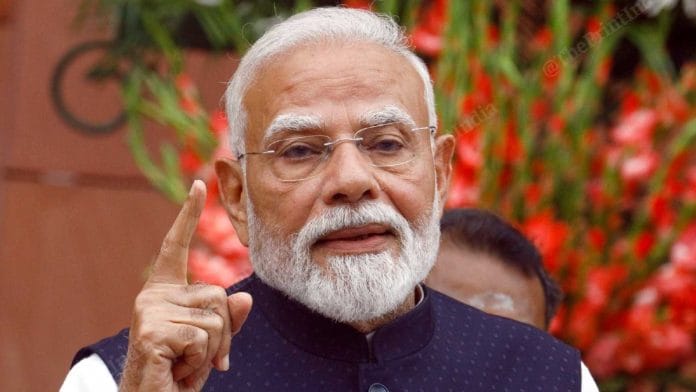

Almost from the time he took office as Prime Minister, Narendra Modi has been lauded by his supporters for his unwillingness to backtrack on a policy or to give in because of public protests. Rare is the minister who has had to resign because of media criticism. And very few policies have been abandoned or even moderated because of complaints from those adversely affected.
Over the last month, however, there are signs that we are seeing a more accommodating Narendra Modi, a man who does not treat every agitation as a masculinity test and does not believe that listening to his critics is a sign of weakness.
The best example of this was the about-turn on the Jantar Mantar protests. The government followed its usual policy by first ignoring the protesters and their demands. When the protests gathered momentum across India, the government sent the police in with lathis and pellet guns to scare the protesters away. Judging by past experience, the stand-off between the government and the protesters would have persisted for several more days, until police brutality broke the students’ will.
This time around, confounding the predictions of friendly media and contradicting his own ministers and aides in their briefings to the press, the Prime Minister gave in. He agreed to sack Dharmendra Pradhan, the Education Minister whose ouster had been demanded by the protesting students. And his government offered an undertaking to the protesters that FIRs filed against them would be withdrawn. (It seems to have kept its word.)
When the unexpected about-turn was announced, many people suggested that this was a one-off development. The Prime Minister was worried that he was losing young India and had agreed to a one-time compromise.
But was it really a one-off? Or was it the start of a change in attitude? The signs are that, on Gen Z outreach at least, the 75-year-old Prime Minister is trying to change the idiom of his communications. We have had in-your-face (literally) selfie videos, and ministers have been told that there is a platform called Instagram which the government seems to have only just discovered and which they should get on to quickly. Some have been encouraged to go on Substack, breaking with a longstanding policy under which the Prime Minister alone was the face and voice of the government. Even on X, the PMO handle now uses terms like ‘slam dunk’ in the manner of a well-meaning grand uncle who believes that all young Indians play basketball and so the best way to communicate with them is to use basketball terminology.
It’s not a style that comes naturally to the Prime Minister or his cabinet, and sometimes the imperial persona breaks through. For instance, if you want to reach out to students who have just been assaulted by your police, does it really help to declare that even though you were insulted by the slogans raised by young protesters, you are such a big man that you forgive them?
But it’s hard to deny that the BJP is communicating differently. When the bosses of the IT cell were replaced, people pointed out that one bunch of hate-mongers had just been replaced with a new bunch of hate-mongers. That may be true, but what’s worth noticing is that the new team is relying more on humour and satire than its predecessors. The humour can sometimes backfire. One video posted by the BJP seemed to advocate slapping young people who might be ‘dimagi Naxals’; this message probably cheered every gunda in the country without advancing the BJP’s real interests.
Also read: BJP’s good times are perhaps ending. But Modi is no Indira Gandhi
Signs of a new style
But there is a certain quick-wittedness to the government’s responses to criticism, which is new. For instance, when it emerged that media baron Subhash Chandra was paying back only a fraction of his debts, there was a national uproar and people drew up lists of industrialists who had benefited from the largesse of the government and public sector banks. Inevitably, this was contrasted with the taxes ordinary people have to pay and the cost to the economy. This sort of thing has happened before, and the Modi government’s usual response has been to do nothing and wait for the uproar to die down.
Not this time. Within 24 hours, the settlement with Chandra had been disowned, and he will have to renegotiate his debts anew. And the government quickly announced that India had grown by 7.8 per cent in the first quarter of fiscal year 2026-27. Its spokespeople made sure that this was widely broadcast as a sign of the success of the Prime Minister’s economic policy. Hardly anyone offered the information that in the quarter before this one, the rate of growth had been 8.6 per cent, so this was actually a fall.
We can argue about India’s actual growth rate (and the figures have been questioned), but it’s clear that the BJP’s PR machine and the tame TV anchors convinced Indians this was a triumph.
Will this change in style persist? I reckon it will. PM Modi needs to ride out the period before next year’s Assembly elections in Uttar Pradesh, which the BJP reckons it will win. (Not everyone in the Opposition disagrees, though they think it is the faithful Gyanesh Kumar, not Narendra Modi, who will be the real winner.)
The Prime Minister cannot risk being seen as he was during the Jantar Mantar agitation: as an Imperial Prime Minister far removed from the grievances of ordinary people. He seems to have realised that he needs to connect — and connect quickly.
I doubt he will ever be seen as a soft and gentle leader, and nor is it clear that he wants to be seen that way. But Modi is shrewd enough to realise that after so many years at the top, anti-incumbency is setting in and the electorate wants a leader who at least seems responsive to public concerns.
Hence the change of approach and the sudden willingness to accept and act on criticism.
Will it work? It’s too early to say. But yes, if he can keep this up, Narendra Modi may well surprise us all.
Vir Sanghvi is a print and television journalist, and talk show host. He tweets @virsanghvi. Views are personal.
(Edited by Prashant Dixit)