





For much of the developing world, the defining shortage of the next two years may not be energy or credit. It may be food. Wheat prices are at a two-year high, fertiliser costs are climbing, and the shipping routes that carry staple grain to import-dependent countries are becoming harder to insure and use. Much of this traces to one stretch of water.
The Black Sea region accounts for roughly a third of global wheat trade and 63 per cent of the world’s sunflower oil exports. Its ports in Ukraine supply food products to more than 55 countries. India is among them, and among the most exposed. It is the world’s largest buyer of sunflower oil, and sources most of it from the Black Sea. It also depends on the same waters for important fertiliser supply lines.
India has spent the last few years arguing that the food and fertiliser security of developing countries cannot be left at the mercy of distant conflicts. It pressed the case through its G20 presidency and the Voice of the Global South summits and has been among the few large economies willing to speak for countries that import what they eat but control none of the routes their food travels on. For countries that buy their food in dollars and subsidise staples at home, a disruption thousands of miles away can very quickly become a problem for government budgets and household kitchens.
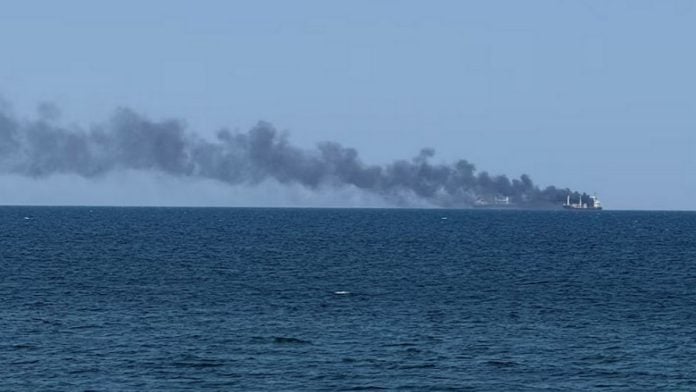
The danger is no longer abstract for Indians either. In July, the Golden Leo, a cargo ship sailing from Ukraine, was struck by Russian cruise missiles off the Greater Odesa port. Nine of its seventeen crew members were killed, including four Indians. India already supplies more than 12 per cent of the global maritime workforce. With the government aiming for one in five seafarers worldwide to be Indian, attacks on commercial shipping put Indian maritime professionals disproportionately at risk.
This could hardly come at a worse time for India. Exporters are already being squeezed by US tariffs, while sanctions risk over Russian oil purchases and disruption at major energy chokepoints are pushing up costs across the economy. Food and fertiliser now threaten to become a third shock, arriving just as India is trying to absorb the first two.
Also Read: How Ukrainian assault on Russia’s largest Black Sea terminal threatens India’s crude imports
Food and fertiliser shocks hit India
In India, the effects are already visible in cooking oil. Sunflower oil shipments from the Black Sea have been delayed by up to 60 days, and India’s imports have fallen 24 per cent this season to 2.48 million tonnes. Meanwhile, soybean oil purchases have risen 54 per cent as refiners look for alternatives.
Crude sunflower oil landed in India at around $1,496 a tonne in August, 18.4 per cent above the previous year. By comparison, palm oil prices rose 9.4 per cent and soybean oil 7.9 per cent.
Delhi has already cut import duties on edible oils, with the deepest reduction on sunflower oil, giving up revenue to limit the effect on consumers. Refiners are increasingly looking to Argentina, which has overtaken Ukraine as a supplier to India for the first time. But finding oil elsewhere is proving more expensive. Longer journeys add to costs just as more countries are competing for the same suppliers.
The second channel is fertiliser, and here the fiscal exposure is even larger. India relies heavily on imports from the Black Sea region and the Gulf, leaving it exposed to upheavals in both conflict zones. To avoid disruption in the Gulf, India has already rerouted procurement to Egypt, Algeria, Nigeria and Georgia. The Union Budget for 2026-27 allocated Rs 1.71 lakh crore for fertiliser subsidies, but the government may now need an additional Rs 70,000-80,000 crore as higher import costs push the bill well beyond budget. Subsidy spending on imported urea alone rose 128 per cent last year to nearly Rs 48,000 crore. A budget written on the assumption of easing global prices is being overtaken by the opposite.
Also Read: Ukraine’s robotic army is already at work. India must rethink the next battlefield
Delhi has leverage others don’t
The wider problem is one India has spent the past decade warning about: countries across the Global South are forced to absorb shocks they did little to create. Bangladeshi buyers are now paying more than $450 a tonne for Australian wheat that cost under $380 before the disruption; replacing Black Sea supply can add another $25-60 a tonne. Somalia imports 90 per cent of its cereals, with six million people already facing acute hunger. These are the countries India has increasingly sought to speak for, and this time it is feeling the same pressure itself.
There is another reason for Delhi to become involved. India has consistently presented itself as a country willing to engage both sides in pursuit of peace, even when that position has attracted criticism.
An arrangement focused on protecting commercial food shipments would address an immediate problem shared by countries far beyond Europe while giving practical weight to its commitment to peace. It could start modestly with a food corridor between Indian and Black Sea ports, using Indian-flagged ships carrying grain, edible oil and fertiliser already bought by Indian buyers, with Indian maritime observers on board rather than military escorts. Striking an identifiable Indian ship carrying food to India or the Global South would carry a very different cost.
India also has leverage few others do. Its substantial economic relationship with Moscow gives Delhi a degree of access and economic weight that many countries simply do not have. It can use that position to press Moscow not to target civilian ships or the ports serving them, and to make the protection of commercial shipping part of the wider economic conversation between the two countries.
For India, this is no longer a distant war with distant consequences. Its seafarers are at risk, its food and fertiliser costs are rising, and the countries it has promised to speak for are being hit even harder. The Black Sea gives Delhi a rare chance to protect its own interests, stand up for the Global South and show what its commitment to peace can deliver in practice.
Parthiva Bhaumik is an analyst with the Tony Blair Institute for Global Change based in Kyiv. Views are personal.