





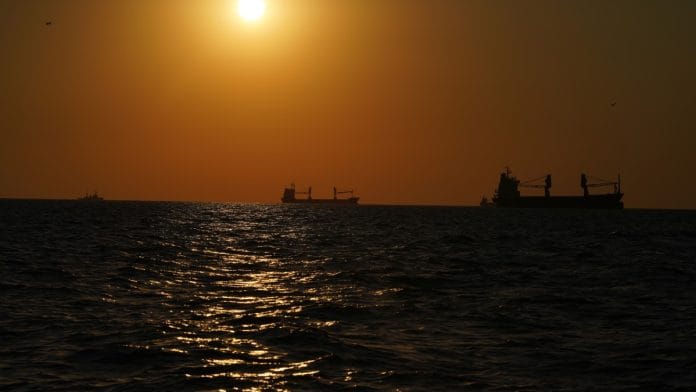


New Delhi: A temporary disruption at Russia’s Sheskharis oil terminal on the Black Sea following a surge in Ukrainian drone attacks in the area has once again underlined India’s growing dependence on Russian crude, with analysts saying developments around Russia’s crude export infrastructure now pose a bigger risk to Indian refiners than disruptions in the Red Sea.
The Sheskharis terminal in Novorossiysk, Russia’s largest crude loading facility on the Black Sea, halted operations last week after a surge in Ukrainian drone attacks on oil infrastructure in the region, Abu Dhabi-based commodity analyst Natalia Katona told ThePrint.
This terminal is particularly important for India, given that, of the 1.1 million barrels per day (mbpd) loaded here in June, around 840,000 barrels per day (bpd) of Russian Urals and Siberian Light crude was destined for Indian refiners. The wider Novorossiysk export complex accounted for roughly 28 percent of all Russian crude imported by India during the same month, cited Katona. The June volumes were a record and coincided with a sharp rise in Russian crude shipments to India in recent months. Before the Strait of Hormuz crisis, Sheskharis accounted for export of an average of around 465,000 bpd in 2025.
Katona, however, was of the view that the disruption is unlikely to last.
“The port infrastructure remains undamaged, while current loading delays may also reflect severe weather conditions,” she said.
She noted that satellite imagery suggests loading activity, halted since 20 July, may downplay actual operations, as some Russian-linked tankers are reportedly sailing with their transponders switched off to reduce exposure to attacks. The terminal loading data also shows that crude has been loaded onto at least two tankers since.
Katona added that Russian operators have become more accustomed to operating under the threat of drone attacks and continue to rely on a “shadow fleet”.
Also Read: With crude at $100 again, Russian supplies may cushion India, but cost pressures set to mount
Black Sea more important for India than Red Sea
The latest disruption underlines how India’s energy security priorities have shifted over the past two years, with Russia emerging as its dominant crude supplier.
According to Sumit Ritolia, manager for oil markets and refineries at Kpler, a trade data intelligence firm, India is importing around 2.6 mbpd of Russian crude in July, accounting for roughly 55 percent of its total crude imports. Saudi Arabia, by comparison, has supplied only around 400,000 bpd in recent months.
“While the Strait of Hormuz and Red Sea remain strategically important, the uninterrupted operation of Russian export infrastructure—particularly Black Sea terminals such as Novorossiysk—has become equally, if not more, critical for India’s crude supply,” Ritolia told ThePrint.
He said Indian refiners still have an important supply buffer if Red Sea transit remains open, with Saudi Arabia able to route around 300,000-500,000 bpd of crude through its East-West pipeline to the Red Sea port of Yanbu.
However, if security conditions in the Red Sea deteriorate and those cargoes become unavailable in August, refiners are expected to replace them primarily with Russian crude, while also purchasing spot cargoes from West Africa and drawing on commercial inventories to bridge temporary supply gaps.
Ritolia said India’s crude sourcing has become significantly more diversified in recent years, with higher imports from Russia, Venezuela, Africa and Atlantic Basin producers, giving refiners greater flexibility than in previous years.
However, he cautioned that Russia’s ability to increase exports remains uncertain. The continued Ukrainian attacks on upstream and downstream energy infrastructure have already contributed to a decline of around 400,000 bpd in overall Russian crude exports in July compared with the previous month.
If threats from Houthis disrupt flows from the Red Sea, Ritolia does not expect India’s supplies to come under severe stress due to regular flows from Russia.
“Russian crude remains India’s strongest supply hedge, and imports could potentially rise toward or even above 3.0 mbpd if market conditions and Russian export availability permit,” he said.
For India, analysts ThePrint spoke to said the geopolitical risk map has fundamentally changed. While disruptions in the Strait of Hormuz and the Red Sea will continue to be a determinant, the uninterrupted functioning of Russia’s Black Sea export infrastructure has become equally critical to ensuring the country’s crude supplies remain secure.
(Edited by Amrtansh Arora)
Also Read: India’s imports from Russia, powered by crude, grew by 52% in 1st quarter of FY26-27