






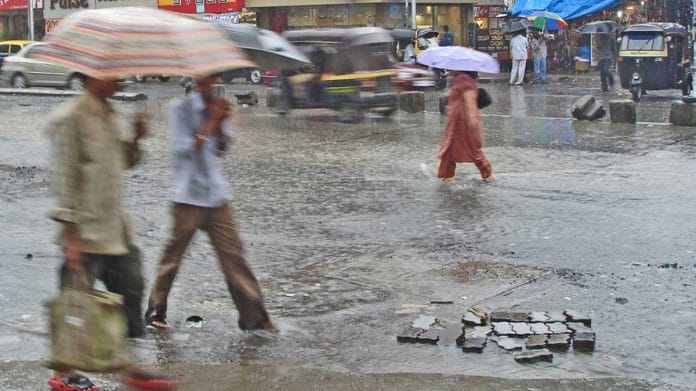


This is the time of the month when large parts of India wait desperately for some sign of the monsoon. Many businesses carry monsoon risk on their books. Too much or too little rain can cause lots of damage.
So, when the NCDEX issued a circular last week announcing a Liquidity Enhancement Scheme for Mumbai Rainfall Futures (ticker: RAINMUMBAI), one naturally got excited. The contract covers the monsoon months and makes a payout based on the occurrence and magnitude of predefined weather conditions. This is different from insurance, which compensates for actual loss. It’s the beginning of a market for monsoon risk, and it is about time India had one.
How will the RAINMUMBAI contract actually work?
Imagine you run a mid-sized construction company in Mumbai with a large infrastructure project underway. Your July budget, which factors in some predictable rainfall, assumes your crew works 20 days, unlike the usual 25 days in non-monsoon months. But if July is an unusually heavy rainfall month, your workers cannot be on site, and your losses increase.
With RAINMUMBAI, you can buy a July futures contract that is structured to pay off when Mumbai’s measured rainfall in July exceeds a certain level, say 700 mm, for the month. The measurement has to come from a designated source such as the India Meteorological Department (IMD). If July ends up getting much higher rain than normal, say 800 mm, your futures position settles at a gain, and offsets the costs you are bearing. If the month turns out to be drier than expected, with rainfall at 500 mm, your futures position settles at a loss.
Let’s say the contract is priced at 700 mm, meaning the market expects 700 mm of July rain. Each millimetre of rainfall above or below this entry price is worth a fixed rupee amount: say Rs 500 per mm per lot. And you buy one lot at 700 mm. If the actual rainfall is 820 mm, then your profit is (820-700) x 500 = Rs 50,000. If the monsoon is 500 mm, then your loss is (500-700) x 500 = Rs 1,00,000. But this may be offset by the fact that your workers were able to pull off the 25 days of work, and your revenues are on track. You may think that it’s a price worth paying for the hedge.
Who is selling this futures contract? The NCDEX contract proposes a designated market maker (DMM): a professional trading member who commits to being present in the market continuously, posting prices at which they will both buy and sell. This is a serious operational commitment. In exchange, the DMM receives an incentive that changes depending on their presence. Over time, there may be traders on both sides of the market.
Also read: The rupee does not need a defender. It needs an economy worth defending
Derivatives and climate change
The idea of derivatives to deal with weather-related risks started around 1999. The Chicago Mercantile Exchange listed the first Heating Degree Day futures in September that year. The derivative essentially prices how cold a winter will be, measured by how many degrees each day’s temperature falls below 18 degrees Celsius, the point at which people start turning on their heaters. If it is a warm winter, people won’t turn on their heaters, and the gas utility would lose revenues.
Cooling Degree Day contracts, which measure how many degrees each day’s temperature rises above 18 degrees Celsius, followed in January 2000. While these were initially tools for gas utilities and energy traders, they gradually came to be used by businesses from breweries to construction companies. Temperature gave way to rainfall, wind speed, frost days, and snowfall.
Outstanding weather derivatives are estimated at $25 billion. However, the vast majority of these are bilateral contracts between banks, energy traders, insurers, and corporates, away from any exchange, without transparent pricing or centralised clearing. India has enormous potential to become a sophisticated user of weather derivatives, given its agricultural dependence, its growing urban economy, and its acute climate vulnerability.
Also read: India must stop being the ‘gentle elephant’. Modi’s Europe tour marks a strategic shift
What will it take to make this work?
First, more details are needed on the contract’s tick size, lot size, and the precise index formula. But this is most likely to be addressed shortly.
Second, the issue of measurement must be resolved. The contract rests on all parties to the transaction agreeing on how much rainfall there was in a month. One may rely on the IMD, but if it is slow to publish or unavailable at relevant geographies, the contract could get into trouble. If another weather station provides a different estimate, disputes may arise. Hence, the exact data source, the measurement methodology, the backup in case of data failure, and the dispute resolution mechanism if participants challenge the settlement value need to be discussed ex-ante. Uncertainty about the contract’s data source when the market is trying to attract its first participants has the potential to damage its development.
Third, the market can take off only if there are both sides to a transaction. Someone has to benefit from low and heavy rainfall to trade with each other. While the existence of the market maker solves this to an extent, it will not work if liquidity does not develop.
Most derivatives serve a narrow constituency—a nickel futures matters to metal traders, a crude oil futures to refiners and energy companies. But occasionally, a product emerges that is truly macro, whose movements ripple across the entire economy. For India, and perhaps only for India, the monsoon has that quality. It moves agriculture, power, inflation, rural incomes, and government finances all at once. If RAINMUMBAI ever matures into a deep and liquid market, it would be one of India’s most consequential financial instruments.
Renuka Sane is managing director at TrustBridge, which works on improving the rule of law for better economic outcomes for India. She tweets @resanering. Views are personal.
(Edited by Prasanna Bachchhav)