








India’s culture and civilisation are our gift to the world. It is a composite culture spread worldwide. It also influences how India engages with the world, especially the West, from the time of Alexander of Macedonia, in 326 BC.
Noted Dutch scholar and Indologist, Professor Dirk Kolff, said, “Why it should be India, and not another place on the face of the Earth, that should claim so much of the curiosity of the Dutch?”
He answered his own question: “India represents Europe’s most fascinating ‘Other’.”
Indeed, having had the privilege of representing India in this beautiful country as Ambassador, I believe that it appropriately sums up the eternal fascination of both countries for our histories and cultures and with regard to India, a fascination for our antiquity and diversity. Prime Minister Narendra Modi’s visit reflected this mutual fascination.
A 400-year-old connection
Dutch footprints in India go back more than 400 years, when the first ship of the Netherlands East India Company reached the famous Malabar Coast in Kerala, known as the Spice Coast. There has been no looking back. Off the beaten track, one can find remains of the Dutch period in our history along the entire coastline from Surat to Kolkata, as well as from Visakhapatnam to Kochi and Pulicat.
Successive Dutch envoys to India proudly recall that on 15 August 1947, the then-Dutch Ambassador was among the three Ambassadors present in Delhi when the then Prime Minister Jawaharlal Nehru delivered the famous “Tryst with Destiny” speech.
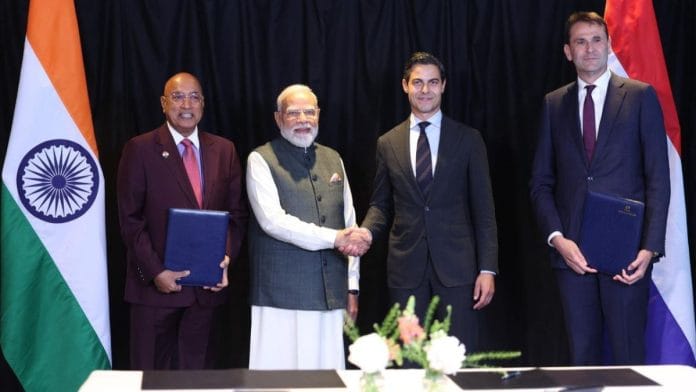
PM’s visit to the Netherlands was long overdue. His recent visit, as part of a five-nation tour, which included the UAE, Sweden, Norway, the 3rd Indo-Nordic Summit and Italy, resulted in the upgrading of the bilateral relationship with the Netherlands into a strategic partnership. It also added new dynamics to the India-EU partnership.
The Dutch Foreign Minister Tom Berendson said the new strategic partnership will be focused in future on trade and investment, security, innovation and people ties.
MEA added that, in addition, the visit would focus on defence, security, green hydrogen, semiconductors and a strategic partnership on water.
The Netherlands is one of India’s largest trade destinations in Europe, with bilateral trade worth $27.8 billion in the Financial Year 2024-2025. India is the fourth largest investor with an accumulative FDI of $55.6 billion.
Modi’s visit resulted in several key outcomes, including the signing of 17 agreements and the elevation of India-Netherlands ties to a “Strategic Partnership” following bilateral talks with Dutch PM Rob Jetten in The Hague.
The most important development from the bilateral talks was the contract between Tata Electronics and ASML to support the semiconductor fabrication plant in Dholera, Gujarat. Modi described the talks as an important step in India’s journey to develop a semiconductor ecosystem. The Netherlands boasts one of the world’s most advanced ecosystems, with Dutch multinational ASML being the leading supplier of high-precision lithography equipment, a critical requirement in manufacturing semiconductor chips.
In a roundtable with Dutch CEO, PM Modi said, “Semiconductor chips will be manufactured in India using ASML’s equipment. The optimism toward India is clearly visible in all your words today. We guarantee that this optimism will translate into an outcome”.
He added that 2026 marks the beginning of a new golden era in India-Europe relations.
“This year, we signed the historic India-EU Free Trade Agreement (FTA). This agreement, between the world’s two largest and democratic powers, will become a strong foundation for shared prosperity,” Modi had said.
Meanwhile, the retrieval of the ‘Chola Plates’, considered among the most significant surviving records of the dynasty, marked great cultural and historical significance for India. They had been at Leiden University since the mid-19th century. Their return had been an outstanding demand for a long time. They were brought to the Netherlands in 1712 by Florentius Camper, who was in India as part of a Christian missionary mission in the period when Nagapattinam was under Dutch control.
“A joyous moment for every Indian. Chola Copper Plates, dating back to the 11th century, will be repatriated to India from the Netherlands. Took part in the ceremony for the same in the presence of PM Rob Jetton,” Modi wrote on X.
Also read: Aggressive outreach isn’t enough to get Norway to invest in India. Its rules are different
New strategic paradigms
On the political side, the joint statement underlined deep concern over the situation in West Asia. It noted its serious implications for the region and the world, including disruptions to global energy supplies and trade networks. Dutch PM strongly condemned the Pahalgam terror attack and expressed strong support to India in its fight against terrorism.
Trade and business remain the most important elements of the relationship. The business-friendly corporate tax structure and the excellent business climate led to most of the major IT companies from India establishing their offices in the Netherlands with impressive business portfolios along with Dishman Pharma, Synergy, Nucleaus and Bharti Airtel. The profile of Indian business has progressively diversified and includes areas such as pharmaceuticals, renewable energy, oil and gas and optical media.
The Netherlands has the largest Indian community in continental Europe, outside the UK. At 2,20,000, they are referred to as the Hindustani community, who came to the Netherlands from India via Suriname. They are proud of their Indian heritage and culture.
The visit was rich in substance and content. It reflects the shared values at the heart of the Indo-Dutch relationship, values that need to be nurtured, strengthened and consolidated. It also marks a new orientation of India’s foreign policy, with India strengthening its strategic partnerships and forging new alliances.
Writing inside his cell as a political prisoner in fascist Italy after World War I, philosopher Antonio Gramsci famously declared: “The crisis consists precisely in the fact that the old is dying and the new cannot be born; in this interregnum a great variety of morbid symptoms appear.”
India is an emerging power. India is the world’s most populous country, having overtaken China in 2024. India is the world’s third-largest economy measured at international prices (purchasing-power parity), at $17 trillion.
This resulted in the development of new strategic paradigms. It also included actively promoting the interests of the developing economies, becoming a ‘balancing power’. Modi has followed carefully what suits India’s vital national security interests. In a hostile neighbourhood with two nuclear-weapon countries, there are few other options for India.
More changes are required. It is time for India to address, as underlined by Pohl (2012), “The issue of its great power deficit which appears to be less one of ability than of political will… India remains wary of assuming global responsibilities that might impose limitations on the options available for pursuing its own immediate national interests…”
India has been compared for too long to the ‘gentle elephant’ as opposed to the ‘Chinese dragon’. It is time to become more assertive while protecting our core national interests.
India follows the philosophy of the Maha Upanishads, which says, “Ayang nijah paro veti, Ganna laghu chetasaam. Udarcharitana tu vasudaiva kutumbakam. (This is mine, this is yours, this thinking is for the narrow-minded. It is only for the generous-hearted that the earth is one family).”
This phrase has become synonymous with India’s soft power and growing international status.
Bharat would need to disseminate this message in the new emerging global disorder. Urging ‘Vasudaiva Kutumbakam’ seems to be the best option to protect international peace and security and bring back a rule-based international order at a time when global disorder has become the norm.
Bhaswati Mukherjee is a retired IFS officer. She has served as India’s ambassador to UNESCO, Paris, and the Netherlands. Views are personal.
(Edited by Saptak Datta)
Do India’s South Asian neighbours see us as a “ gentle “ elephant. They must sometimes feel nostalgic about the Gujral Doctrine.
Any number of foreign visits will not help socialist India. The world doesn’t give two hoots about our corrupt, dirty, overpopulated, poor, and undeveloped country.