



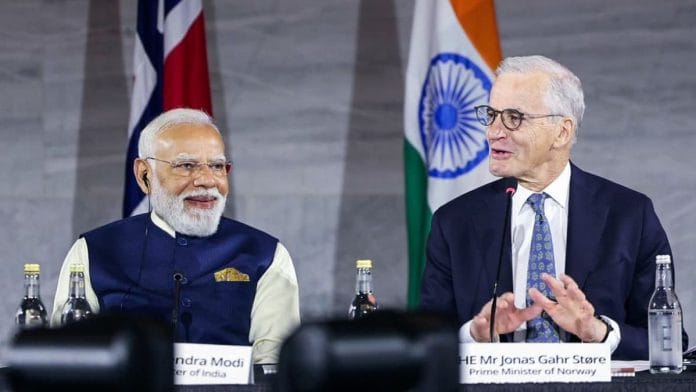
In the last two days Norway featured hugely on the Indian prime time—but for the wrong reasons.
Television and social media were outraged over Helle Lyng’s condescending questions on trust and media optics, but paid little attention to the substance of Prime Minister Modi’s visit. A far more consequential story got lost in the noise—India’s deepening strategic-economic engagement with a country that sits outside the European Union, yet commands one of the world’s most influential pools of capital and the world’s largest sovereign wealth fund.
Norway is not merely another wealthy European country with staggeringly high per capita income. It is a unique geopolitical and economic actor—an energy superpower with a population smaller than New Delhi, a state built through disciplined, transparent and long-term economic planning with humongous wealth collected from oil exports.
For India, which is simultaneously seeking capital, technology partnerships, energy cooperation and long-term investment flows, Norway deserves far more serious attention than it did this time around.
A non-monolith
Europe is not institutionally monolithic. Norway is not a member of the European Union because its people do not wish to join the bloc. It sits outside the EU’s political and economic architecture, while remaining deeply integrated into European markets through the European Economic Area and the European Free Trade Association (EFTA). This distinction is important because India’s engagement with Norway operates through a different framework than its negotiations with Brussels, as India continues to pursue FTAs with both sides.
The India-EFTA Free Trade Agreement signed in March 2024 has been strategically significant. Alongside Norway, the agreement includes Switzerland, Iceland and Liechtenstein—small states with small demographies, but disproportionately influential in global finance, technology and capital flows. Unlike usual trade agreements, which are focused narrowly on tariff reduction, the India-EFTA deal carried a larger strategic bargain: India would provide greater market access in exchange for long-term investment commitments from EFTA partners—mainly Norway.
That requires a better understanding of what kind of capital inflows India is seeking amid capital flights, a depreciating rupee and tightening energy situation due to a disrupted Hormuz.
The centrepiece of this discussion is Norway’s Government Pension Fund Global, commonly referred to as the Norwegian sovereign wealth fund. Built from petroleum revenues generated in the North Sea, the fund today stands as the largest sovereign wealth fund in the world, with holdings across thousands of companies and markets and with a current valuation at $2.2 trillion.
Also read: The Social Stock Exchange is India’s answer to inequality
Luck by chance
Norway’s story is remarkable because it was not destined for such prosperity.
Norway was a relatively poor country shaped by geography and climate. Harsh winters meant little agriculture, much of the economy revolved around fishing, hunting and subsistence farming. And large numbers of Norwegians migrated to the United States in search of opportunity. For centuries, Norway existed under Danish rule until 1814. It entered into a union with Sweden, before achieving full autonomy in 1905.
By the nineteenth century, maritime trade and shipping began integrating Norway more deeply into European commerce and fate, particularly through ties with Britain. Fishing, timber and shipping created pockets of growth, while the country’s seafaring culture strengthened its commercial networks. By the late nineteenth and early twentieth centuries, Norway had also begun developing a stronger public sector and traditions of economic planning. Yet despite these advances, it remained a relatively modest European economy, at the receiving end of the two world wars. The transformation, however, came with oil.
In 1962, Phillips Petroleum approached Norwegian authorities seeking permission for exploration in the North Sea continental shelf. Just as they were about to give up, they hit the jackpot in 1969. Commercial extraction began in 1971.
Norway approached petroleum discovery with remarkable strategic insight.
The Norwegian state insisted on sovereign control over natural resources and regulatory structures were established early. Statoil—today Equinor—emerged as a powerful state-backed energy company. Petroleum wealth was treated not as a short-term windfall but as a national asset requiring careful institutional management.
This mattered because Norway was acutely aware of the dangers associated with sudden resource wealth. Economists had already identified the “Dutch disease”—an economic concept where a sudden, massive boom in one specific sector (typically natural resources) paradoxically causes the decline of other sectors, like manufacturing or agriculture; ultimately creating structural dependency. Add to that the ‘oil curse’—where many oil-producing states became cautionary examples of corruption, inflation, institutional decay and elite capture. Norway chose a different path and did wonders.
Oil revenues were systematically channelled into long-term public investment and eventually consolidated into the sovereign wealth fund in 1996. Strict fiscal rules limited excessive domestic spending from petroleum income. Political consensus emerged on inter-generational responsibility—the idea that oil wealth belonged not merely to present citizens but to future generations as well and should therefore be used for their well-being.
Its Government Pension Fund Global became one of the world’s most reputed institutional investors, with stakes across global equities, infrastructure and real estate. Over the years, it has become a very sophisticated capital pool with burgeoning investments in AI, data centres and green technology and has created red lines by excluding investments in weapons, hydrocarbon entities, carbon-heavy industries and tobacco.
Countries across the world court Norwegian capital because of its size, stability and long investment horizon, naturally India is no exception.
During Modi’s Norway visit, the two sides upgraded ties to a “green strategic partnership”, paving way for investments into sectors like renewable energy, shipping, green transition infrastructure, logistics and maritime cooperation. India requires enormous volumes of long-term capital to sustain infrastructure expansion, industrial growth and energy transition goals. Sovereign wealth funds provide precisely the kind of long-term capital India hopes to attract as it positions itself as a major global manufacturing and investment destination.
Challenges
But India’s Norway investment relationship is more complicated than elegant diplomatic statements from both sides.
Despite India’s aggressive investment outreach, Norges Bank Investment Management’s (NBIM) portfolio exposure to India declined in 2025, roughly by 40 basis points, to 2.1 per cent. Further, India emerged as the only major market in the fund’s portfolio to deliver negative returns during 2025 in dollar terms. While Norges generated overall portfolio returns of around 15 per cent in 2025, its India investments declined approximately 1.4 per cent.
Interestingly, the reduction also coincided with higher allocations to other Asian markets. For instance, China’s share in the portfolio increased to 3.6 per cent, while Taiwan’s allocation reached 2.7 per cent, overtaking India, which shrunk to 2.1 per cent.
Such detail deserves more attention than it has received domestically because it highlights the constraints of Norwegian institutional investment policy as well as the volatile investment ecosystem in India. Governments may speak the language of strategic partnership, but their sovereign wealth funds operate through a calculus shaped by governance standards, regulatory predictability, environmental frameworks and long-term risk assessments.
The Norwegian sovereign wealth fund does not function merely as a profit-maximising entity. It operates through one of the world’s most closely scrutinised ethical investment frameworks. Companies can face observation or exclusion over concerns involving environmental damage, labour violations, corruption risks or governance failures. Ethical investing is not peripheral to the Norwegian system; it is central to the legitimacy of the fund itself.
This became evident in controversies surrounding the Adani Group’s exclusion from parts of the fund’s investment—first in 2024 for Adani ports on alleged involvement in Myanmar and next in February 2026 for Adani Green for alleged financial crimes.
In India, such decisions are frequently interpreted through the lens of political prejudice, Western hypocrisy or ideological targeting. Yet within Norway’s institutional ecosystem, these decisions are tied to a broader philosophy of investing that successive Norwegian governments have defended for decades. For instance, the same Norwegian firm has excluded US-based L3Harris Technologies Inc., which develops components for nuclear weapons and China’s Weichai Power Co., based on concerns over sale of military equipment to Russia and Belarus.
Also read: Norway’s Modi cartoon was not satire. Just colonial laziness
Is Norway too rich and too complacent?
The Norwegian model itself has come under scrutiny. An interesting critique by Norwegian economist, Martin Bech Holte, questioned fundamental aspects of the sovereign wealth governance and the growing political influence with lessening pro-business manoeuvring. In his 2025 bestseller, The Country That Became Too Rich, he argues that Norwegian sovereign wealth funds’ performance peaked in 2013 after which productivity has stagnated and foreign investments are not coming as expected. He also explained that the debt-to-income ratio of Norwegian households remains the highest among the Organisation for Economic Co-operation and Development (OECD) countries at 220 per cent because of the complacency of falling back on the mammoth wealth funds and argued for more pro-business reforms.
Despite these criticisms, the Norwegian sovereign wealth fund retains enormous international credibility. Markets continue to view it as disciplined, stable, transparent and institutionally trustworthy. That credibility is precisely why countries across the world continue courting Norwegian investment.
India therefore faces a more sophisticated challenge in attracting investments via these instruments than domestic political debates usually acknowledge.
Swasti Rao is a Consulting Editor (International and Strategic Affairs) at ThePrint. She tweets @swasrao. Views are personal.
(Edited by Theres Sudeep)
If Norway can invest in hundreds of Chinese companies shadow-backed by the state and perhaps not even of sound financial books, then dropping Adani on the back of a US corruption indictment by a New York court in what appears to be a geopolitical game rather than any actual legal scrutiny in the last years of the Biden administration, is politics trumping any sound investment strategy. Along with China l, whose green energy investments helped it reduce 56 trillion units of fossil fuel use in 2025, India had reduced its fossil fuel footprint by a comparable figure of 52 trillion units in 2025. Together these two countries reduced global fossil fuel use by a historic figure unmatched since the Covid pandemic. India has done so through private enterprise, while China has done so through state owned or backed entities. So a sovereign wealth fund claiming to be ethical should have not given priority to ventures backed by an authoritarian state that has no proven business standing of its own. Adani has diversified and proven its mettle as its own company — and even after the fund dropped it, the group’s valuation only rose. Around the same time that the Norwegian fund dropped Adani from its portfolio, a so called investigative firm based in New York accused Adani and even India’s financial institutions like SEBI of wrong doing. Around the time Trump assumed office they shut shop with its founder saying they made some ethical mistakes in going after some companies. Norway should acknowledge that its Fund should be depoliticized so Norwegians are not being mislead and their future diminished by their own financial institutions and it’s questionable choices in investing.
What’s condescending about asking a country’s prime minister at a “press briefing” why he never takes questions from the free press?
Imagine if such oil reserves were found in India?! It would not be a sovereign wealth, it would be Ambani- Adani wealth!! That’s the difference.
An ethical framework underpins decision making at Norway’s $ 2 trillion sovereign wealth fund. The other is a prudent, far sighted approach to investment, of the sort Warren Buffett represents. On both these parameters, if India measures up better, additional allocations will be made. Norwegian businesspersons, in their interaction with the Indian delegation, spoke of ground level difficulties and the regulatory maze. Expressed diplomatically, that conveyed a lot about how India’s Ease of doing business is viewed globally.