




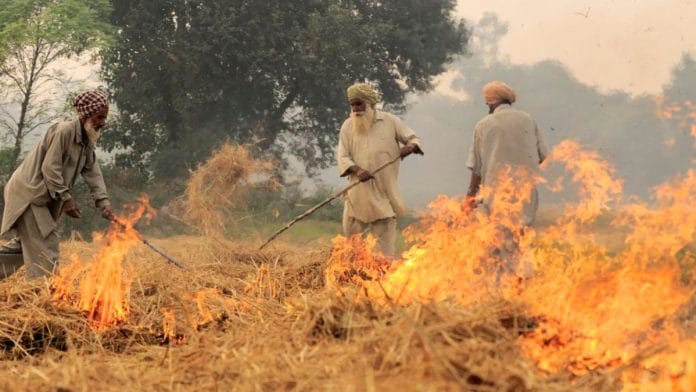

As the paddy harvest ends across Punjab every October, a familiar orange glow appears on the horizon. Farmers set fire to the stubble left behind, and within days, a thick grey haze settles over north India. In 2020, Punjab alone recorded nearly 80,000 fire incidents in a single paddy season, with more than half the state’s paddy area going up in smoke.
Bans were announced. Subsidies were offered. Awareness campaigns were launched. Yet the fires kept returning.
The persistence of stubble burning reveals a hard lesson about environmental policy: information alone rarely changes behaviour. People do.
Lessons of PRANA
In a village in Punjab, Jaswinder Kaur attended a camp unlike any she had been invited to earlier. Held within the premises of a Gurudwara, the session focused on crop residue management, water conservation and soil health. She listened carefully, asked questions, and returned home with new ideas. Over the following weeks, she shared what she had learned with the men in her household, neighbours and fellow villagers.
“When women have access to the right information,” she later reflected, “We don’t just grow crops. We grow communities.”
Kaur does not own any land. In Punjab, women account for less than two per cent of landholders, despite contributing substantially to agricultural labour. Yet, she was an agent of change within a deeply patriarchal society. Her story points to a question that development practitioners, policymakers and behaviour-change experts have grappled with for decades: who carries change into a community, and how does it take root?
This is where the lessons from The Nature Conservancy’s PRANA (Promoting Regenerative and No-Burn Agriculture) programme in Punjab prove useful. When PRANA came to Punjab in 2021 to address the issues of stubble burning, it confronted an environmental policy problem that had been misread for a long time. Farmers were not burning because they were uninformed. They were burning because, in the narrow window between paddy harvest and wheat sowing, burning was fast, cheap, and familiar.
Apart from these operational pressures, there was a deeper misalignment in how the problem had always been framed. Crop residue burning is typically presented as an air pollution crisis. That framing, while accurate, does not resonate with a farmer whose immediate concerns are yield, cost, and soil.
However, paddy residue contains nitrogen, phosphorus, potassium, sulphur, and carbon. When incorporated back into the soil rather than being burnt, it enriches fertility and reduces dependence on chemical fertilisers. When the conversation shifted from air quality to soil health, farmers listened differently.
PRANA went on to build an ecosystem of change around the farmer rather than targeting them in isolation. A farmer’s decision does not happen in a vacuum. It happens inside a web of social relationships, cultural expectations, and economic pressures, and to shift behaviour at scale, that entire matrix needs to move.
Also read: Delhi has too many actors to tackle air pollution. Beijing offers an alternative
Following a leader
Sarpanch Agyapal Singh understood this instinctively. With PRANA’s support, he adopted water-conserving techniques in paddy cultivation on his own fields, visibly reducing his irrigation cycles and demonstrating that the practice worked under real farming conditions. He then organised village-level meetings, opened his fields to neighbours as demonstration plots, and personally sat with older, more hesitant farmers, working through their doubts one conversation at a time.
When the most respected person in a village changes his behaviour publicly, the social actions shifts for everyone around him. Singh was not alone. PRANA deliberately galvanised a network of such ‘champions’ across Punjab’s villages. Each champion became a node in a growing peer network, quietly normalising no-burn agriculture and groundwater conservation through the most powerful mechanism available: the example of someone you already trust.
Religious institutions carried the message further. Gurpreet Singh, the head of the local Gurudwara in Dittpur Jattan, immediately connected PRANA’s environmental message to the Sikh faith’s own teachings on the natural world. Drawing from the Guru Granth Sahib, “Pavan Guru, Pani Pita, Mata Dharat Mahat” (Air is the Guru, Water is the Father, Earth is the Mother), he wove that teaching into daily announcements broadcast through the Gurudwara’s public address system.
Verses were chosen carefully, and an entire narrative was built around conservation as duty rather than regulation. For farmers who had tuned out extension workers for years, hearing the same message from a place of spiritual authority changed how they felt about their land.
Women, too, were engaged as thinkers capable of seeing connections across domains they already understood intimately. Punjab’s women knew soil, health, and water from tending kitchen gardens, managing household water use, and watching the quality of what their families ate. What the nearly 750 dedicated women-centric camps did was link these together.
When women could see that burning stubble depleted the very soil that grew their food, and contaminated the water their children drank, no-burn agriculture stopped being an agronomic abstraction and became something immediately personal. This knowledge unlocked something that had always been there: a covert agency that women exercised quietly within their households, shaping decisions from the inside.
Kaur’s story was not exceptional. Across Punjab, women who attended these camps went home and talked about the grave issue. This had never happened before, and in doing so, it nudged decisions that had always belonged to the men in their families.
Also read: India wasn’t always like this. Things have never been as bad as they are today
The power of street plays
Street theatre reached into something deeper still: identity. Agriculture is not merely a livelihood for the people of Punjab. It is what defines them. Lush green fields, the granary of India, the pride of feeding a nation, are a part of the social fabric of Punjabi life. Street plays staged in saths (common hang-out spots in Punjab’s villages) made farmers imagine Punjab in the year 2050—no groundwater, crops failing, neighbours fighting over water, and the social world they had always known collapsed beyond recognition.
The question the plays left hanging in the air was not about policy or practice. It was about inheritance. What kind of Punjab are you leaving behind for your children? That question, asked through story and performance in the heart of a village rather than through instruction from above, hit home in ways that were powerful beyond expectation.
Finding entry points within daily recreational life was equally central to this strategy. In Punjab’s villages, men gather at the sath to play cards. A deck was designed in which each of the 52 cards carried a distinct message on regenerative agriculture, covering crop residue management, water conservation, and seed variety choices. Farmers absorbed this guidance not in training sessions, but across hundreds of games played over months.
For school children, a version of ‘Snakes and Ladders’ was redesigned around Punjab’s agricultural future: burning stubble lands you on a snake, adopting regenerative practices moves you up a ladder, so that agricultural science became intuitive knowledge for them.
Also read: Delhi’s new fuel policy is forcing people to buy new cars. It won’t reduce pollution
Tangible results of PRANA
This is what distinguishes lasting behaviour change from a campaign: the message lives in the texture of everyday life. Importantly, to sustain adoption beyond the first season, PRANA maintained a year-round field presence. When a farmer incorporates stubble into the soil for the first time, they may face agronomic challenges. If their subsequent wheat yield suffers and there is nobody to explain why, they will draw a straightforward conclusion: the new practice does not work.
Sustained field presence converts a difficult first experience into a learning curve rather than a deterrent. To support farmers, nearly 600 frontline field workers were trained not just in agronomy, but in public speaking, storytelling and filmmaking, enabling decentralised, real-time knowledge creation, shared through farmer WhatsApp groups.
The results are now documented. According to government data, fire incidents in Punjab fell by over 90 per cent, from nearly 80,000 in 2020 to 5,114 by 2025.
These numbers matter. But the more transferable lesson is this: India has no shortage of well-intentioned behaviour change programmes that broadcast the right message and still fail to move people. What Punjab’s experience demonstrates is that lasting change requires meeting communities inside their own lives, speaking through voices they already trust, and making the new behaviour feel less like an instruction and more like an obvious choice.
Fateh Veer Singh Guram leads behavior change strategies for The Nature Conservancy’s Project PRANA (Promoting Regenerative and No-burn Agriculture), supported by Nature Conservancy India Solutions.
Views are personal.
(Edited by Saptak Datta)