




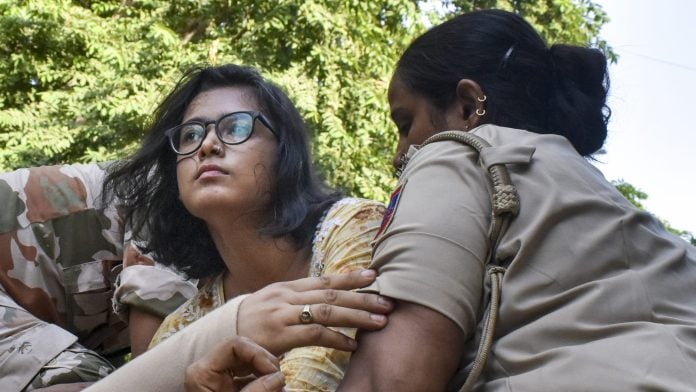

It’s hard not to be struck by Neha Bora. From her 23-day fasts during Jantar Mantar 1.0 to her daily run‑ins with the Delhi Police, her courage, conviction, and clarity shine through. The AISA national president has, without question, become one of the defining faces of the protest movement, especially in its 2.0 phase. She calls to mind Irom Sharmila, though in a very different register.
Sharmila was known nationwide as an unyielding lone voice against state and military injustice; her marathon fasts and the image of the feeding tube became inseparable from her identity. She fought the government again and again for a long time.
Neha carries a different kind of fire. Like Sharmila, she, too, is a fighter, but the student leader chose the street over hunger strike. That choice has made her appear not as a victim of an unjust system but as a proactive, high‑energy force. Her repeated detentions, her standoffs with police, her defiant stance atop barricades — these are the stuff of viral reels, a breath of fresh air in a country long starved of visible protest. Her trademark black glasses and unassuming dress give her the look of a classic Left leader, reinforced by her plainspoken presence and sharp articulation.
A familiar alarm
The Left itself has been reduced to a faint echo in Indian politics, surviving mostly on university campuses, with JNU as its strongest bastion. Like Kanhaiya Kumar, who was an AISF leader from JNU before her, AISA’s Neha faces the challenge of carrying her activism beyond the campus gates under the CPI (M‑L) banner, at a time when mainstream politics has little room for the Left.
Right now, she has managed to rise above party labels through sheer personal courage, leadership, and charisma. Admirers call her a sherni (lioness), a modern-day Jhansi ki Rani. While such praise is understandable, and in many ways deserved, it also raises a familiar alarm. India has a long tradition of personality cults, often born of goodwill but ultimately proves counterproductive. History shows that disproportionate adulation, the building of icons rather than the questioning of them, can undermine the very purpose of the struggle.
This is not to say that a young leader like Neha should not be celebrated. But enthusiasm needs balance. Sometimes, unconditional praise can do more damage than sharp criticism, because it blinds supporters to nuance and complexity. In that sense, the adulating crowd can harm more than the opponents.
Neha herself seems aware of this risk. When compared to CJP founder Abhijeet Dipke, she urged unity rather than rivalry. Still, the road ahead is long, and the danger lies less in her own choices than in the public’s hunger for heroes. In a country starved of role models, it is tempting to crown Neha as a saviour, overlooking the gritty realities of her struggle and the personal costs of her bold leadership. We are, by nature, hero‑worshippers. We prefer clean labels, hero or villain, rather than grappling with shades of grey. The result is that someone like Neha risks being elevated with every gesture magnified, every move adored, beyond the realm of sober critique. The masses crave simple narratives. Few are willing to take the trouble of issue‑based judgement, of giving credit or discredit where it is due.
Charisma is, of course, essential for leadership. But its side effect is the creation of more bhakts and fans than genuine allies. The antidote lies in surrounding oneself with equally, if not more, competent voices from diverse fields. Without that, it is all too easy to drift into the current of unquestioning adulation, until the current inevitably ebbs.
Also read: India’s Gen Z is fighting, not praying. Why its protests are bigger than politics
Lesson is ours to learn
It is also vital to remember that Neha is not alone. Many others are protesting with equal courage and resolve. Without diminishing her leadership, the narrative of the movement must not become person‑centric. This is especially true of Jantar Mantar, where countless individuals standing up to police pressure and independent journalists asking hard questions and amplifying the struggle have carried the protest forward with fierce determination.
The danger lies in our collective tendency to wait for messiahs. Too often, people are duped by false demi‑gods. We saw how sections of the intelligentsia once hailed Narendra Modi as a saviour, ignoring the obvious elephants in the room. India does not need manufactured messiahs — whether Indira Gandhi, Narendra Modi, or anyone else. What we need are leaders willing to admit shortcomings, engage with criticism, introspect, accept mistakes, and change course. That is the kind of leadership worth aspiring to.
We should wish the same for Neha Bora, for CJP leaders, and even for Rahul Gandhi: that they remain human, with their share of failures and limitations, but also with the humility to learn and amend. Ultimately, it is on us to decide what kind of leaders we want. Haven’t we had enough of self‑serving autocrats who rose to power through democracy only to manipulate it once in office? The lesson is ours to learn. If we believe we deserve better leaders, then we must also ensure they get better comrades, associates, and followers.
Urvish Kothari is a columnist and writer based in Ahmedabad. He tweets @urvish2020. Views are personal.
(Edited by Aamaan Alam Khan)