





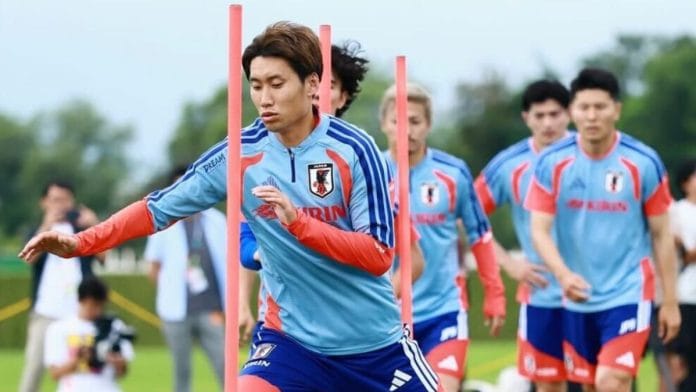


Asia’s FIFA World Cup dreams have always been short-lived. The best performance of an Asian team remains South Korea’s run to the semi-finals in 2002, where they eventually lost 1-0 to Germany. More than two decades later, Asia arrives at another World Cup with hope. In the 2026 FIFA World Cup, those hopes rest largely on Japan.
Japan enters the tournament carrying a burden no Asian nation has previously borne. Asian teams lacked tactical awareness and individual names. It was perceived as nations which lack homegrown youth development, grassroots coaching, and club-level competitiveness compared to European standards.
But this is the first Asian side entering a World Cup where success and failure will be judged not by group-stage survival or a famous upset, but by how far they progress in the knockout rounds.
Japan arrives in this tournament with expectations beyond just “doing well” or reaching the Round of 16. They are a team that can redefine what success for Asia looks like, the product of a disciplined and dedicated process that began more than three decades ago.
For Japan, the venture to place itself on the pedestal of other top footballing nations began in 1991. Structural investment into football began with the formation of the Japan Professional Football League (J League), which officially kicked off in 1993.
In 1996, the Japan Football Association (JFA) introduced an ambitious century-long master plan. They established youth academies and invested in local grassroots sports infrastructure.
Later, several ageing global legends like Zico, Gary Lineker, and Pierre Littbarski were roped in to the league to boost popularity and give it a global reach. However, big names and money did not materialise in a better Japanese team. Things changed after that.
JFA dropped the big names, which did its initial part of grabbing eyeballs. The country then focused more on youth academies and local infrastructure. The funds which went to global icons were now diverted for local upliftment.
By 2021, Japan had created a structured pipeline to export youth players to Europe, which had been done occasionally earlier. Along with that, the J League changed its fixture dates and aligned them with the European calendar.
This revised roadmap recognised that local community-rooted football is required at the start, but with it, technical and physical development in modern football is also needed. And for that, what other part in the world is better than Europe?
So, with a combination of these two, Japan started to create icons instead of buying them.
Why Japan, why now?
It was a systemic road for Japan. A properly chalked five-year plan for the 2026 FIFA World Cup. This year, Japan’s squad boasts the largest number of European-based players in history. With almost all players competing in the top tiers of European leagues, manager Hajime Moriyasu has highly adaptable tactical depth across the pitch, which will likely compensate for the high-profile injuries of Kaoru Mitoma and Takumi Minamino.
Let’s dissect Japan’s international men’s team.
1) Midfield and attack: Takefusa Kubo (Real Sociedad, Spain) acts as the creative mastermind, flanked by dynamic threats like Ritsu Doan (Eintracht Frankfurt, Germany). Meanwhile, Wataru Endo (Liverpool, England) provides elite defensive stability as the centre.
2) Striker: Ayase Ueda (Feyenoord, Netherlands), who won the Eredivisie Golden Boot, spearheads the attack. He is backed by Daizen Maeda (Celtic, Scotland), who is known for his pace and relentless pressing.
3) Defence: Takehiro Tomiyasu (Ajax) and Ko Itakura (Ajax) provide formidable, physically robust European defensive profiles. A crucial segment in which Japan has been falling behind in the previous World Cups.
4) Goalkeeping: Zion Suzuki (Parma, Italy) has solidified the goalkeeping position, bringing regular top-flight European experience.
These talents allow the Samurai Blue to switch seamlessly between an aggressive 3-4-2-1 and a more transitional 3-1-4-2, depending on the opponent. Their tactical flexibility and squad depth have been key to their recent form in friendly fixtures, where they defeated giants like Brazil and England.
A 3-2 comeback against Brazil and a 1-0 triumph over England at Wembley proved this Japan side can dismantle football’s elite and run over the midfield with command. These matches demonstrated how Moriyasu’s strategic flexibility can systematically overcome top-tier footballing nations.
While the speed, vision and passing were always there for the Japanese side, the biggest change in the current squad is that they have successfully competed physically with robust sides. After all, football is a body-contact game.
With this, Japan’s story has moved out of ‘just participating in the World Cup.’
Also read: Football needs Brazil to be Brazil again. Carlo Ancelotti might just be the right person
A shift in perception
Asian teams are still discussed as “giant killers”. They are not yet ‘contenders’. And Japan has the chance to shift this exact thought process. This makes the 2026 FIFA World Cup different for Asia. There are expectations.
Earlier Asian teams entered World Cups mostly to create an upset or survive the group stage. However, Japan has a different tale to tell. Their narrative has moved beyond upsets and group stages. They revolved their game around tactics, squad, and technicality for the biggest football tournament.
And this exact shift signals how far Asian football has travelled.
If Japan reaches the semi-finals or even consistently outplays major European, African and South American football powers, it would change Asian football. The real test for Japan lies after the group stage of the tournament, and how they can hold on to their temperament.
Other Asian countries can point to the famous ‘Japan model’ as an example that long-term planning, youth development, and structural investment can close the gap.
Winning the World Cup for Japan may be a bit far-fetched. They don’t even need to do that to change Asian football forever. It simply needs to prove that an Asian nation can realistically compete against other major football countries and show the way forward.
(Edited by Prashant Dixit)