





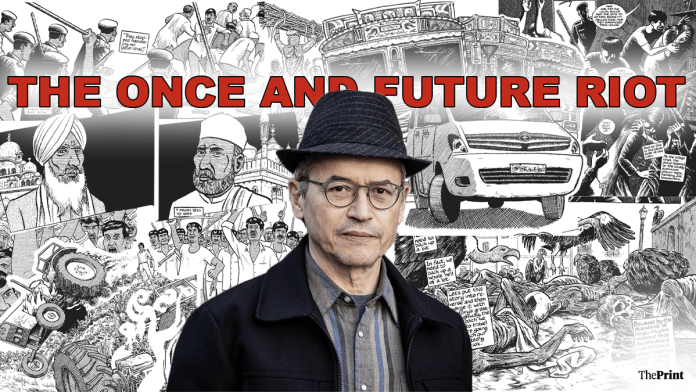


For all the global fame he has earned for his unique brand of ‘comics journalism’ Malta-born American Joe Sacco checked one more box on his overloaded CV when Penguin Random House India pulled his latest The Once and Future Riot.
There was some criticism of the weak-kneed publisher. Instinctively, however, much of the blame went to the usual suspect: the Hindutva-seeped establishment under whose watch anybody would be scared of publishing such a book. It is, after all, about a major communal riot, in fact the biggest since Gujarat, 2002. The book also makes dire prognostications about where Hindutva might take India.
Let’s get the facts sorted first. India does have an unhappy if occasional history of banning books. But Sacco’s isn’t banned. The publisher’s action was pre-emptive, lily-livered and probably predicated on the hope that in the popular opinion, especially in the liberal chic that populates the litfest circuit, the blame will automatically go to the Hindutva establishment. It was Penguin Random House that blocked it and sent out a five-page note of amendments that Sacco declined. Other Indian publishers are chasing Sacco. And as he told Himanshi Aggarwal of ThePrint, he wants his book to go out to the largest numbers in India.
The fallacy of any ‘sarkari censorship’ established, we can take a look at Sacco’s book of 144 pages. It’s a complex story told with the most brilliant sketches from a master of the comics journalism genre. The text only features in the blurbs and would take no more than two hours of reading. Unless of course you get transfixed by the quality of his drawings and the story that the faces, even a half-turned tractor tell us. These need no words.
The book isn’t banned and, in any case, there’s no law forbidding one from reading any book whatsoever. My generation read Lolita and Lady Chatterley’s Lover between our oversized science practicals folders and the only reason I wasn’t able to fully read Salman Rushdie’s Satanic Verses was because I’m not designed to decipher his magic realism, something I truthfully said to him as we recorded our Walk The Talk interview in 2013. “You aren’t alone,” he replied, “but at least you are honest.” And we laughed.
I’m grateful to Sacco for making a digital copy of The Once and Future Riot available to me. And, much as I read in a trance, marvelling at his unusual storytelling brilliance, I can’t understand the publisher’s excuse.
Also Read: Dhurandhar shows hard cinema is soft power and Pakistan is unapologetically the target
Sacco’s story of the 2013 Muzaffarnagar riots is simple, mostly linear, factual, and has been told scores if not hundreds of times in Indian journalism. Including, notably in The Indian Express, where I worked then. Nothing in the book is a surprise, a revelation, or exaggeration. If anything, Sacco uses expressions like “puny” or “small” for the riot, given India’s context.
Why is he doing an entire book on it then, Sacco whose work on the massacres and genocides in Bosnia and Gaza has earned him fame and awards? What’s he doing with a riot he calls relatively “puny” and where 62 people died, 42 Muslim and 20 Hindu. Of course 62 killed in a communal riot less than 150 kilometres from New Delhi is 62 too many. But, like it or not, there’s a size perspective to communal riots as well.
Sacco’s ‘reporting’ is incredibly granular but there are areas where he can be faulted. For example, his understanding that, after the great killings of the Partition, communal riots in India began post the Babri Masjid demolition in December, 1992.
Within Gujarat there’s a pre-1992 history of riots, notably Ahmedabad, 1969 (512 dead). The larger data is instructive. Scholarship on communal violence leans on the Varshney-Wilkinson dataset, named after professors Ashutosh Varshney (Brown University and ThePrint columnist) and Steven Wilkinson (Yale University). It lists 1,194 significant communal riots in India between 1950-95.
Of these, 871 or 72 per cent took place under Nehru, Indira or Rajiv governments. Communal rioting in India isn’t a post-Babri phenomenon and it’s ironic that Sacco buys into it. For more details on our national shame of communal riots check out also “A factsheet on Communal Riots” on the website of Public Policy Research Centre.
Also Read: CJI, IPS, IAS & Homebound: A wake-up call 75 years in the making
Don’t let this undermine where Sacco’s true focus is, in showing how little local disputes led to riots, sort of leaderless and initially politics-free as the crowds take over. Politics and ideology wade into this opening. This is what, he shows, happened in Muzaffarnagar. He also reminds us who was in control then. In Uttar Pradesh it was Mulayam Singh Yadav’s Samajwadi Party (with son Akhilesh as chief minister) and the UPA in New Delhi, both ‘secular’ forces. Of course the resultant polarisation helped the BJP going ahead.
Given how polarised our public debate, especially journalism, has been since Babri (1992) and the Gujarat riots (2002), sometimes a pair of sharp foreign eyes give you a more clinical picture. Sacco shows how isolated incidents, a Muslim girl’s rape and attempted murder that the police took lightly, a Muslim boy’s killing on suspicion of harassing a Hindu girl, the revenge murder of two cousins from a Hindu group, a Muslim mob’s ambush of a Hindu (Jat) procession were all handled lightly. Either because the local police were complicit, or political interference. He also doesn’t call the clashes one-sided. He does underline, however, that the Jats (he uses Jats not Hindus and mentions in a footnote that they are Hindu), skirt the Muslim dominated villages and turn on their own, landless Muslim labour for revenge.
In the murder of the two Jat boys, he writes, the Senior Superintendent of Police (SSP) Manzil Saini personally led the raids. Sacco draws an imposing Manzil Saini (sometimes called the Singham of UP Police) in determined stride. The police take a number of Muslim males into custody “for killing the Jat boys—some with blood on their shirts,” Sacco notes. “The next morning,” he says, “the detainees are let go, with both the SSP and district magistrate (Surendra Singh) transferred.” To UP’s Jats, he says, “this could only seem like SP’s nefarious attempt to satisfy their Muslim constituents.”
Rather than annoy, this will please the BJP because this is what they’ve maintained, or call pseudosecularism. What they won’t like is his 17-page conclusion headlined ‘The Future Riot’. He says ‘sectarian violence helped grease the rails of his (Modi’s) political career,” that the riot helped the BJP sweep 2017 and 2022 in the state where “Modi installed as UP chief minister Yogi Adityanath, a Hindu monk almost as radical as the swami (Yati Narsinghanand) in Ghaziabad.”
Now think hard, hand on your heart, or simply google. How often do you find similar points made freely in the Indian debate? No government was going to ban a book for making these arguments. I can find these in two dozen other books published over the past decade, including probably by Penguin Random House India.
And the issue with that flawed, unlawful map? It’s a perennial challenge in a region with unsettled borders, historical and sometimes irredentist claims and grave cartographic sensitivity. The publisher is right to say it’s a serious and criminal violation of Indian law to publish the map drawn in Sacco’s book. But everybody knows how to deal with it. In foreign publications these maps are rubber-stamped as wrong or blanked out. No Indian editor would ever be reckless with this. But this, as I just explained, is easily resolved. To use this as an excuse to pull the book is a cruel joke on publishing and India’s freedoms, stressed as they might be.
Also Read: Manoj ‘Bharat’ Kumar sang so Sunny Deol could yell—journey of Bollywood patriotism
Above all this why allow someone who has no stake in Indian democracy to write books on it?
I wouldn’t blame Penguin Random House. Or film directors who increasingly understand, without needing to be told, what the No go areas are. A natural stillness in the air. It gets picked up and reflected in global indices of press freedom for example, other metrics of the vibrancy of democracy. India has chosen the West as its abiding partner. We must abide by standards they follow in such matters ( Israel a notable example ).