






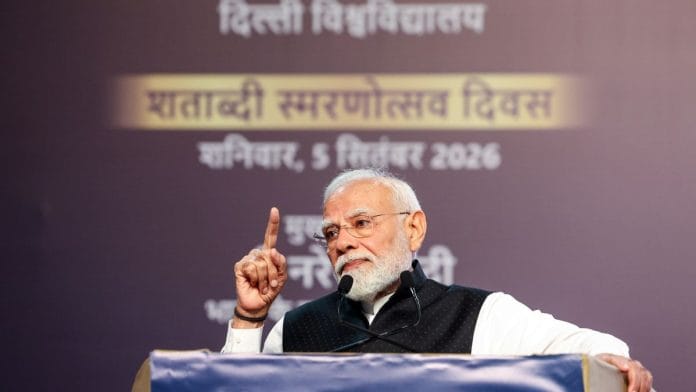

Gen Z or OG (original gangster), not many things have changed in 13 years in the century-old Shri Ram College of Commerce in New Delhi. A lot, however, seemed to have changed for Prime Minister Narendra Modi when he returned to the campus last Saturday. For one, he was not the same Gujarat chief minister whose genial smile, disarming mannerism, and positive, futuristic outlook had left the audience at, and much beyond, the college spellbound in 2013. PM Modi sounded bitter and frustrated on Saturday. He did wear a smile as he played to the gallery, praising SRCC and its alumni. The tone, however, changed drastically once he started giving his ‘report card’ since his last visit.
He was angry with the so-called ‘dimagi naxals’ who wanted to see him fall. At one point, he seemed to suggest that he, an individual, and Bharat, the country, are no different. Talking about the challenges India faced during Covid-19 and the West Asia crisis, among others, he said, “My ‘admirers’ (read baiters) were happy that ‘ab Modi fansaa (Modi is trapped now), Modi is about to fall now, he can be crushed now’.”
“But there is so much power in my countrymen’s blessings that the wishes of those wishing harm to Bharat remained unfulfilled,” PM Modi said. Essentially, wishing harm to him and to Bharat are one and the same thing.
PM Modi presented an elaborate report card on what he achieved since February 2013, when he had last visited the SRCC campus, in what was his launch pad for his successful bid for the BJP’s prime ministerial candidature. His speechwriter didn’t seem to have listened to his entire speech in 2013, beyond the half-full-and-half-empty glass analogy. His 2026 SRCC speech, on Saturday, would have probably sounded more convincing without references to the vision he had laid out for the country from the same college 13 years back. As it is, PM Modi himself might be disappointed with the huge gap between what he wanted to achieve in 2013 and what he has been able to do by 2026.
From 2013 to 2026
A significant message from PM Modi’s SRCC speech was to Manipur, when he said that “peace has increased from Jammu & Kashmir to the Northeast”. He didn’t name Manipur but his remarks seemed to validate Inner Manipur MP Angomcha Bimol Akoijam’s view about Manipur being the case of “out of mind, out of sight”, not the other way around. How could one talk about ‘better peace’ in the Northeast when Manipur is virtually geographically partitioned along ethnic lines? So much so that a couple of Kuki-Zo MLAs coming to Meitei-dominated Imphal to attend the Assembly session after three years made national headlines.
We will come back to Manipur a bit later. Let’s look at what then-Gujarat CM Modi had said at the SRCC 13 years back. As I was writing this piece on Sunday, I had to keep checking news updates about the collapse of a five-storey building at Satya Niketan, just about four km from my residence. Dozens of young students were trapped there. Seven young lives were already lost. “CM vows action” was the newsflash. She declared that all the unsafe buildings in the vicinity would be “demolished”.
Didn’t we hear such outrage many times before? Barely three months earlier, 21 people had died in a blaze in an unauthorised hotel in Malviya Nagar, about six km from my residence. There were similar vows for action then, too. Just a couple of years back, too, young students had died in an illegal coaching centre basement flooding in the Old Rajinder Nagar. There were 17 deaths in the 2019 Karol Bagh hotel fire. All these have been happening within a few kilometres’ radius of the Prime Minister’s residence. Of course, he couldn’t be blamed for the criminal neglect of the BJP-led local administrations in the national capital. I got back to PM Modi’s speech at the SRCC in 2013: “Usually, our administration works as a firefighter. When there are problems, the administration follows it up, tries to find ways…. The job of the administration is to visualise….” So true! Especially so for the triple-engine government in the national capital.
In his 2013 speech, then-CM Modi shared his talk with an ambassador who wanted to know about the two biggest challenges facing India. The first, Modi told him, was how to use the demographic opportunity in a country where 65 per cent of the population was below 35 years. And, second, how to utilise the huge natural resources in eastern India? As it is, the first challenge remains unmet. According to the NITI Aayog, only 8.25 per cent graduates are employed in roles aligned to their qualification.
Also, 8.7 crore people aged between 15 and 29 years fall under what’s called the category of NEET — not in education, employment, and training. Incidentally, it’s another NEET — the medical entrance test — that triggered nationwide protests recently, in what was yet another reminder of the growing frustration among the young population Modi spoke about at SRCC in 2013.
“The world thinks India is a big market. Time demands that we make the world our market, lead in the manufacturing sector and dump our goods in the global market….If we have to compete with China in the 21st century, we will have to focus on skill development,” said then-Gujarat CM, dwelling at length on “Made in India”.
Thirteen years later, as a Press Information Bureau release said on 14 August, the manufacturing sector now contributes “about 16-17 percent of the GDP”; it was 17.3 per cent in 2013-14. So much for the ‘Make in India’ slogan. As for the competition with China, India’s trade deficit with the neighbouring country widened to US$112 billion in 2025-26, up from US$51 billion in 2016-17.
In his 2013 speech, PM Modi spoke of his 5F concept for cotton-growers — farm to fibre to factory to fashion to foreign — which changed their fortune in Gujarat. As it is, India has gone from second largest exporter to becoming a net importer of cotton.
“Why not export teachers?” Modi said at SRCC in 2013. A parliamentary committee pointed out in its report last year that there were 10 lakh teaching vacancies across India’s school education system in 2024-25. Obviously, we have a long way to go before we start exporting teachers.
Also read: The ‘Modi power’ Gujarati tourists now flaunt: We’ve arrived with a bang, we’ll bajao your band
‘Peace’ in Manipur?
There were many other talking points in the 2013 speech, which have remained what they were — mere talking points. Let’s now come to PM Modi’s assertion about an “increase” in peace in the Northeast. On the face of it, one can’t discount it. Many peace accords have been signed with insurgent groups in the Northeast although the framework agreement with the National Socialist Council of Nagaland, signed at PM Modi’s residence with much fanfare in August 2015, has remained a framework with a final agreement eluding after 11 years. That’s beside the point, though. The question is: when PM Modi claims more peace in the Northeast, is he counting or discounting Manipur? Because Manipur has been in dire straits for over three years, with the BJP government in the state and the Centre looking clueless about a solution.
Only last week, the Centre appointed Rajeev Singh Thakur the new Chief Secretary of Manipur — the fifth since the ethnic turmoil started over three years back. Thakur is known as a very upright and efficient officer but sending a Rajasthan cadre IAS officer to a strife-torn state going to polls barely six months later suggests ad-hocism. The Centre obviously doesn’t know what to do in Manipur. It first imposed the President’s Rule to run things directly from New Delhi only to re-install a BJP government fearing rebellion by BJP MLAs. There are just five ministers, including the CM and two deputy CMs, in this government for the last over seven months.
The CM has 20 portfolios. And one deputy CM, a Naga, has accused the other deputy CM of colluding with Kuki militants against the Nagas. Yet, the Centre is looking the other way. The man taking all the decisions in the government today is Governor AK Bhalla during whose tenure as the Union Home Secretary the Manipur turmoil had started and festered. Do all these things suggest even a semblance of a strategy in Manipur? It looks surreal. Yet, PM Modi chose to claim ‘increased peace’ in the Northeast at SRCC on Saturday as if Manipur didn’t exist.
PM Modi’s SRCC speech on Saturday portrayed a ‘shining India’. He may want to listen to his 2013 SRCC speech. He has achieved a lot for India since then but it’s still far from the vision he had laid out. The glass is still half full. It’s good to be positive and optimistic, but for Modi 4.0, he should start looking at the glass as half empty.
DK Singh is Political Editor at ThePrint. He tweets @dksingh73. Views are personal.
(Edited by Aamaan Alam Khan)