






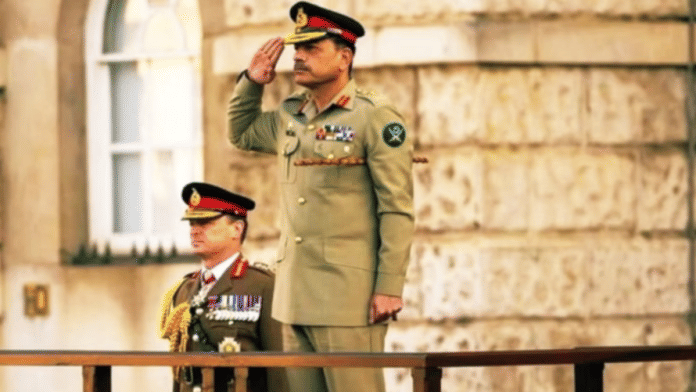

Pakistan’s National Assembly on 20 August approved the Defence Forces Act, 2026, and amended the National Command Authority Act, 2010, amid an opposition walkout. The Senate also passed both bills the same day.
Indian analysts see this as another step by Pakistan’s Chief of Defence Forces (CDF) Field Marshal Asim Munir to tighten his control. But this focus on politics misses another change that could affect how the next India-Pakistan conflict plays out.
In August 2025, Pakistan set up the Army Rocket Force Command for conventional deep strikes. In November, the 27th Constitutional Amendment changed Article 243, removed the Chairman Joint Chiefs of Staff Committee, and created the CDF. Munir assumed the new CDF role on 4 December, while retaining his position as Chief of Army Staff. Four days later, the CDF Headquarters was established, and its leader described the May 2025 conflict as a model for future warfare.
In July 2026, General Aamer Raza became the first four-star Commander of the National Strategic Command, recommended by the CDF. The new law now gives legal support to these changes, retroactive to November 2025, so Parliament has approved a headquarters that has already been functioning for eight months.
The script of the bill
The wording of the Bill matters. The CDF is responsible for organising, managing, and commanding the armed forces. This role also involves advising the prime minister on national security, issuing orders and regulations to carry out the framework, and making personnel decisions across all services, including retirement, release, dismissal, and retention.
The Chairman Joint Chiefs of Staff Committee, however, never exercised operational command over the three services. With the new rule-making powers, joint structures can now be set up without needing Parliament’s approval every time. Managing careers across all three services makes jointness real, because if one headquarters manages a naval or air force officer’s career, that officer is integrated, even if their own service disagrees.
In July, I noted how the People’s Liberation Army’s Western Theatre Command brings missile, cyber, aerospace and information-support capabilities into its joint operational structure. By contrast, the Indian commander must coordinate and cajole with tri-service agencies and national authorities to get similar results. Now, Pakistan has adopted a similar model on our Western Front, leaving India as the only military in the region that still depends on coordination instead of direct command.
Both countries have made changes, but the main difference is at what level these changes took place. India has set up Rudra all-arms brigades, Bazz Drone Battalions, Bhairav light commando battalions, Shaktibaan artillery regiments, and the first Integrated Battle Groups within the XVII Mountain Strike Corps. These are credible steps forward, but all are at or below the corps level. Meanwhile, Pakistan spent the year changing its Constitution, removing a command level, creating a joint headquarters with command authority, building a rocket force, and passing laws to support these changes.
The key difference is about scope and permission. Rudra primarily needed the Chief of Army Staff’s approval, but theatreisation still awaits final approval. A country can undertake only the military reforms its civil-military agreement allows. India’s pending reforms are exactly those that need this cooperation. Tactical integration and campaign integration happen at different levels, and one cannot replace the other.
Also read: Why Asim Munir may be softening on Imran Khan
Sequencing in the air
Indian air doctrine follows a sequence: first gaining control of the air, then carrying out interdiction, and finally supporting ground battles. This order makes sense because air control protects all other operations, and losing it is very risky. However, the benefits of air control take time to become clear. It’s fatal in the current swift-and-short conflict dynamic.
A single campaign commander does not need to treat air superiority as a separate goal. Instead, they can use the Pakistan Air Force in ways that best support the immediate short campaign. If the main aim is to threaten Indian political pressure points through missiles, the PAF’s first jobs might include guiding the rocket force, opening corridors for long-range strikes, defending launch sites, and helping ground forces. This leads to a difference in purpose: the Indian Air Force fights for control of the air, while the Pakistan Air Force supports the specific campaign. India could win in the air, only to find that the real battle was decided somewhere else.
A joint commander can plan actions one after another, while separate services tend to run their campaigns at the same time. Running parallel campaigns works if there is enough time. But in a short, hundred-hour war, each service focuses first on its own doctrine, and none of these efforts may be finished before political decisions end the conflict.
On 12 May last year, Prime Minister Narendra Modi said India would respond decisively on its own terms, not be deterred by nuclear blackmail, and treat terrorists and the states that support them the same way. He also said “terror and trade” could not go together and that water and blood could not flow together. This marks a shift from trying to deter attacks to punishing them, and punishment requires a different structure than denial.
Punishment must be clear and one-sided, because if the other side responds right away, it looks like an exchange, not a penalty. A faster, more integrated opponent can challenge this idea both through their actions and in how events are seen. Punishment also needs to be repeated after every provocation, with each response serving as practice for a system meant to learn from these events. Finally, India must retain the ability to stop its actions when it chooses.
There is also an irony in the tools each side has chosen. India announced its doctrine after a war in which standoff weapons, missiles and drones played a prominent role. Pakistan responded by creating a rocket force and the command structure to use it, while India’s most visible reforms have focused on its land forces.
Also read: India and China need to build trust—not manage rivalry
Dynamic response strategy blunted
General Anil Chauhan explained the transition from Cold Start and the Proactive Operations Doctrine to a Dynamic Response Strategy in Chapter 13 of Ready, Relevant and Resurgent II. He framed it as calibrated proactive options for the political leadership below the threshold of general war, a shift General MM Naravane had signalled in 2020. That promise rests on three assumptions, and Pakistan’s restructuring affects all three.
The first assumption is that India owns the ladder, when in fact it owns the first rung. Calibration works while the adversary responds proportionately, and there is no reason for the response to be symmetric. A strike on terrorist infrastructure may be met through counter-air operations, long-range fires against mobilisation, pressure at sea, the electromagnetic spectrum, or several of these in sequence. Earlier, such a response had to be coordinated across separate service headquarters after India had already acted, and that delay was itself a hold on the speed of Pakistani escalation. A joint headquarters with command authority can now swiftly deliver an integrated response as the same chair controls both conventional deep strike and strategic direction.
The second effect is that graduated response packages are viable only if they have been prepared and authorised in advance. Assembled during a crisis, they are proposals. This is an Indian weakness rather than a Pakistani achievement, but there is now less room for it. This is because the time India has to assemble a response is decided by how quickly Pakistan can answer the first one.
The third assumption is that the window for action stays open, but some options become useless if the other side responds before India’s action has its intended effect. Shortening that response time is exactly what a common targeting picture, a dedicated rocket force and a single release authority, which Pakistan has now created, are built to do. The ladder loses its middle steps rather than simply being contested.
There is a fourth key point. Operation Sindoor was described as a pause, not an end, with India reserving the right to resume. India sees this as flexibility, but Pakistan probably sees it as a warning that any stop could just be a break before the next phase. When one side keeps the right to strike, pause, and resume, retaliation becomes an ongoing campaign. This means a campaign posture must be kept during both pauses and fighting. This is also likely why Pakistan built a permanent headquarters with command authority instead of just a crisis response system.
The Integrated Battle Group idea was created to fix the mobilisation problem seen first during Operation Parakram, when it took almost three weeks to gather strike forces. Faster mobilisation does not remove the difficulties of building combat power, since units still need to mobilise, assemble, communicate, sustain, and establish air defence. Each step creates signals that can be detected and attacked. So, the real question is not how fast a unit can reach the border, but whether India can build up combat power faster than Pakistan can find, target, and disrupt it. Pakistan now has a dedicated conventional rocket force, created in August 2025, designed to strike targets deep inside India.
Also read: The tank isn’t dead. It just needs a robotic army around it
Two seams
India’s two main gaps are operational, not just institutional. The first is the civil-military decision-making gap, which is about who has the authority to approve responses and under what conditions. India’s style of making crisis decisions case by case is valid, but it has a cost in a short war. Deciding these authorities ahead of time would actually give political leaders more control, because they could decide in peacetime what actions they are willing to approve.
The second gap is between services: an Indian commander must negotiate for resources across 17 single-service commands and multifarious civil agencies and ministries, while a Pakistani campaign commander can allocate them directly. These gaps are most obvious in the sensor-to-shooter chain, where political delays take hours, service delays take minutes, and technical delays take seconds. All of these add up during mobilisation.
There are two limitations in this analysis. Pakistan has built a new command structure, but it has not yet proven that its rocket force, surveillance, and service assets actually work together as one system. This is the difference between just having a rocket force and being able to run multi-domain operations. A single large headquarters can also become a bottleneck, and its electromagnetic signature makes it a big target. This approach also has costs India has avoided, since authority is concentrated in one person and it is unclear what happens after Munir.
So, Pakistan’s fast reforms offer a comparison, not necessarily a model to follow. By distinguishing between terrorists and their sponsors, the declaration of May 2025 raised the level of every future conflict and made each of them state-on-state from the start. Pakistan has spent the last fifteen months building a system suited to fighting at that raised floor, not necessarily by intent, but certainly by effect.
The lesson is about the function, not the office. India already has a Chief of Defence Staff, but it is still unclear whether that role and the theatre commanders below it will have operational authority or just coordinating responsibility. Pakistan has answered this by giving the function to the head of its largest service, making it part of the Constitution and linking it to strategic direction, which creates jointness the army will always see as its own.
With two land fronts and a maritime theatre, India needs an integrating authority that does not belong to any single service and answers to the political leadership. This is a different design but meets the same operational need. Instead, India needs to answer four key questions it has been delaying: Who controls conventional long-range strikes at the campaign level—should this be through a rocket force or a joint command, with the latter avoiding the complications of a new service? Which response options are prepared and approved in peacetime? Who manages joint operations on the Western Front while theatreisation is still pending? And who represents India in the first 12 hours of a conflict that could be decided within three days?
Three of these four questions need decisions from political leaders, which is the main issue. The reforms India has not finished are the ones that need cooperation between civilian and military leaders. In short wars, decisions that used to be made during the conflict now have to be made ahead of time. A doctrine that promises a set response to a known trigger cannot depend on building that response after the trigger. Operation Sindoor made India’s political response more predictable, but now the focus must be on making the military response faster.
Brigadier Anil Raman (retd) is a Research Fellow at The Takshashila Institution. Views are personal.
(Edited by Saptak Datta)