








There was a revealing moment during Prime Minister Narendra Modi’s visit to France this month for the G-7 Summit. In a viral social media clip, Modi was heard delightedly discussing Instagram with Italian Prime Minister Giorgia Meloni, who replied with equal amusement: “We are the most famous on Instagram.”
The exchange was merely the latest episode in what sections of the Indian media have christened the “Melodi” phenomenon—a carefully cultivated social-media friendship built on selfies, reels and viral moments.
During an earlier visit to Italy, Modi and Meloni posed with Melody chocolates, a playful reference to a portmanteau of their surnames that promptly generated millions of views online.
These viral moments aren’t isolated instances. In 2017, Modi famously told the American journalist Megyn Kelly, “I have seen you with an umbrella on Twitter.”
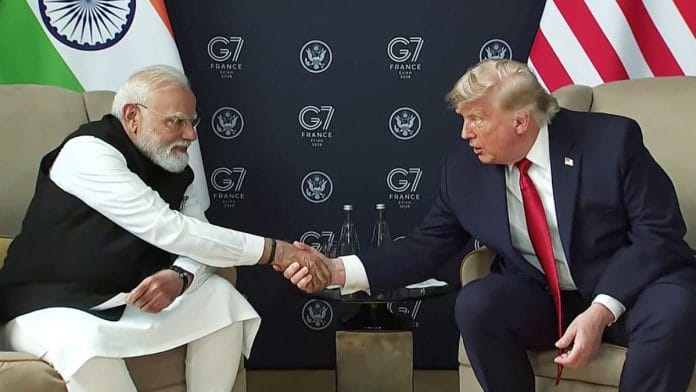
Last year, also on the sidelines of the G-7, Modi again referred to Twitter, when he joked with French President Emmanuel Macron about a viral video involving Macron being face-swatted by his wife. More recently, mainstream media zealously circulated a photograph of Modi pointing a finger at US President Donald Trump as if it were a moment of diplomatic triumph.
Also read: Reset, rapprochement or relief? What Modi and Trump bonhomie in France achieved
Influencer strategy
Every overseas trip of Modi is accompanied by a steady stream of “viral moments”—carefully spun photo opps, choreographed interactions and social-media-friendly soundbites designed for maximum virality.
None of this would matter if it were merely harmless public relations. The problem is that it points to something far more troubling: The gradual transformation of India’s foreign policy into triviality and social media performance.
A moment during Modi’s meeting with Trump at the G-7 in Evian, France sums it up. When Trump, responding to a question about the killing of three Indian sailors in US military strikes in the Straits of Hormuz, casually remarked that “it’s a rough profession,” Modi sat smiling silently beside him.
These images may well come to define the character of India’s foreign policy under the Modi government: Highly visible, intensely personalised, relentlessly marketed—and yet sadly lacking in the moral clarity, substantive vision and strategic confidence that once distinguished India’s voice in world affairs.
Contrast this with another iconic moment from India’s diplomatic history. In 1971, Prime Minister Indira Gandhi journeyed to the US to meet then President Richard Nixon. Faced with Nixon’s hostility, she snubbed him in style, sitting with her eyes closed during a state banquet and answering his questions in monosyllables.
“We will not retreat,” she had thundered during the Bangladesh war in the face of American pressure to withdraw, “not by one step will we move back.”
During her historic 1982 visit to the US during the Cold War, when asked whether India tilted towards one bloc or another, she famously replied: “India stands upright.” A bold statement of sovereign confidence that did not require any media massaging.
That confidence emerged from a foreign policy tradition that believed India represented something larger than itself. Jawaharlal Nehru helped craft the Non-Aligned Movement, convened the 1955 Bandung Conference to oppose the neo-imperalism of the former colonial powers, articulated the Panchsheel Agreement—or principles of peaceful coexistence with China, and sought to give newly independent nations a voice in a world divided by superpower rivalry. Indira Gandhi displayed formidable strategic courage in 1971, resisting American pressure and helping create Bangladesh.
Yes, Nehru misjudged China and paid a terrible price in 1962. But even then, India stood for a moral commitment toward justice and respect for what was then called the third world.
Also read: The Modi paradox in 2026. Complete political domination alongside worsening economic slide
An absent foreign policy
What exactly does India stand for today?
When Russia invaded Ukraine in 2022, India spoke the language of balance but avoided the language of principle of condemning armed aggression. When Gaza burned, India hesitated. Four times between 2023 and 2024, India abstained from UN resolutions demanding immediate ceasefire in Gaza.
When war threatened to engulf Iran and West Asia, New Delhi remained cautious to the point of invisibility and near-total silence. When Iran’s head of state Ayatollah Khamenei was assassinated in a US-led targeted killing, India’s moral cowardice became glaringly obvious. Modi refrained from expressing even his condolences. India did not emerge as a clear voice for international norms and stability.
Some argued that strategic ambiguity is necessary. But realism is not the same as passivity. And strategic autonomy is not the same as avoiding every difficult position.
Indeed, the entire purpose of India’s traditional foreign policy was to combine national interest with a larger vision of global order. India has always sought not merely to react to events but to shape them. But the Modi regime’s diplomacy often appears content merely to stage-manage events, in a familiar pantomime repeating itself time and time again on Modi’s trips abroad.
Every overseas trip follows a familiar script. Modi-adoring diaspora crowds. Choreographed cultural performances. Endless visual imagery. Prime Ministerial hugs. Social-media amplification. Drone shots. Carefully edited videos. The optics are viral, but the outcomes are often harder to identify. Trump recently re-posted on his social media platform a statement from the US ambassador to India that Indian companies plan to invest $20.5 billion in the US. Why have we not heard similar substantive statements about investments in India after Modi’s trips?
Where is the comparable conversation about India? How much fresh American investment has flowed into India as a direct result of Modi’s diplomatic engagements? How many manufacturing jobs have been created? How much technology has been transferred? What are the measurable gains for ordinary Indians? Instead we hear of FIIs abandoning India, and net FDI plummeting downwards.
The not-yet-concluded India-EU trade deal is being touted as the “mother of all deals.” But there is little clarity about the real benefits that will flow from this trade pact. All the reels and viral moments did not stop Trump from slamming a punitive 50 per cent tariff on Indian exports, although these have now reduced. Nor did Modi’s reels stop the US state department’s astonishingly condescending statement mandating Indian commercial vessels to immediately comply with US orders and warning that violations “will not be tolerated.”
Modi has undertaken 100 foreign trips in 12 years. Have these trips significantly expanded Indian exports? Have they secured greater market access? Have they strengthened India’s position against Chinese territorial aggression? Have they produced measurable outcomes? The government rarely provides clear answers.
Most of the time all we get are reels, Instagram moments and photo ops, and any criticism is dismissed as negativity.
The incident in May involving a journalist in Norway asking Modi a question, followed by huffing and puffing from the External Affairs ministry, illustrated this discomfort with scrutiny. Foreign policy, like domestic policy, is increasingly presented as spectacle, event management and monologues from Modi; there is a glaring lack of accountability and responsiveness to citizens’ needs.
Also read: The new foreign media battle in India— inside the playbooks of RT, Sputnik, BBC & DW
Are we Vishwaguru?
Perhaps the most troubling aspect is the growing gap between rhetoric and reality on China policy. For decades, India insisted that territorial sovereignty was non-negotiable. Yet today, after repeated reports of Chinese incursions and military tensions along the border, the government’s language on China is decidedly meek. Foreign minister S Jaishankar has even said: “Look they are a bigger economy, as a smaller economy am I going to pick a fight with a bigger economy?”
The contrast with India’s earlier diplomatic strength of purpose and bold defence of sovereignty is striking.
Nehru’s generation may have lacked economic power but was armed with purposeful intellectual confidence. Indira Gandhi’s India was poorer than today’s India but often projected far greater strategic self-belief and confidence.
Today, the Modi government’s diplomacy often appears oddly eager for international approval, focusing on touchy-feely hand-holding and embraces, as if foreign policy is a popularity contest or an influencer campaign for Modi measured in likes, shares, followers or viral clips.
More fundamentally, however, the deepest weakness of contemporary Indian foreign policy is not economic. It is moral. India’s national movement was, at its heart, a struggle for sovereignty of those denied their democratic rights. The moral force of the Gandhi-led freedom struggle inspired anti-colonial movements across Asia and Africa. Independent India consequently became one of the world’s strongest voices for sovereignty, territorial integrity, peace and the equality of nations. That tradition now appears terribly diminished. Whether in Gaza, Ukraine, Iran or elsewhere, India increasingly appears reluctant to speak clearly when questions of sovereignty and international law arise.
Today’s India possesses far greater economic and military strength than it did under Nehru and Indira Gandhi. Yet the Modi government seems less willing to exercise moral and political leadership. Power without purpose is influence diminished. And foreign policy without principles eventually becomes little more than public relations. India has moved from being a country with a foreign policy philosophy to a country with a foreign policy based on social media marketing strategy.
India’s biggest rival, Pakistan, despite its many internal weaknesses, has managed to place itself at the centre of the most consequential diplomatic negotiation of the moment, while India—the self-proclaimed Vishwaguru—appears largely absent from the room.
The recently signed Islamabad Memorandum of Understanding between the United States and Iran bears Pakistan’s imprint as mediator and witness, with Islamabad playing a key role. At US-Iran talks this week, US Vice President JD Vance stated that his two favourite South Asians are his wife and Pakistani Field Marshal Asim Munir.
How did a nation that once helped shape the Non-Aligned Movement, championed anti-colonial solidarity and spoke with authority on questions of war and peace become a spectator while others occupy the diplomatic centre stage?
The question is particularly uncomfortable because the Modi government has invested enormous political capital in projecting India as a “Vishwaguru” and a leading global power. Influence is measured not by slogans but by whether nations seek your counsel when crises erupt and whether your presence is considered indispensable at the negotiating table. Today, Modi appears present in the photographs, in hugs and in smiling handshakes, but India is absent from the process as a global negotiator. Modi has turned India’s foreign policy into an Instagram reel. Modi dominates social media feeds but India finds itself peripheral to the negotiations that matter. Modi is highly visible, India is not.
That is perhaps the defining contradiction of the Modi era. Modi projects himself loudly on the world stage. Yet it is under Modi’s watch that Indian foreign policy has turned meekly uncertain, unsure, timid and hesitant about the distinctive role India has always played in shaping world events. Reels, Instagram moments, viral X videos, and Facebook posts are no substitute for a substantive, coherent and purposeful foreign policy that acts in the interests of the people, not simply to build an individual personality cult prancing on the world stage.
Sagarika Ghose is a Rajya Sabha MP, All India Trinamool Congress. She tweets @sagarikaghose. Views are personal.
(Edited by Theres Sudeep)
It would have been great, burnished India’s credentials for a permanent seat on the UN Security Council, if our diplomacy had contributed meaningfully to helping end the conflict in Ukraine. Iran is closer, economically far more consequential. Making friends with the Taliban in Afghanistan, Tatmadaw in Burma.
Ms Ghose’s piece is a interesting chronicle of facts – past and present – and no doubt about the journalistic quality. However, one must remind Ms Ghose that Mrs Gandhi’s time had no internet, no social media, no means of easy and ubiquitous ‘candid moment’ propagation – today things are fundamentally different. Therefore, diplomacy also needs to adapt to the times. If India is well served by a effective brand ambassador like Mr Modi – so be it. Additionally, direct talk like “India stands upright” will only enrage a highly volatile global leader who seems to do diplomacy between 1AM and 4AM via high decibel social media posts!