




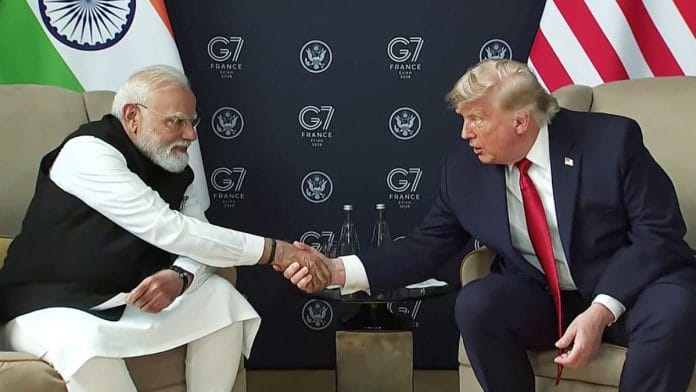

Indian strategic circles and the media were keenly following the proceedings at the G7 summit in Évian-les-Bains, France. Prime Minister Narendra Modi met President Donald Trump in person after 16 long, bruising and bumpy months in India-US relations.
Differing opinions floated in the hours before the meeting began: Should the PM have agreed to it? Or should he not have? The former argued that it was time for the two leaders to meet in person and repair the most consequential relationship of the 21st century. The latter argued that the PM was better off avoiding a grumpy Trump, unable to find a favourable victory in Iran and frustrated with both Benjamin Netanyahu and Mohammad bin Zayed.
However, to begin with, this much-awaited meeting turned out to be significant not because it produced any major breakthrough, but because it avoided a breakdown.
That may sound like a low bar for two leaders who, not long ago, portrayed one of the warmest personal friendships in international politics. Yet, reeling under the pressure of tariff disputes, the Operation Sindoor ceasefire, differences over Pakistan, the purchase of Russian oil, the deaths of Indian seafarers in US strikes, and several statements undermining India and its economy, the fact that the bilateral passed without drama was itself notable and, may I say, a relief.
The optics were certainly positive but operated in an air of caution. Trump described his meeting with Modi as “very good”, called him a “tough negotiator”, and spoke about future engagement with India. Modi, in turn, spoke of the relationship acquiring “new speed and new energy”. Officials on both sides highlighted progress in trade negotiations and reiterated their commitment to deepening strategic cooperation. The atmosphere was cordial, but it was also carefully calibrated.
Beneath the smiles lay grievances over the deaths of the seafarers, which Modi mentioned but was unable to extract an apology for from a self-assured Trump.
Also read: The Quad is fading. India must now confront the limits of strategic ambiguity
The contrast
The contrast with their previous meeting, held on 13 February 2025, is particularly striking.
Although not present for Trump’s inauguration on 20 January, Modi flew to Washington with glee a month later for an official working visit. The outcome, the COMPACT Initiative, was reassuring and predictable, even if not pathbreaking. The joint statement added to the extensive record of tangible deliverables and agreements that have emerged from the numerous high-level engagements between these two leaders and between the US and India over the years.
COMPACT spoke of expanding defence cooperation, accelerating technology partnerships, increasing energy collaboration, strengthening supply chains, and working towards the ambitious “Mission 500” target of achieving $500 billion in bilateral trade by 2030. The two sides discussed everything from advanced defence co-production and critical minerals to artificial intelligence, semiconductors, civil nuclear cooperation, and maritime security. At the time, the document reflected a remarkable degree of strategic optimism.
However, in the months that followed, India-US ties saw a disruption that few could have predicted, leading many to argue that Trump had lost the partner in New Delhi that successive administrations had worked so hard to cultivate. For New Delhi, Trump’s shocks were a rude awakening to its limited strategic leverage and shrinking room for strategic autonomy in an upended geopolitical landscape, despite India’s huge potential and strategic geography.
Subsequently, New Delhi’s foreign-policy pathways shifted towards seeking more reliable partners in Europe, Japan, and the UAE. Meanwhile, in Washington, the Trump administration kept springing new shocks on its allies around the world, becoming increasingly entangled in the wars and regime changes Trump had promised never to start.
Subdued wisdom also dawned on New Delhi that it could have managed Trump and its strategic communication better during and after Operation Sindoor, which Pakistan used to raise its diplomatic profile and engagement with the US and others despite its military defeat.
Also read: Nuances, complexities & sore points of India-US trade deal sealed by Trump & Modi
Incremental progress
Despite apparent discomfort and Trump’s haphazard public berating of India and Indians, US-India relations did display a degree of perseverance through sustained trade negotiations and the signing of a 10-year defence agreement in October 2025.
As the year drew to a close, the total value of Indian exports to the US—already India’s largest export market—surged. This came despite the 25 per cent Liberation Day tariffs imposed on 2 April 2025 and a second tranche of an additional 25 per cent tariff imposed on 27 August 2025 over India’s purchase of Russian oil.
Overall, Indian merchandise exports to the US grew month after month and rose by 11 per cent year-on-year.
Defence collaboration, too, kept its space. Since taking office in 2025, the United States has approved or finalised five major defence sales and sustainment packages for India. These come over and above those inked earlier, which are in different stages of implementation.
The appointment of Sergio Gor as US Ambassador to India in January 2026 and the finalisation of the framework for the trade deal, alongside burgeoning energy purchases and India’s joining the US-led Pax Silica initiative, all played their small parts in building consistency. However, they could not balm the bruised bilateral relationship.
Subsequent US apathy towards the Quad, wobbliness on Taiwan, and generosity towards Xi created further mistrust. Even Secretary of State Marco Rubio’s recent visit to India was interpreted as operating at the “bare basics”, with little of the bonhomie of earlier times.
Trump did provide temporary relief to India over its purchases of Russian oil when Hormuz became weaponised, but many in Indian strategic circles interpreted it as the US dictating terms to a sovereign country. This negativity surged into massive public outrage when three Indian seafarers were killed in US strikes on sanctioned vessels. To make matters worse, just hours before the bilateral meeting, the US sent a favourable signal to China by reverting the Indo-Pacific Command (INDO-PACOM) to PACOM, thereby removing the salience given to India in its strategic semantics. The same administration had changed the name from US Pacific Command to Indo-Pacific Command in 2018.
Évian-les-Bains rapprochement
Apart from effusive compliments and smiles, the MEA press release highlighted five points: Modi commended Trump on peace efforts in West Asia, underscored freedom of navigation, and, for the domestic audience watching him, raised the issue of the seafarers’ safety.
The two sides reviewed progress under COMPACT and alluded to progress in negotiations over the trade deal. This was followed by a generic statement on enhancing cooperation across all domains.
The MEA release made no mention of Trump’s expressed desire to visit India later in the year or his inscrutable statement about coming to Modi’s defence if need be.
All of this alludes to strategic convergence and lasting institutional mechanisms, but not to the rebuilding of strategic trust, which was eroded single-handedly by Trump over the past 16 months. And trust cannot be built or sustained through summit optics, cheesy one-liners, or thank-you tweets.
That is why the significance of Évian-les-Bains lies less in what was said than in what follows—the aftermath.
The bilateral did not resolve the underlying question that has snowballed over the past 16 months: Can India rely on a US administration whose goalposts appear to be constantly shifting?
Therefore, the real measure of Évian’s rapprochement will be the trade negotiations, the handling of future crises, the follow-through on defence cooperation, and, most importantly, the willingness of both sides to rebuild confidence after a period of visible strain.
And in diplomacy, as in politics, the proof of the pudding remains in the eating.
Swasti Rao is a Consulting Editor (International and Strategic Affairs) at ThePrint. She tweets @swasrao. Views are personal.
(Edited by Prashant Dixit)
Renaming of INDPACOM, a few hours before the two leaders were to have their first in person meeting in sixteen months, was not a coincidence. Or a matter of semantics. There have been many signs that the Trump administration does not see Quad as central to its China strategy. Questions about how much value India brings to the table. Perhaps the Philippines in Squad is more worthwhile. 2. To get to the nub of the issue. The triangle of India and our two most consequential relationships. It would be prudent for India to mould its engagement with China in a purely bilateral format. The economic content is solid in terms of trade, could grow to include investments. The political relationship touched its nadir in the summer of 2020, is still limping along. There is no prospect of a boundary settlement in our lifetimes. 3. Really for the government to think long and hard about moving from congealed hostility towards a more productive modus vivendi. The 5 : 1 asymmetry is a fact of life that should be addressed in a spirit of realism and pragmatism.
Frustrated with both Benjamin Netanyahu and Prince MbZ. What does that tell us about the future of I2U2 ( Quad of West Asia ), which marked a departure from the proven utility of the earlier approach to West Asia. Solid economic partnerships with major players, not getting entangled in their disputes and rivalries.