




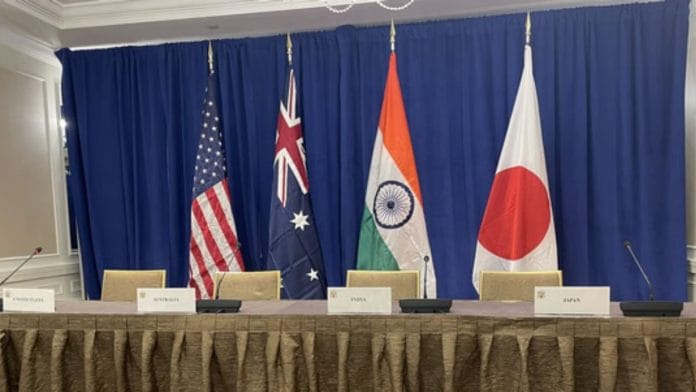

Marco Rubio’s recent India visit was important for two reasons: to gauge the mood in Washington about US-India bilateral ties and to ascertain the future of the Quad.
For the first part, the visit reflected a degree of continuity in India-US ties. It was an attempt to restore trust in a partnership that, for nearly twenty-five years, has been built on a convergence of strategic interests and an unusual degree of bipartisan consensus in Washington. Even when scepticism over “how much to trust the US” persisted within sections of India’s strategic community, there remained a broad recognition of how deeply embedded the partnership had become. The breakdown of that trust stung when it happened under Trump’s second term.
This piece, however, is not merely about repeating that sentiment, but about four structural issues related to the Quad that now need closer attention. First, though, a quick run-through of why the US today remains India’s most consequential strategic partner.
Also Read: From Kolkata to Quad, Marco Rubio’s India visit sparks anxiety and mockery in China
Bilateral momentum
The numbers speak for themselves. America is India’s largest export market, a major defence partner, and among the country’s biggest investors. It recently overtook Mauritius to become India’s second-largest source of FDI. The US is also a critical source of remittances, an often-understated but vital pillar for an economy where remittance inflows remain higher than FDI.
The relationship is also driven by technology, with the US emerging as India’s most important technological partner — from semiconductors and AI to critical and emerging technologies.
Despite political friction, the strategic architecture has continued to deepen. India recently renewed the long-term defence cooperation framework with Washington and, albeit later than some others, joined the US-led Pax Silica, an initiative to strengthen supply chains for AI-era technologies. Simultaneously, the US has become an increasingly important actor in India’s energy imports as well, particularly in the context of energy diversification after the Hormuz crisis.
There is also a renewed push on the economic front. Commerce Minister Piyush Goyal’s visit to the United States was aimed at progressing negotiations on finalising the long overdue bilateral trade agreement.
The crux is that despite tariff disputes and Trump’s unpredictability, the India-US relationship continues to move through institutional continuity.
Plurilateral woes—the Quad
It is on the Quad that Rubio’s visit left a lingering sense of disappointment despite new add-ons.
Even as Rubio was in New Delhi, reports began circulating that India may not convene the annual Quad Leaders’ Summit later this year. In addition, the summit may no longer be convened as a standalone marquee event, the form it had acquired after the Quad was elevated to the leaders’ level in March 2021, and began drawing considerable global attention, and objection from Beijing.
India, which has held the Quad chair since 2024, was expected to host the long-pending summit but has cited scheduling constraints. It now appears prepared to pass the baton to Australia.
It does not require great strategic imagination to read between the lines. The earlier enthusiasm seems to have faded after Trump’s return to office, alongside the collapse of many earlier expectations and the growing caution with which New Delhi now approaches Washington. There are reasons, known well in Delhi circles, why Prime Minister Modi has carefully avoided an in-person meeting with Trump, either bilaterally or otherwise.
The Quad is no longer the centrepiece of the US administration’s Indo-Pacific strategy, and India must revisit four factors in this regard.
The China question
The first assumption was perhaps the most foundational — the belief that India occupies a central and indispensable place in the US Indo-Pacific strategy as a counterweight or counterbalance to China.
For nearly two decades, a broad strategic consensus had taken shape in India: that the United States needed India as the demographic, geographic, and security counterweight to China’s rise in the Indo-Pacific. The Quad’s strategic elevation only reinforced that perception. The grouping appeared to evolve into a nimble, function-driven plurilateral architecture through which Washington, Tokyo, New Delhi, and Canberra could collectively strengthen their respective strategic positions in the Indo-Pacific without forcing New Delhi into a formal alliance framework.
For India, this arrangement was perfect.
India has always remained deeply uncomfortable with openly framing or naming China in adversarial language. Unlike the United States, Australia, or increasingly Japan, New Delhi has carefully avoided publicly designating China as an “enemy”, “rival”, or even a “competitor” in formal strategic discourse. India’s traditional instinct has consistently been to preserve ambiguity and a certain ‘country-agnosticism’. It wants room for deterrence without direct reference, and engagement without alignment.
The Quad allowed India to inhabit precisely that space. The Quad’s other partners wanted the Indo-Pacific to be free and open, but India also wanted it to be inclusive—a semantic directed at assuaging China’s allegation that the grouping was an Asian NATO.
It gave New Delhi the ability to enhance its strategic profile in the Indo-Pacific, deepen maritime cooperation, expand technological coordination, and participate in balancing China, while simultaneously retaining the diplomatic flexibility to insist that the Quad “was not aimed at any one country”.
That said, everyone understood what Quad really aimed for.
The repeated diplomatic assertions that the Quad was not directed against China enabled India to participate in a ‘containment-like’ architecture without openly endorsing containment. That balancing act fit perfectly within India’s larger worldview of strategic autonomy, a foreign policy culture that avoids treaty entanglements and resists reducing India into a subordinate pillar within another power’s geopolitical design. India, for its part, balanced that with other groupings such as BRICS and the SCO, even with zilch strategic alignment in the latter two on economic or security matters.
But that underlying assumption — that India remains central to Washington’s Indo-Pacific calculus — now appears far less certain under Trump 2.0.
America’s Indo-Pacific drift
Second, the signs are already visible in the declining political energy around the Quad itself.
The Trump administration’s lukewarm approach toward the grouping, coupled with its broader tendency to undercut allies and partners through transactional bargaining, is evident. The earlier belief that the Quad represented a carefully nurtured American strategic investment in India now looks shakier.
And that is because the United States’ Indo-Pacific strategy itself has changed considerably since it was first articulated in late 2017 under the banner of a “Free and Open Indo-Pacific”. The phrase survives, but not the clarity.
In 2026, the US under Trump remains intensely engaged across multiple theatres — homeland security, Latin America, the war-engulfed Middle East, even Africa. Despite loud rhetoric about reducing commitments to Europe and NATO, structural constraints imposed through congressional mechanisms such as the National Defense Authorization Act (NDAA) have prevented any meaningful strategic withdrawal from Europe. Washington also doubled down on Greenland, creating global confusion, before eventually settling into negotiations and strategic deals.
Simultaneously, the United States has emerged as one of the main hydrocarbon suppliers in the post-Hormuz global energy order, making substantial long-term investments in energy infrastructure across Central and Balkan Europe.
In other words, American strategic activism has not diminished globally. It has merely shifted elsewhere and at the cost of Indo-Pacific.
The pause on US arms sales to Taiwan after Trump’s summit with Xi has amplified that perception further. Today, nobody is entirely certain what the United States would actually do in the event of a contingency in the Taiwan Straits. The rhetoric of deterrence remains, but the strategic signalling underneath appears inconsistent. Across the region, the dominant impression is not one of energetic commitment, but of apathy and pressure on partners to do more.
Also Read: Aggressive outreach isn’t enough to get Norway to invest in India. Its rules are different
Quad vs Squad
And this is where the third factor becomes important.
Even as the Quad appears to have lost some salience in Washington’s strategic imagination, that cannot be said of its far more operational and militarised cousin — the so-called “Squad”, a grouping comprising the United States, Japan, Australia, and the Philippines.
The growing security coordination between these countries has accelerated from mid-2023 onward. Unlike the Quad, which was deliberately designed as a broad diplomatic and strategic framework, the Squad emerged as a tactical frontline security arrangement centred around the South China Sea.
The distinction matters enormously because India, although deeply invested in the Quad, has always preferred bilateral engagement with the Philippines rather than participation in overtly militarised plurilateral frameworks directed against China. The sale of BrahMos missiles to Manila represented a major development in itself, but New Delhi has remained cautious about integrating that relationship into a tighter operational grouping.
The Squad, however, is built differently. It is designed for real-time tactical coordination in highly contested waters where Chinese coercion is already active and immediate. With the Philippines directly confronting aggressive Chinese manoeuvres inside its Exclusive Economic Zone, the grouping focuses on joint coast guard patrols, maritime deterrence, direct military equipment transfers, and coordinated responses to South China Sea incidents.
And unlike the Quad, three members of the Squad — the United States, Japan, and Australia — are formal treaty-bound military allies of the Philippines. That changes the nature of deterrence entirely. Their security architecture is explicitly designed around the possibility of direct intervention should Philippine forces come under attack. The Trump administration itself has assured Manila of its ironclad commitment to the 1951 defence treaty while also approving large-scale arms sales.
Compared to this, the Quad increasingly appears broader, softer, and less operationally cohesive to tackle China.
Ironically, even after Operation Sindoor and repeated statements by the Indian defence establishment regarding China’s role in aiding Pakistan, New Delhi appears to have opted not for greater hawkishness, but for a cautious rapprochement. One might have expected India to harden its China posture further. Instead, what has emerged is a renewed caution.
A hard lesson for India
This brings us to the fourth and perhaps most sobering and oft-repeated realisation now shaping Indian foreign policy: that no external power is ultimately going to underwrite India’s interests, directly or indirectly.
The only durable solution, however difficult, lies in converting India’s long-advertised strategic potential into actual strategic leverage — the real and rude awakening of Trump 2.0. And this recalibration is already visible.
Fears of a full-fledged US-China G2 remain exaggerated because the structural rivalry between Washington and Beijing remains very real. Nevertheless, India has been forced to rethink its own position within a bipolar world with unipolar characteristics due to Trump’s actions.
Therefore, one of the important takeaways of the Trump 2.0 era has been India’s renewed search for more stable and predictable partnerships — particularly with Europe, Japan, South Korea, and Canada — while preserving old ones like Russia and simultaneously developing strategic initiatives such as the Great Nicobar Project.
But this does not mean India is returning to the commonly professed equidistance from all great powers. In fact, much of the confusion surrounding Indian foreign policy stems from India’s own long-standing reluctance to clearly define its strategic outlook in explicit terms. Indian strategic culture often thrives on interpretations rather than clarity. Whether that ambiguity is an asset or a liability remains deeply debated within the strategic community itself.
What can no longer be denied, however, is that the current international (dis)order is increasingly forcing India to confront its own neglected structural weaknesses.
Swasti Rao is a Consulting Editor (International and Strategic Affairs) at ThePrint. She tweets @swasrao. Views are personal.
(Edited by Asavari Singh)
I am certain India will rise, economically and strategically, as China has. By its own industry, enterprise, wisdom. However, there are no short cuts. Was intrigued to hear a senior diplomat say recently, China does not treat India as an equal. That is International Relations # 101. Had India’s GDP been larger than China’s, would we have treated it as an equal. 2. India needs to forge a harmonious, cooperative modus vivendi with China. Spending the next sixty years frozen in hostility with it is not far sighted foreign policy. As a developing country, India has such a vast, pressing domestic agenda.