



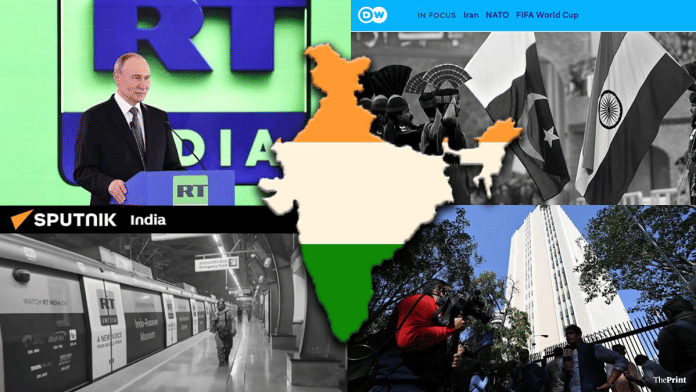
New Delhi: The Kremlin’s most powerful international broadcaster arrived in India last year with a handicap. Unlike the BBC, it had no legacy. Unlike The New York Times, it had no audience waiting to dissect its Modi coverage. So RT did what it has done elsewhere: it borrowed India’s voices instead.
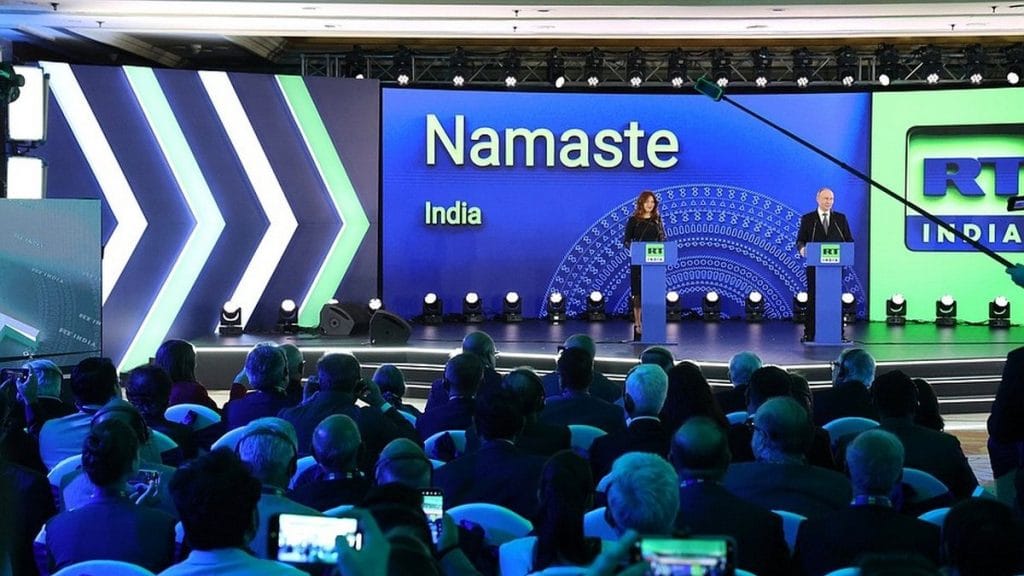
Shut out of much of Europe and pushed off air in the US, RT’s India arm was launched with much fanfare by Russian President Vladimir Putin in New Delhi last December. The Russian state-backed network quickly enlisted actor Anupam Kher, former external affairs minister Salman Khurshid, and Congress MP Shashi Tharoor, whom it had already featured months earlier. The channel wrapped itself in familiar faces as it attempted one of its most ambitious expansions anywhere in the world. It’s Kremlin TV in Indian clothing.
For decades, India’s attention on foreign media has centred on how Western media portrays the country. But there is a more deliberate kind of foreign media presence that receives far less scrutiny: new entrants embedding themselves locally — with studios, public figures, media partnerships and even direct content pipelines to the country’s largest public broadcaster. Some have existed under the radar for decades. Others, like RT, are making their presence felt with a splash.
These foreign broadcasters are all competing for a slice of the 1.4 billion Indian audience, but they are not playing the same game.
While RT’s format may be unmistakably Indian, the framing is not: it is anti-Western, anti-colonial, and directed at what Russia calls the “global majority”—an agenda also visible in Sputnik, Russia’s other major media arm in India. The BBC, among the oldest foreign media institutions in India, has been forced to reinvent its structure after regulatory scrutiny and political controversy. Germany’s Deutsche Welle has spent years building influence through partnerships and digital collaborations.
Yet whether they present themselves as voices of balance, public-service broadcasting, or defiance against a Western-dominated information order, all recognise a common reality: India is no longer simply a country to report on.
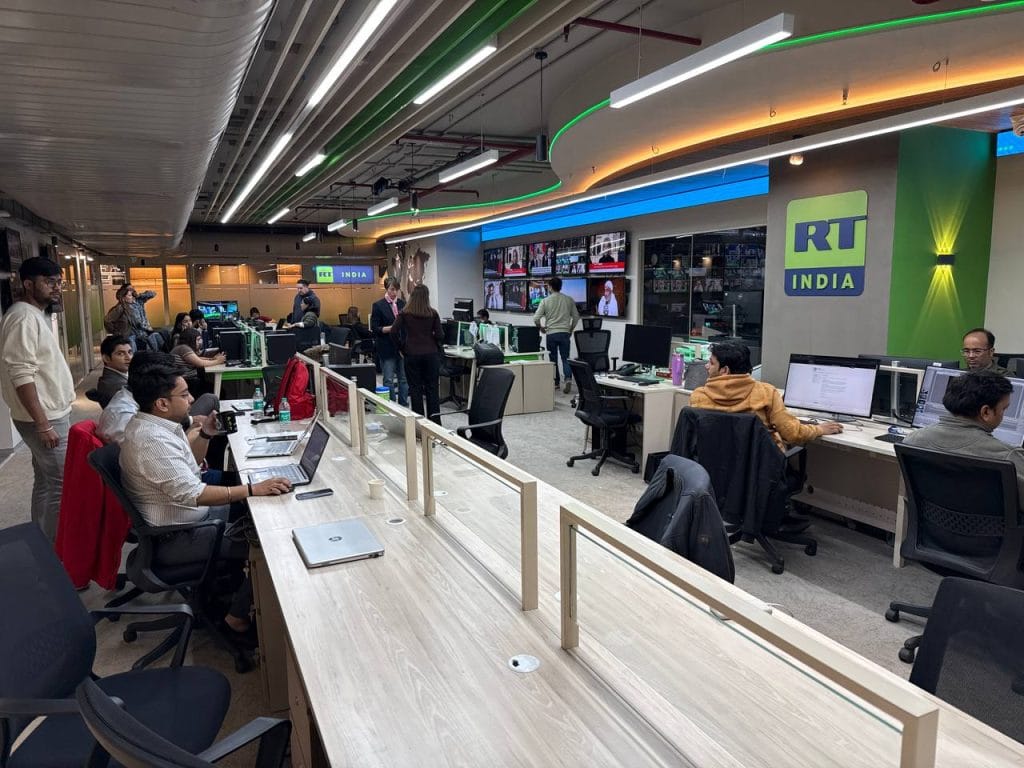
RT has chosen the most aggressive route to this massive market. Rather than reporting from the outside, it has spent the last six months entrenching itself within the country’s political, cultural, and media ecosystem.
This new focus on India is tactical, according to France 24 senior editor Leela Jacinto.
“There is no doubt that RT is a state propaganda channel. They are here for the reach, and the Global South is getting attention so India is an interest to Putin. But they have no credibility,” she said. “And now the Indian public risks becoming less informed than it already is.”
The Russian Embassy told ThePrint that it wasn’t in a position to speak about Moscow’s strategy.
“RT and Sputnik in India are highly capable teams as far as we can tell, and we follow their reporting with great interest,” a spokesperson said.
Also Read: Pakistan’s spy satellite network watching India has grown faster than ever in just 16 months
RT’s Mission India playbook
RT’s entry into India began in retreat.
After Russia’s full-scale invasion of Ukraine in 2022, the Kremlin-funded broadcaster lost its licence in the UK, was banned across the European Union, and shut down its broadcast operations in the United States. The contraction in the West forced a recalibration.
Mission India came three years later.
The launch of RT India fits into what analysts describe as Russia’s broader “turn to the Global South” — a strategic pivot towards audiences in Asia, Africa and Latin America as relations with Western capitals deteriorated. RT had already been building its foothold through Arabic and Spanish-language networks, while expanding aggressively across parts of Africa. But the loss of Western markets accelerated the process. Resources and attention were redirected toward new regions where anti-Western sentiment, strategic autonomy, and scepticism of the post-Cold War order already had political currency.
What makes India a particularly attractive target is the combination of a government that has shown receptiveness to RT’s anti-Western narrative, particularly after Moscow’s full-scale invasion of Ukraine, while simultaneously curbing domestic press freedom.
– Leela Jacinto, senior editor, France 24
India, with its longstanding ties with Moscow and a huge audience, became a natural next step. Yet what distinguishes RT’s India operation is not where it expanded, but how.
The network has spent years refining a formula for entering new markets without appearing overtly foreign. One key tactic is to platform people audiences already know and trust. In the US, that meant TV hosts such as Abby Martin. In the UK, political personalities such as Alex Salmond and George Galloway were roped in. In India, RT is following the same template.
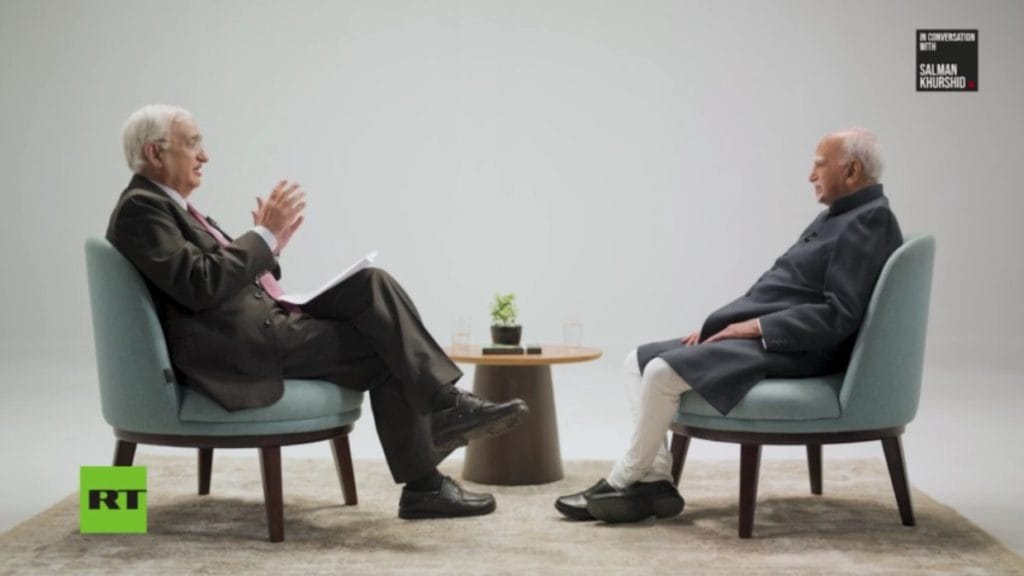
Actor Anupam Kher hosts a 30-minute weekly show called Let’s Talk Bharat. Former external affairs minister Salman Khurshid anchors In Conversation.
📺 RT India's BRAND NEW Show: In Conversation With Salman Khurshid
Far from just another interview show – this is conversation shaped by experience. Because foreign policy is not just theory. It must be lived.
Hosted by India’s former EAM and one of the country’s most respected… pic.twitter.com/XTTn9xu9LD
— RT_India (@RT_India_news) February 24, 2026
The channel’s news operations are led by Runjhun Sharma, a journalist who spent years reporting from Moscow and developed rare access to the Kremlin. Its podcast India, Russia and the World has featured the likes of BJP spokesperson Jaiveer Shergill, Andhra Pradesh minister Nara Lokesh, journalist Palki Sharma, Suhasini Haidar of The Hindu, and Shaurya Doval.
But the Shashi Tharoor link is likely the most instructive example of how RT built its footprint before the channel even officially launched in India.
Three months before RT India officially launched, the network premiered Imperial Receipts, a ten-part series featuring the erudite Opposition MP with well-known anti-colonial credentials. Hosted by Sharma and aired on RT International and YouTube, the programme explored British colonialism in India, economic extraction, cultural destruction, and the question of reparations.
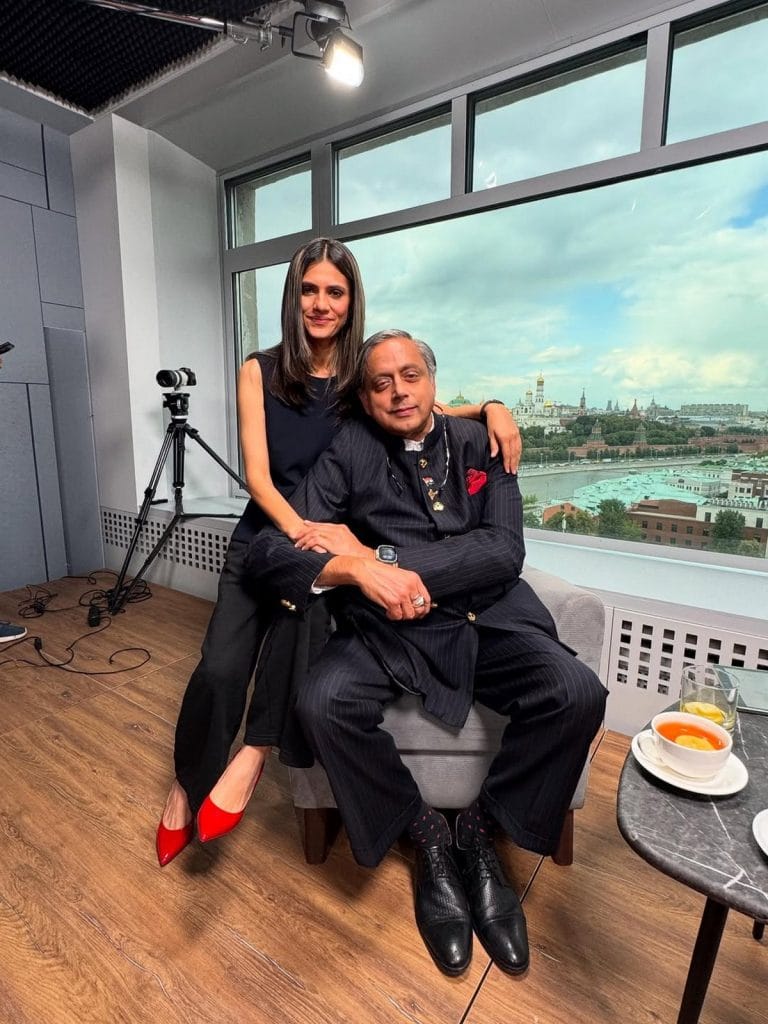
Tharoor’s famous Oxford Union speech on colonial reparations had made him the global face of this emotive issue, and this time RT piggybacked on it at exactly the right time.
A special preview episode, filmed during Tharoor’s visit to Moscow — where he also met Russian Foreign Minister Sergey Lavrov — aired in August and trended on social media. The series gave RT exactly what it needed months before launch: credibility and reach.
Well before it had a television audience in India, the series helped RT paint itself not as Moscow’s mouthpiece, but as a platform for India’s own voices to air their grievances against the West.
Ahead of its launch, RT also ran a pan-India advertising blitz, with billboards in major cities carrying the line: “The dialogue began decades ago. We’re just turning up the volume.” RT positioned itself as a natural extension of the India-Russia relationship that stretches back to the Soviet era.
But the localisation tactic is paired with a broader narrative strategy that has remained consistent across RT’s global operations. Rather than presenting itself as explicitly pro-Russia, RT positions itself as an alternative to a dominant Western media order. In India, that framing is adapted to local context. Campaigns around the channel’s launch questioned why “the West still sees India as a third-world country” and described RT as “not anti-Western… just not Western.”
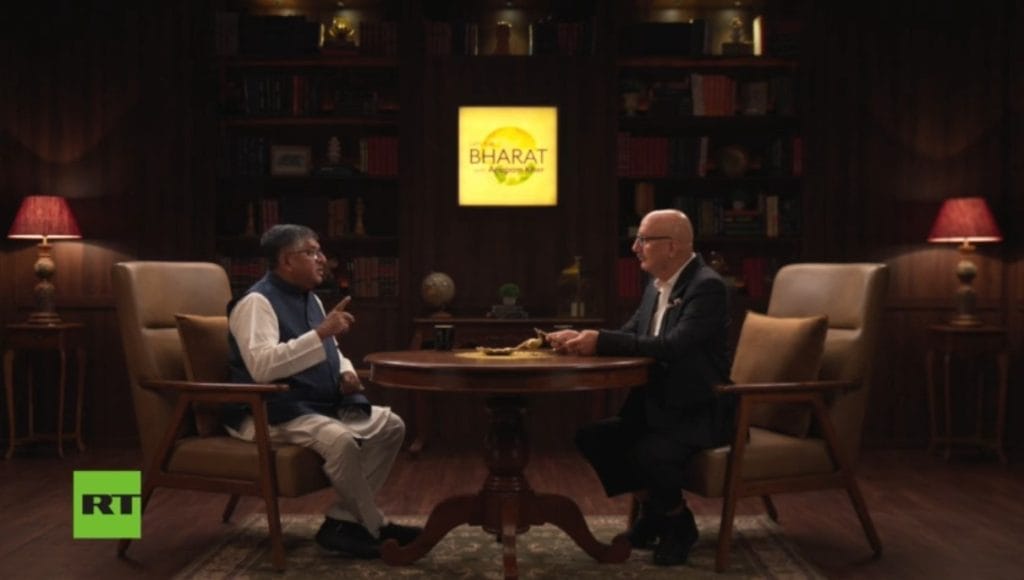
And RT’s India approach goes beyond programming. During Putin’s December visit, a series of media agreements were signed alongside the RT launch. The Press Trust of India, the country’s dominant newswire whose content flows to hundreds of media outlets, signed a cooperation pact with TASS, the Russian state news agency. National Media Group, a Kremlin-aligned media conglomerate, signed content-sharing and co-production agreements with Asian News International and TV9 Network. Most significantly, TV BRICS signed agreements with Prasar Bharati — India’s largest public broadcaster, with a 98 per cent reach to the country’s population. Moscow’s media agenda now flows directly into India’s largest multimedia platforms.
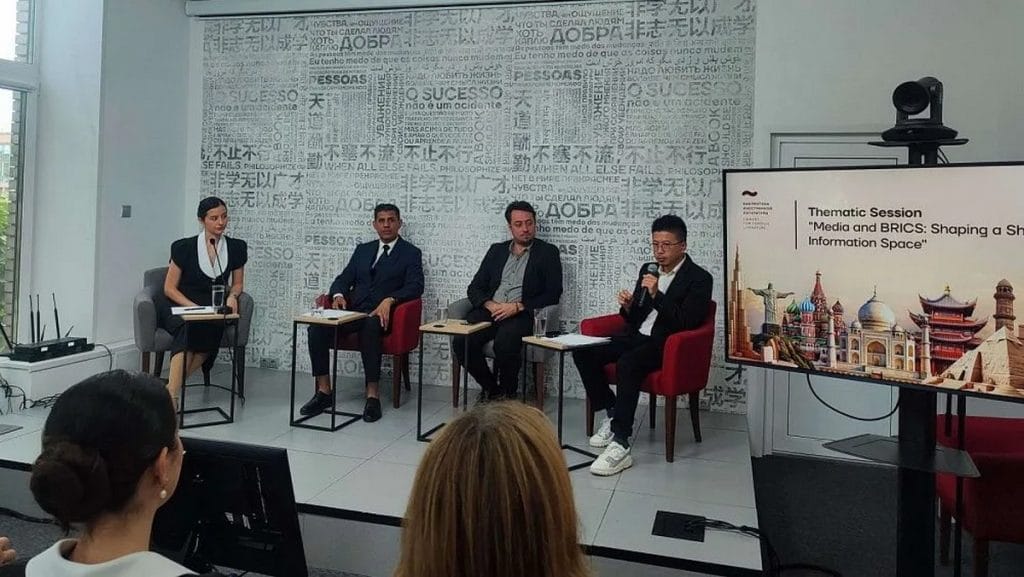
This has raised an alarm among some researchers and press freedom organisations. Reporters Without Borders (RSF), in a report published this month, described RT India as a “Kremlin-funded propaganda channel” and said the network “sits precisely at the crossroads of Indian national interests and Kremlin narratives, viewed through an anti-Western geopolitical lens.”
ThePrint reached out to RT India via messages and calls for an interview. The network declined to comment.
A well-worn strategy
RT’s India playbook did not emerge in a vacuum.
In West Africa, Russia spent years building influence infrastructure in the wake of retreating French power in Mali, Niger and Burkina Faso, using RT, Sputnik Afrique and a web of proxy platforms to push narratives that tapped into existing local grievances.
According to the Africa Center for Strategic Studies, Russia, through RT and a web of proxy operations, ran at least 80 documented disinformation campaigns targeting more than 22 countries, representing nearly 40 per cent of all documented disinformation campaigns on the continent. The institution is under the US Department of Defense.
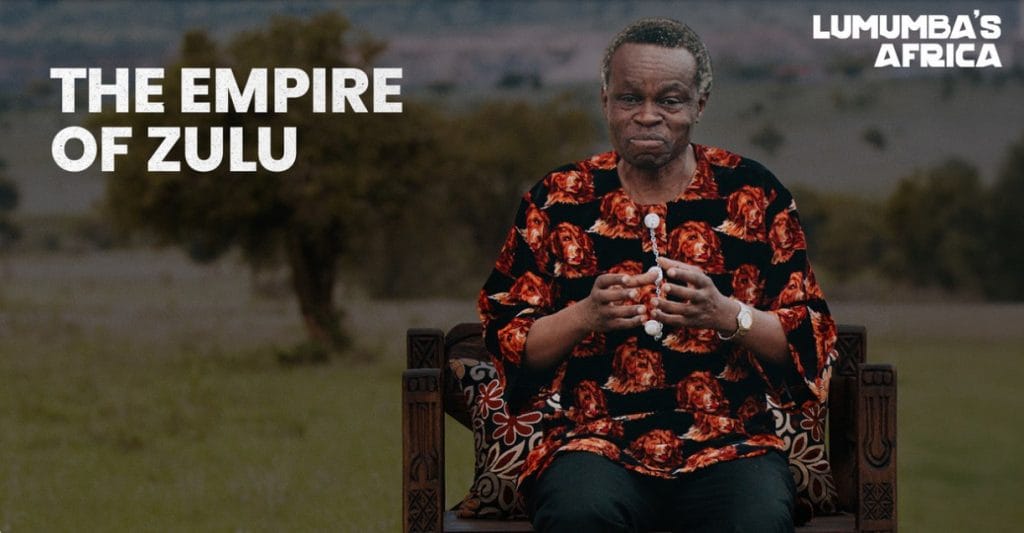
One of the most prominent examples was African Stream, a platform that presented itself as an independent pan-African voice but was later accused by the US State Department of operating as part of a covert Russian influence network. Google, Instagram, Facebook, and YouTube banned it in September 2024.
Leela Jacinto sees the West Africa model as a direct template for what could unfold in India. The conditions, she argues, are not identical but they rhyme — a large, politically engaged population, existing scepticism of the Western post-war narrative, and a government that has shown little incentive to push back.
RT and Sputnik in India are highly capable teams as far as we can tell, and we follow their reporting with great interest
-Russian Embassy spokesperson
“What makes India a particularly attractive target is the combination of a government that has shown receptiveness to RT’s anti-Western narrative, particularly after Moscow’s full-scale invasion of Ukraine, while simultaneously curbing domestic press freedom,” she told ThePrint.
In French-speaking West Africa, Jacinto says, Russia-linked media and influencers used French as the vehicle. In India, it is the English-language internet, Bollywood-scale reach, and a bilateral relationship with Russia that helps give RT legitimacy and familiarity no amount of advertising could manufacture.
RT’s need to borrow the local idiom is a necessity. The BBC broadcasts in English — the same language as its headquarters. So do CNN, The New York Times, The Washington Post and other major publications known in India. Even when they set up foreign bureaus, they are extending an editorial identity that’s already well-known, at least in urban India. RT had no such foundation in India.
At its core, it is a Russian state broadcaster, despite global offerings in English, Arabic, Spanish, French, and German. In every new market, it still has to build local recognition from scratch: new faces, new cultural references, new grievances to tap into. There’s no solid RT brand identity to leverage in new locations.
RT does not plant itself in other cultures because it is more sophisticated than others — it’s because it has no other choice.
How Sputnik is different — and isn’t
If RT is the television face of Russia’s media push in India, Sputnik is its newsroom.
The two organisations operate differently, but increasingly share the same vocabulary.
Sputnik India launched in late 2022, well before RT India appeared on the scene. The timing was not accidental. According to Dmitri Simes Jr, head of Sputnik’s geopolitical department, the organisation’s expansion into India emerged from a broader reassessment taking place inside Russian media after 2022.
“The world has changed a lot… Russia’s relationship with the rest of the world has changed,” Simes told ThePrint.
For years, Russian media had looked mainly to the West. After 2022, that no longer made sense. The focus redirected towards what Russian officials and media organisations increasingly describe as the “global majority” — countries in Asia, Africa and Latin America that they argue have historically been underrepresented in international news coverage. India sat near the top of that list.
The goal is to emphasise India’s role in the new emerging world order. Because we understand that India is not just a major geopolitical player, not just a major economic and demographic player, but also that it is a unique and ancient civilisational state
-Dmitri Simes Jr, head of Sputnik’s geopolitical department
Much of international journalism, Simes argued, continues to be filtered through Western newsrooms.
“Most major international media companies are based in New York, London… and they have a Western-centric worldview,” he said.
Sputnik’s answer has been to flip that model.
Its India newsroom is built less like a foreign bureau and more like a domestic operation — staffed with Indian journalists, plugged into ministries, drawing voices across the political spectrum. The idea, Simes said, is to avoid reporting on India from the outside and instead construct a narrative that travels outward.
Coverage leans heavily into foreign policy, economics and geopolitics: areas that allow India to be positioned as a player, not a subject.
“The goal is to emphasise India’s role in the new emerging world order,” Simes said. “Because we understand that India is not just a major geopolitical player, not just a major economic and demographic player, but also that it is a unique and ancient civilisational state.”
But the line Sputnik India takes is not necessarily the same as Sputnik International’s. Its coverage is more pragmatic: pro-Pakistan when it deems fit. Rather like Russia itself, which has long been India’s ally while supplying engines for JF-17 fighter jets jointly developed by Pakistan and China.
🇵🇰 Sanctions forced Pakistan to build its own fighter jet
💥 The result? The JF-17 Thunder
"An example of what sanctions can do to you," Dr. Maria Sultan, an advisor to the Pakistani Ministry of Defence on Strategic and Military affairs, told Sputnik https://t.co/MloPywFk7K pic.twitter.com/fpJEzhupzN
— Sputnik (@SputnikInt) January 22, 2026
Sputnik, however, insists that its position is neutral.
“We’re not in the business of coming to India and telling Indians how to run their country,” Simes said. “Our goal is to serve as an effective bridge.”
Like RT, it is built for scale. The newsroom leans aggressively into digital distribution, prioritising speed and reach over legacy structures.
“Sputnik is extremely adaptable,” Simes said. “Just look at our social media game.” He pointed to timely, interactive posts aimed at Gen Z audiences, although Sputnik India’s X handle has a relatively modest following of about 129,000. Meta has banned Russian state media from its platforms.
BBC’s long game
Back in 1940, the BBC laid the groundwork for foreign broadcasting in India and over the decades achieved what newer arrivals only hope to become: a household name.
From its early radio services to its current digital and television presence, the BBC gradually expanded in India with reporting from remote corners of the country, building a cachet of credibility and brand recall built over eight decades.
But where RT and Sputnik are tapping into the political zeitgeist, the BBC has run afoul of it, leading to practical implications.
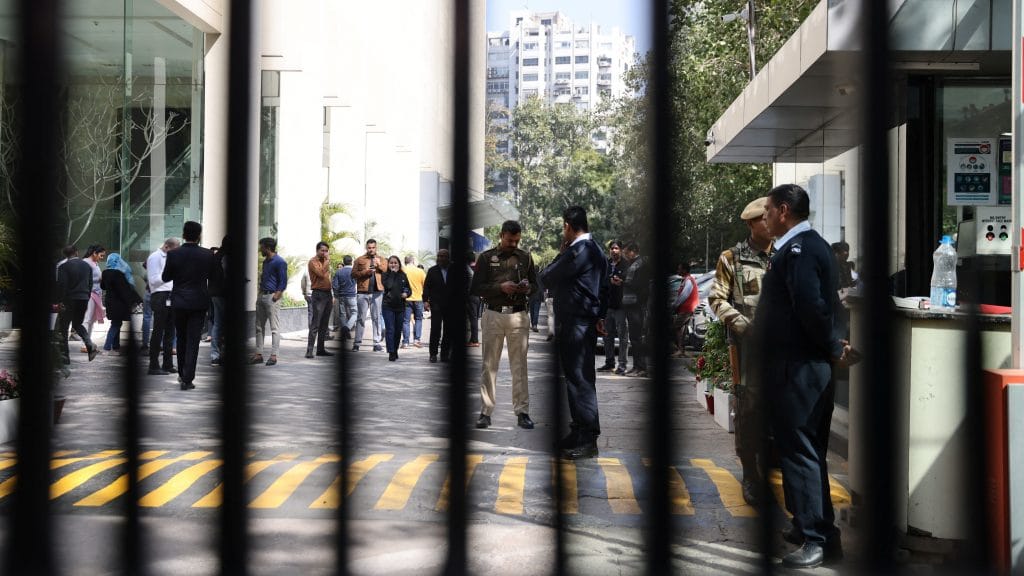
In January 2023, the BBC aired a two-part documentary series, India: The Modi Question, which examined PM Modi’s role in the 2002 Gujarat riots. The government banned the documentary from being shared online using the IT Act, directing X and YouTube to remove the content. Despite the ban, millions watched it through VPNs. Students at Jawaharlal Nehru University and Jamia Millia Islamia attempted screenings that were disrupted by authorities.
Three weeks later, in February 2023, dozens of Income Tax officials arrived at the BBC’s offices in New Delhi and Mumbai. What the government called a “tax survey” lasted three days. Laptops and phones belonging to journalists were seized and the broadcaster later came under scrutiny for alleged violations of foreign exchange regulations. In 2025, BBC India was fined under the Foreign Exchange Management Act (FEMA).
Jacinto points out the irony.
“The same administration that raided the BBC and banned a documentary is now rolling out the red carpet for a Kremlin broadcaster,” she said.
The turbulence forced the BBC into one of the most extensive restructurings in its history in India.
In late 2023, four of its most senior India-based executives — Rupa Jha, Mukesh Sharma, Sanjoy Majumder, and Sara Hasan — left to create Collective Newsroom, an independent Indian company that now produces content for the broadcaster’s six Indian-language services.
The move was designed to comply with India’s foreign direct investment rules, which cap foreign ownership in digital news entities at 26 per cent. Collective Newsroom is wholly Indian-owned. BBC World Service India had been 99 per cent owned by the BBC.
The arrangement effectively split the BBC’s India operations in two.
Collective Newsroom became the BBC’s sole provider of content for its six Indian-language services — Hindi, Marathi, Gujarati, Punjabi, Tamil and Telugu — as well as the BBC News India YouTube channel and other English digital output.
Even then, tensions persist.
After the Pahalgam terror attack in April 2025, in which 26 people were killed, the Ministry of External Affairs sent a letter to BBC India head Jackie Martin objecting to the use of the word “militants” rather than “terrorists” to describe the perpetrators.
Similar objections were raised to some of BBC Urdu’s programming on historical India-Pakistan wars, which angered many in the government. The X account was also briefly withheld in India in 2025 during Operation Sindoor. The BBC also ran a headline during India’s military offensive that was poorly received: “Pakistan suspends visas for Indians after deadly Kashmir attack on tourists”. Social media users protested, saying it read as if “India killed the tourists”.
The government, too, expressed its displeasure and then announced it would monitor BBC’s reporting going forward.
Another major foreign broadcaster, Deutsche Welle (DW), represents a third model that’s distinct from both the BBC and Russia’s media outlets.
Also Read: Modi beats Nehru’s record. TV channels & newspapers choose a victory tune over band baaja
Deutsche Welle’s slower, steadier route
If there has been a silent partner in India’s media landscape, it is Deutsche Welle. Heard on radio since the 1960s, then seen on television and digital platforms, the German broadcaster has never made much noise.
Its expansion has been under the radar, almost deliberately so.
“We were always present in India, but the medium has changed,” Debarati Guha, DW’s director for programs in Asia, told ThePrint, pointing to the shift from shortwave broadcasting to digital-first distribution.
Much of its content is geared towards younger, digital-first consumers, with success measured in engagement and reach rather than ratings or market share.
Even in its expansion, there is restraint.
RT’s values and our values are very different. We want to do journalism which is balanced, has a different perspective, and is as neutral as one can be
-Debarati Guha, DW director for programmes in Asia
Where RT arrived with studios, celebrity hosts, and a ready-made presence in India’s public discourse, DW has grown for decades by working within the existing media ecosystem. Its impact today rests on a network of partnerships with public broadcasters, private media houses and digital platforms, rather than a standalone, high-visibility entry. Guha also pointed out that their resources are far more limited than BBC or RT.
Even today, DW plugs into platforms in India that already exist, co-producing content and extending its reach through collaboration rather than scale. The model allows it to be present without being dominant.
It also determines how the organisation approaches editorial questions.
DW’s reporting tends to move across perspectives rather than anchor itself in a single geopolitical frame, particularly on issues where national positions collide.
“You cannot be democratic in one story and biased in another,” Guha said.
The organisation has largely held to a position of presenting competing viewpoints rather than aligning with one. Where RT embeds itself within the conversation and Sputnik seeks to reframe it, DW’s approach is to sit alongside it.
“RT’s values and our values are very different,” Guha said. “We want to do journalism which is balanced, has a different perspective, and is as neutral as one can be.”
That approach can bring its own tensions, especially in a country like India where coverage of conflict or foreign policy is often closely scrutinised.
“When we show Kashmir as a conflict area, India is not happy. If we want to make India happy, Pakistan won’t be happy,” she said.
As such we’re struggling to differentiate false from truth in Indian media. People have long left TV and gone to other digital media.
If the main news consumption is from RT, only God can save us!!
Putin, the master manipulator!!
How is RT any different from BBC or Al Jazeera ? On the other hand they don’t actually look down on us and don’t do absolutely biased reporting against us.
Don’t believe me, just look at their headlines which are so misleading and so awful. No wonder people are sick and tired of western media.
Screw them. Especially Al Jazeera, like has anyone read their Arabic version ? It’s a complete Islamist propaganda machine.
Why do we even allow foreign media to report here? Clearly for every government they are a propaganda tool. If they want public opinion in a certain way regarding foreign policy they’ll do what RT did. Global propaganda service BC and their 3rd rate reporting needs no introduction. (I’m not familiar with DW or watched their stuff, same with france24). If nothing we should have our own state media in these foreign freedom loving countries.
All of them are foreign propaganda channels. The BBC, especially, is pernicious – it’s anti-Hindu flavoured news and documentaries are a major reason for the widespread Hinduphobia and anti-India hatred in the West.
You present this report as of RT has done something that other foreign media houses are not doing in India , as bbc , dw , nyt or for any foreign news broadcasters specially al zajeera , what they do spread their state sponsor propaganda against india , you check out their archives for india stories and you will not find a single piece of positive development, just political , religious or racist stereotypes hit pieces , . These are same broadcasters whos hiring requirements for journalist is that he should be anti Modi or anti govt (present ) ,in opinion as widely reported some years back , may be nyt or Washington Post .