



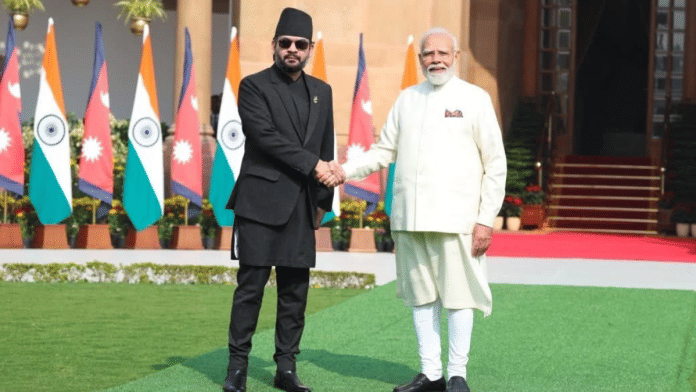
Nepal Prime Minister Balendra Shah’s two-day visit to India from 22-23 November was on the front page of all national dailies in the two countries and made it onto prime-time media panel discussions. But a state visit is measured by diplomatic signalling, not just the media coverage. On that front, the two countries succeeded in showing a diplomatic shift in how two neighbours have interacted.
One way to identify this change is the time and effort put into the visit since the new government came to power in March this year. Despite initial media anxiety over PM Shah’s maiden destination—India or China—the 36-year-old leader chose instead to continue with the practice of visiting Delhi for his first official bilateral trip. However, in the past, most newly elected prime ministers used to visit India soon after taking office without a plan in hand.
PM Shah’s visit took eight months. His visit showed that it was not rushed, and required more economic and development-centric planning and high-level coordination between ministries concerned with science and technology, space innovation, education and innovation, climate and hydropower energy, connectivity, and digital public infrastructure.
The breadth of outcomes also reflects the depth of background work done for the visit. It sets the benchmark for future visits from neighbouring countries in terms of clarity and purpose.
The success of a state visit can also be measured by the follow-ups and substantial outcomes that are generated in the months and years ahead. At the same time, the language used in the diplomatic communiques—statements by the Prime Ministers of India and Nepal, a Joint Press Release, a vision document titled “Viksit Bharat and Samunnat Nepal: Re-imagining the Partnership” and a List of Outcomes—was positive.
For a newly elected Balen Shah, who remains a popular face among Nepalese youth, a visit to India was an opportunity to convey his foreign policy vision. However, the visit was still tougher for the young PM, who had to find a middle way between people’s expectations of him and what was doable.
Highlight to ‘High Volume’
The announcement of development assistance worth Rs 15,000 crore ($ 1.62 billion) was among the most anticipated. It also made its way into the joint communique released by Indian Prime Minister Narendra Modi and his Nepalese counterpart.
While the assistance comprises a grant of Rs 3,500 crores for post-disaster reconstruction and new infrastructure projects in Nepal, the remaining Rs 11,500 crores is a rupee-denominated line of credit for energy sector projects in the Himalayan nation.
In the past, India has extended such a line in US dollars, but in recent years, especially in the context of neighbours, Delhi has chosen to extend credits in rupee denominations. But why does it matter? By offering credit lines in rupees, India would reduce its dependence on the US dollar, especially given the global economic vulnerabilities surrounding the dollar.
At the same time, it strengthens financial integration between the two countries, as Rs 1 is pegged at 1.6 Nepali Rupees, reducing the risks of inflated/deflated exchange risks and could facilitate debt adjustment through electricity exports to India, for which the two countries have set an ambitious target of 10,000 MW. The target was agreed upon in 2023 and formalised in January 2024 with the signing of a 25-year Long-Term Power Trade Agreement in Kathmandu to facilitate the export of 10,000 MW of electricity from Nepal to India over a 10 years.
Therefore, the Rs 15,000 crore financial package provides stable development assistance to Nepal and forms the basis for future economic integration.
Beyond the financial understanding, a total of eight MoUs signed during the visit are the key drivers of the two countries’ future partnership envisioned in the vision document, Viksit Bharat and Samunnat Nepal (Developed India and Prosperous Nepal), covering areas such as forensic science research collaboration. This collaboration was seen more practically during the Bhotekoshi floods in Nepal in August this year, when India sent a team of forensic experts to conduct DNA examinations and analysis.
The MoUs also cover policing and security capacity, civil service training, research and collaboration in Ayurveda and traditional medicine. While areas such as yoga remain a shared heritage, Ayurveda makes both India and Nepal major global powerhouses in producing high-quality traditional medicines.
Beyond cultural lines, collaboration in the area of space exhibits the ongoing collaboration through the South Asia Satellite, which was launched in 2017 by the Indian Space Research Organisation. The spacecraft is a geosynchronous communications and meteorology satellite that provides enhanced capability to each participating country in terms of DTH (direct-to-home), while also linking Afghanistan, Bangladesh, Bhutan, the Maldives, Nepal, Sri Lanka and India for disaster information transfer.
Also, as two land-linked countries, connectivity forms the lifeline of the comprehensive partnership between the two countries. From creating linkages with “supply chain”—a rarely used phrase in joint statements with neighbours—to the launch of new railway connectivity between two ancient cities, Ayodhya in India and Janakpur in Nepal, new check posts for trade, and additional energy pipelines between the two countries, Balen Shah’s first state visit was by all means, productive.
However, such announcements are neither new nor surprising, yet what has changed is the intent between the two governments. For Delhi, the stability of Nepal’s current government is a major driver for pushing forward agreements that could deliver long-term outcomes and sustain momentum. At the same time, for PM Shah, delivering on diplomatic ties with its key neighbour, India, is essential for his political future.
Departure from the ‘Past’
One key outcome reflecting a departure from the “past” was reflected in Foreign Secretary of India Vikram Misri’s press briefing on Shah’s India visit. Answering a question about the Eminent Persons Group (EPG) report that the two sides have not yet made public, and whose details remain discreet, he added that the EPG is “not relevant” now and remains “something in the past.”
Formed in 2016 by the two governments and comprising experts with a mandate to submit a report in two years, the EPG included experts from both sides to recommend solutions on key issues such as the border, revising the 1950 Treaty of Peace and Friendship, and boosting diplomatic engagement.
For critics of India in Nepal, the EPG’s non-submission and subsequent halt became the basis for further criticism, framed as the challenges a “small state” faces.
However, little attention is ever paid to why the EPG could not succeed. Political instability in Nepal was clearly the main factor, with a new government often rotating among KP Sharma Oli of the Communist Party of Nepal (UML), Pushpa Kamal Dahal alias Prachanda of the Communist Party of Nepal (Maoist Centre), and Sher Bahadur Deuba of the Nepali Congress.
And yet, it still took India a decade after the EPG’s formation to convey the hard truth about ending the debate over the report. Undoubtedly, it had political consequences in Nepal, too. And now, critics may have found another opportunity to debate it further, yet leaving that “past” behind is as consequential as it is crucial for the road ahead.
Also Read: Balen’s India visit could reset ties. Delhi and Kathmandu must look beyond history
The Road Ahead
With a major diplomatic event between India and Nepal now concluded, the two governments must maintain the momentum of cooperation. The challenge for Nepal is to look to the future of cooperation rather than dwell on the past, which may align with the aspirations and ambitions of youth and next-gen businesses.
At the same time, differences and disputes over boundaries, border security, territory, and the 1950 Treaty, among others, remain.
While the resolution can happen through established diplomatic mechanisms, expecting a quick political resolution alone derails the overall gamut of bilateral ties. Therefore, differences are not a question of small neighbour and big power; it is a matter of finding a resolution through mutually acceptable terms.
Also, for India, it is a “Naya Nepal” (New Nepal), where timely delivery of projects will determine the future of political goodwill from a neighbour, especially from those who do not carry the burden of history—the youth—and who would continue to track developments in what has been agreed upon.
However, Delhi and Kathmandu must be appreciated for making PM Shah’s India visit not just another diplomatic event but the start of a new chapter aligned with the future, where technology, digitalisation, innovation, trade, and business take the lead.
Rishi Gupta is a commentator on global strategic affairs. The opinions expressed in this article are those of the author alone and do not reflect the views of the author’s current or past affiliations in any form.
(Edited by Insha Jalil Waziri)