



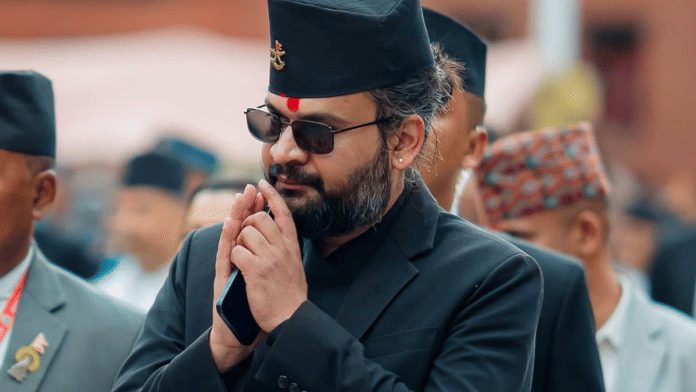
Finally, the official announcement is here. Nepal’s Prime Minister, Balendra Shah, alias Balen, is scheduled to be in Delhi for a two-day visit from 22 October, giving observers of India-Nepal ties some respite from reading between the lines about why the visit was delayed.
Undoubtedly, Prime Minister Balen Shah’s visit has already become one of the most closely watched events in the seven-decade history of India-Nepal ties. Why? For one, this is the first trip by Prime Minister Balen since he took office in March 2026. Second, he has finally broken the popular belief that he may not undertake a foreign visit in his first year and would focus on domestic affairs, given the aftermath of the Gen Z Movement. And third, Delhi has managed to keep Kathmandu in its sphere of influence, despite Beijing’s attempts to host Balen first.
As the two Prime Ministers meet in Delhi and hold talks on a range of bilateral issues, they are expected to release a much-awaited joint statement outlining the future of India-Nepal ties, alongside a reported 10-point plan titled ‘Samriddha Nepal, Samunnat Bharat’ (Prosperous Nepal, Developed India).
But what issues must be resolved, beyond political lines?
Political signalling and normalisation of state visits
One cannot help but wonder: when was the last time a state visit from a neighbouring country, including Nepal, was treated by observers for its value rather than through the lens of geopolitical rivalry? Perhaps Nepal’s political instability has been so acute that observers in Delhi have had to be wary of a new leadership tilting towards Beijing. However, this may be the time for a reset, grounded in caution and pragmatism.
With Prime Minister Balen Shah landing in India, the priority should be to set aside the temptation to revisit a loaded history and focus more on the future.
Some may argue against this in Kathmandu, especially if one dares to suggest moving beyond the long-pending issue of releasing the report of the Eminent Persons Group (EPG), formed in 2016 – something that the two governments appointed, but never released.
What the report contains is largely unknown outside those who wrote it. However, it is widely assumed to favour Nepal’s position over India’s.
Then there is the Pancheshwar Multipurpose Project, agreed upon in the 1990s but still stalled; the issue of demonetised Indian currency held in Nepali households since 2016; recruitment of Gorkha soldiers under the Agniveer programme; and the climate crisis.
Who is to be blamed for the climate crisis, and will India and China take responsibility as two of the world’s largest carbon emitters? And, of course, there is the unresolved border dispute.
The history of India-Nepal ties, and the issues embedded in it, is long and complicated. But crossing this historical Rubicon is necessary. Policymakers and officials on both sides know that one visit by Prime Minister Balen Shah will not resolve everything, nor will it guarantee Nepal’s tilt towards India.
What, then, could potentially change the course of ties? Perhaps it is time to move away from the cycle of diplomatic formalities and normalise more frequent exchanges. Instead of one visit annually, leaders could travel to Delhi or Kathmandu as and when needed to take stock of bilateral affairs.
Very interestingly, an open border and a no-visa regime help people across the border keep ties intact. But the same open border can often blur political boundaries.
The cardinal point here is that neighbours need not wait for an auspicious date to meet. Rather, they could consider a 1.5-hour-long flight to resolve issues. This may sound too literal, as diplomacy is not just about distance; it is also about messaging.
Also read: Climate change has a cost. Balen Shah’s UNGA speech shows Nepal wants the world to pay
Change is here, but it must last
In the past seven decades of India-Nepal relations, successive leaders on both sides have tried to bring in change and introduced policies and plans. But a few of these initiatives lasted.
However, there has been a change in Delhi and in Kathmandu.
The newly appointed Nepali Ambassador to India submitted his credentials within a week of his arrival in Delhi. Similarly, India’s newly appointed Ambassador to Nepal had an early audience with the Nepali President, submitted his credentials, and met the Prime Minister — all within a month of his arrival in Kathmandu.
The other change that must last even longer is engaging with the future generation. After seven decades, people-to-people ties continue to carry the weight of the past. But strengthening present-day connections could give them greater longevity. When the key constituents of people-to-people ties have changed, should this not be reflected in bilateral ties?
The Gen Z movement in Nepal made one thing clear: its participants did not want to carry the baggage of history, whether in the form of traditional, ageing leadership or conventional diplomacy. They wanted to debate the future.
Looking towards that future, there isn’t much difference in the median age of the two countries. Recognising this shared generational reality could mean stronger data connectivity and collaboration on shared digital futures.
A shared future would also mean more joint data centres, technological collaboration, and ventures to establish world-class educational hubs, with their doors open to students from both sides of the border.
To conclude, Prime Minister Balen Shah’s India visit is an opportunity for the two countries to restore normalcy, which makes conflict resolution quicker, so energy is channeled into river management and data sharing.
Issues concerning national security must also be discussed continuously, rather than episodically, whether they relate to air connectivity or the border.
Rishi Gupta is a commentator on global strategic affairs. The opinions expressed in this article are those of the author alone and do not reflect the views of the author’s current or past affiliations in any form.
(Edited by Maryam Hassan)