




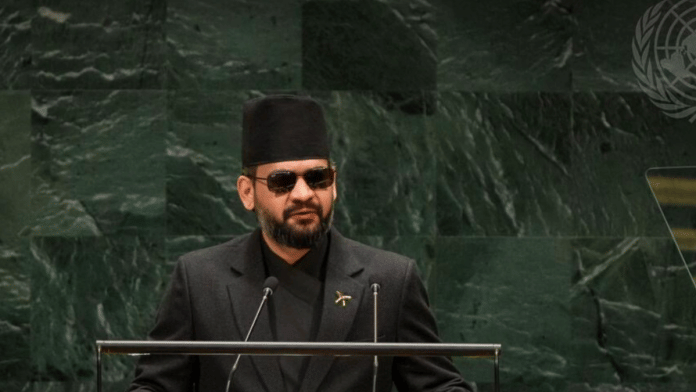

Balendra Shah, popularly known as Balen, Nepal’s youngest-elected Prime Minister, delivered perhaps one of the most powerful speeches at the United Nations General Assembly in New York on 24 September.
With fewer gestures and procedural acknowledgements, Balen spoke of “death and destruction of a young nation…and about families waiting for loved ones who will never come home”, referring to recent flash floods in Nepal.
If parallels were to be drawn, the message was as powerful as King Mahendra Bikram Shah’s at the UNGA. In 1967, the Nepalese king spoke of challenges faced by landlocked, small, and developing countries, and strongly advocated non-alignment and peaceful coexistence.
King Mahendra presented an era of a party-less panchayat system and a strong monarchy in Nepal. At the UNGA, the Himalayan nation sought a neutral space in the aftermath of the 1962 war between its two neighbours—India and China.
Fifty-nine years later, the democratically elected prime minister took the podium at the same multilateral forum, where he spoke of the “Himalayan tsunami” that resulted in “1,400 deaths and 6,000 missing”.
Making a courageous case beyond an appeal, Balen said: “The Bhote Koshi-Trishuli disaster was not just a local tragedy; it was a warning to the world. And I ask you today: have we really heard that warning?”
Presenting a case beyond appeal
It is unclear how many delegates were present in the hall to hear Balen’s UN debut. He was the 17th speaker of the afternoon session and the 106th speaker since the proceedings began on 22 September. From the live telecast, the hall looked relatively sparsely attended.
What is clearer, however, is that Balen’s speech has drawn attention beyond the hall for both its substance and its wider political resonance. But the larger issue is who answers his questions. Is it the biggest emitters of greenhouse gases, top economies, industrial nations, or multilateral and regional forums, or the global community, forced to switch screens from Nepal to the crisis in Europe and West Asia?
Representing Nepal, nestled between the world’s number one and third-biggest greenhouse gas emitters, China and India, Balen warned about climate change affecting the “rooftop of the world”, while also referring to India and China in the most modest yet impactful ways.
Balen made note to acknowledge its neighbours, India and China’s continued efforts in Nepal to trace the missing and help the country get back on its feet after the disaster on 26 August. At the same time, emphasising the need to “establish a Himalayan Climate Resilience Mechanism, led by Nepal, India and China” was a diplomatic masterstroke that is rarely seen from Kathmandu at such forums.
The proposed mechanism is aimed at sharing “satellite data and expertise… monitoring dangerous glacial lakes…strengthening joint early-warning systems” with an appeal to “coordinate assistance across borders.”
The follow-up question remains: who funds such initiatives? Especially when countries like India are making a case for themselves as both emerging global powers and developing countries still entitled to substantial climate finance under the principle of common but differentiated responsibilities.
However, there have been reports alleging that China has not shared data and early warnings, which Beijing has debunked as false. Both media narratives are making headlines.
Meanwhile, an endless debate continues over who should take responsibility for greenhouse gas emissions, as all-powerful nations defend themselves. What matters is that Nepal has long wanted to be heard, and PM Balen’s address at the UNGA did just that.
Nepal contributes less than 0.1 per cent of global greenhouse-gas emissions, and if Balen is to be quoted, “We (Nepal) did not create this crisis. Yet we are paying a colossal price for it.”
But for a country landlocked between two giant Asian economies and the world’s most powerful militaries, being heard could be challenging.
Also Read: Walkouts, threats, memes—why the UNGA now feels more like theatre than diplomacy
The ‘pay up’ movement on social media
Since the devastating floods earlier, the “pay up” movement, primarily led by Gen Z, has been trending on social media in Nepal. After the 36-year-old world leader’s speech, that movement has been given a new face. In a blazing video, one Nepalese youth took a sly dig.
“PAY UP. We don’t need your sympathy videos. We need accountability. You industrialised. You profited. You polluted. Now pay the bill,” the video said.
Interestingly, a New York Times report titled “Nepal’s Gen Z Is Taking on the World’s Polluters Over Climate Disasters” details how many in the country are seeking reparations as it bears the brunt of collapsing Himalayan glaciers, as well as what Balen avoided asking at the UNGA.
While Balen referred to India and China multiple times in his speech: first to appreciate help that has come and is on the way. Second, on common misfortunes related to climate change; and third, when he proposes a Himalayan Climate Resilience Mechanism, led by Nepal, India and China.
What Shah has done is an implicit indication without naming a country, suggesting, “Climate Justice cannot just remain a beautiful phrase in a United Nations document.”
The young leader recognised that what the world needs is an action-oriented approach framework involving “distributive justice” and “procedural justice”, where the former questions “who bears the costs” and the latter is about “who has a voice.”
Additionally, Balen requested grant-based support, the loss and damage fund and the global environment facility without making it a lengthy process and suggested, “When the house is burning, we do not ask the family to complete fifty forms. We act. That is what climate justice must mean.”
The PM asked the global community to address climate change not on an ad hoc basis but as a shared urgency to create “a culture of preparedness.”
As extraordinary situations require equally extraordinary efforts, Balen’s remains a prominent one.
After inheriting a country in turmoil, Balen has witnessed one of the worst climate disasters the country has ever faced, and he represented it accordingly, raising important questions that must be answered.
At a time when multilateral forums are being debated for reform in the current global context, and UNGA has become an annual affair with fewer top leaders and more representatives, countries like Nepal have reintroduced the need for such forums to be effective.
Rishi Gupta is a commentator on global strategic affairs. The opinions expressed in this article are those of the author alone and do not reflect the views of the author’s current or past affiliations in any form.
(Edited by Insha Jalil Waziri)
If Nepal wants international financial mechanisms for climate adaptation, bilateral relations need a reality check too.
India has maintained an open border and tax-free transit for decades under the 1950 treaty. It is time India ends free border crossings, implements a regulated visa regime, and levies standard transit and work permit fees on Nepali citizens in India.
A dedicated percentage of those revenues can then be earmarked directly for regional “Himalayan climate resiliency funds” .
It won’t. 2. Sad with sadness and realism.