




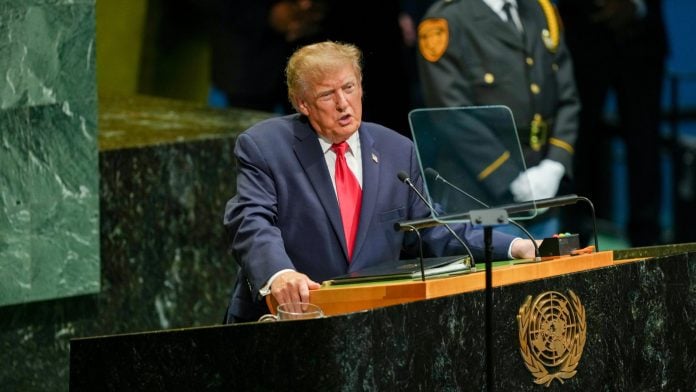

The United Nations General Assembly is beginning to look less like a diplomatic forum and more like a political sitcom. Countries sideline its conventions, diplomats debate whether the institution is dead, and heads of state deliver impassioned speeches defending their actions. Amid the decline of diplomacy, the UNGA has no shortage of drama. The latest session offered plenty.
As Israeli Prime Minister Benjamin Netanyahu approached the podium at the United Nations on Thursday, more than 100 UN delegates rose from their seats and walked out of the General Assembly chamber—for the second year in a row. He called them ‘moral cowards’. Later, New York mayor Zohran Mamdani, American-Turkish political commentator Hasan Piker and Israel’s use of pagers to bomb Lebanon found a mention in his speech. There were more jeers than cheers. More ironic still, some delegates, including Pakistan, reportedly walked out but then stood at the sidelines listening to his speech.
On social media, Iran labelled him the ‘Dark Lord’ lecturing the world on morality. Its Ghana embassy’s X account likened him to ‘Voldemort’ and Israel’s allies that walked out mid-speech as the ‘Death Eaters’. A journalist humorously posted on X: the UNGA just got millennial.
The drama around Netanyahu’s speech was perhaps the most conspicuous moment of a week built around speeches as much as it was a reminder of how little agreement there is among the countries gathered here.
The 81st session of the General Assembly opened this week under the theme “Restoring trust, managing transformation: a United Nations that delivers for all.” The phrase has an almost melancholy resonance at a moment when the institution is struggling to demonstrate precisely that: that it can still deliver anything at all.
The wars in Gaza, Ukraine and Iran have exposed the fractures in the international system. The Security Council remains restricted by the competing interests and vetoes of its most powerful members. The General Assembly can pass resolutions, but they are not binding. And the secretary-general, António Guterres, is preparing to leave office at the end of the year.
For all the drama surrounding the UNGA debate, it is predictably ThePrint Newsmaker of the Week.
Less diplomacy, more drama
The General Assembly has produced its share of memorable performances. In 2006, George Bush spoke against the backdrop of the Iraq war and growing concerns about Iran’s nuclear programme. The following day, Hugo Chávez, then Venezuela’s president, took the podium and declared that he could still smell the sulphur left behind by the “devil” who had spoken there the day before.
Three years later, Muammar Gaddafi arrived for his first and only General Assembly address and spoke for roughly an hour and a half, far beyond the customary 15-minute limit. The interpreter eventually struggled to keep pace.
Gaddafi, with a brown robe and a large black map of Africa on his chest, used the speech to attack what he viewed as the inequalities of the international system.
The personalities have changed. The dynamic clearly has not. Trump dominated headlines the day he spoke. He threatened Iran with “annihilation” if it failed to reach a deal with Washington.
He also invoked the phrase “to the victor go the spoils” while discussing Venezuela, whose leader he kidnapped in January. The rhetoric stood in absolute contrast to the institution’s founding purpose. The United Nations was created in 1945 after two world wars, with the aim of establishing a system in which international disputes could be managed through collective rules rather than military power alone.
But the world represented inside the General Assembly is increasingly one in which those rules collide with the interests of powerful states.
Also read: Why the Trump-Xi summit just produced a truce, not a breakthrough
Is the UN dead?
The United States was instrumental in creating the United Nations. Yet in the Trump era, the relationship between Washington and the institution has become increasingly fraught. Trump’s first appearance at the UN in 2.0 saw complaints about a stalled escalator and problems with the teleprompter.
Instead of asking what the UN can do, the discourse now increasingly veers towards: Is the UN dead? In a 2026 speech, Mark Malloch-Brown, a former senior United Nations official, said the organisation is “walking dead”, arguing that powerful nations frequently sideline it and act without regard for its authority.
Then there is South Asia. Nepal’s maverick Prime Minister Balendra Shah used his speech to describe the devastation caused by the Bhotekoshi–Trishuli disaster and connect it to the vulnerability of the Himalayan region. “We have built a world with flawless logistics for war and broken logistics for food,” said the rapper-turned-PM who is yet to hold a press conference or speak in Parliament back home.
Bangladesh’s Tarique Rahman, speaking in Bangla, said his country had been freed from what he called “fascist rule” in 2024 and was pursuing a three-part strategy of “Recovery, Restoration and Reconstruction.”
Amid all of this, the UN now resembles the MUN simulations it created. All talk and no show.
The institution remains the world’s most visible gathering place for discussing war, displacement, climate change, poverty and human rights. Yet the larger the crisis, the more apparent its structural limitations have become.
The result is a kind of diplomatic vertigo: everyone is talking, everyone is watching, and the institution itself appears increasingly unable to make the most consequential actors agree.
(Edited by Aamaan Alam Khan)