






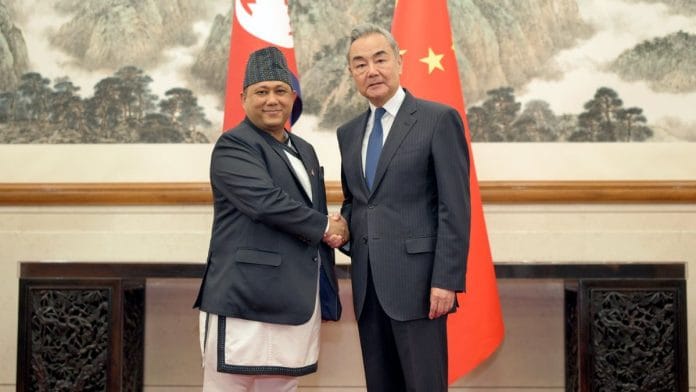


Nepal’s Foreign Minister, Shishir Khanal, paid a four-day visit to China from 14–17 June, marking the highest-level Nepali visit to China since the formation of the new government under the leadership of Prime Minister Balendra Shah. His agenda included meetings with his Chinese counterpart, Wang Yi, and with Wang Huning, Chairman of the National Committee of the Chinese People’s Political Consultative Conference.
While Nepal’s ties with China have historically been shaped by religious and cultural links through Tibet, the economic relationship has become increasingly important. The bilateral trade between the two countries stood at $ 2.16 billion in 2024, with Nepal’s exports to China at a very meagre $10 million, resulting in a trade deficit of $2 billion. Beijing’s highest-value exports include electrical and electronic equipment. China has also promoted people-to-people connectivity, with Chinese tourist arrivals rising steadily in recent years.
In Nepal’s foreign policy calculus, China is seen as a valuable development partner. Governments over the past decade have tried to frame ties with Beijing as an independent bilateral relationship rather than as leverage against India, but with limited success.
For instance, the Communist regimes in Nepal, especially under the leadership of former Prime Minister KP Sharma Oli, made the China card a prominent driver of Nepal’s regional foreign policy. Political instability and short-term policymaking often turned ties with China into a vehicle for nationalist politics. Under Prime Minister Balendra Shah, that approach may be changing.
In its first 100 days in office, the Rastriya Swatantra Party (RSP)-led government under the leadership of Balen Shah has guided Nepal’s foreign policy with planning, patience, partnership, and progress. Recent engagements between India and Nepal exhibit all of these. Kathmandu would like to bring the same energy with China.
Also read: Rabi Lamichhane’s high-profile Delhi visit shows Nepal’s two-layer India policy
A planned visit
For many in Nepal, Foreign Minister Khanal’s visit to China is a product of meticulous planning—something the past government always struggled with. Previous Prime Ministers often made hasty visits to either China or India, indicating what was a priority for a landlocked country. This time, however, it is the RSP leadership and the foreign minister who have laid the ground for major diplomatic exchanges with the two neighbours, before the Prime Minister makes his first foreign visit.
Just before landing in Beijing, Khanal also made his first visit to India on 5 June. He met his Indian counterpart, S Jaishankar. It was a follow-up to RSP Chairman Rabi Lamichhane’s week-long visit to Delhi. Lamichhane held meetings with Prime Minister Modi, National Security Advisor Ajit Doval, and Foreign Minister Jaishankar. While balance is key for a landlocked country in planning and executing its foreign policy, a visit to India was a major opportunity for Minister Khanal and RSP Chairman Lamichhane.
Nepal wants to deepen economic integration and upgrade its relationship with India. A development partnership with Delhi is fundamental to the new youth-led government’s domestic and foreign policies. As Lamichhane wrote in his op-ed in the Hindustan Times, “Nepal is not heading towards an uncertain future; it is embracing a strikingly aspirational vision”.
Therefore, Khanal’s visits—first to Delhi and now to Beijing—convey a vision of partnership, away from the notion that Nepal is being used as a ground for influence between India and China.
The former Prime Minister of Nepal, Baburam Bhattarai, commented on Khanal’s China visit. “I would like to add that Nepal-China relations have remained the most stable, predictable and friendly relations in history, despite changes in political systems and personalities on both sides (sic),” he said.
In a separate post, Bhattarai welcomed the visit, describing it as an opportunity to strengthen long-standing Nepal-China ties.
Clearly, the visit is being closely watched by those in Nepal.
Also read: Nepal backtracks on mango ban. India says exports to continue
Reconfiguring Nepal-China ties
It is no secret that Nepal’s geostrategic location is a key consideration in India’s and China’s Nepal policy, but Nepal’s self-perception today must also be taken into account.
Ahead of the visit, Nepal’s Ministry of Foreign Affairs noted that Khanal’s visit was aimed at discussing “matters of mutual interests for further strengthening Nepal-China relations for advancing deeper cooperation.”
Khanal, in his high-level meeting with Chinese Foreign Minister Wang Yi, discussed economic partnership, investments, infrastructure development, and people-to-people exchanges. While the Chinese press release on the meeting does not mention the trade deficit, the Nepalese side noted trade talks within a broader gamut of discussions with Wang Yi.
One of the key challenges of Nepal’s China policy is the lack of continuity and execution, largely due to Kathmandu’s political instability. Since the RSP-led government has promised greater policy continuity, China would like to see projects such as the Belt and Road Initiative move forward. It has been stuck since its signing in May 2017.
During Chinese President Xi Jinping’s 2019 visit to Nepal, Beijing laid out a comprehensive plan for cooperation with Kathmandu, prioritising BRI and its associated projects.
In the 2019 joint statement, the two sides noted, “China and Nepal take the Belt and Road Initiative as an opportunity to deepen mutually-beneficial cooperation in all fields in a comprehensive manner, jointly pursue common prosperity and dedicate themselves to maintaining peace, stability and development in the region.”
While Kathmandu is likely to assess the BRI through the lens of economic viability, Beijing continues to view it as a strategic initiative.
For instance, the most ambitious projects proposed under the BRI framework, the “trans-Himalayan Multi-Dimensional Connectivity Network”, lays down road and rail infrastructure between Nepal and China. This network of connectivity certainly brings the Chinese closer to the subcontinent.
Wang Yi has once again reiterated during his meeting with Khanal that the Chinese position that “China is willing to build the ‘Belt and Road’ with Nepal with high quality, focusing on cooperation in power grids, highways, ports, aviation, etc., and helping Nepal change from a ‘land-locked country’ to a ‘landlocked-linked’ country.”
China would want Nepal to move forward with BRI and its linked projects.
It should also be noted that when Nepal signed the MoU on BRI, Beijing treated it as a diplomatic and strategic victory over India’s long-standing influence in Nepal, especially as Delhi had refused to join the Belt and Road Forum saying, “No country can accept a project that ignores its core concerns on sovereignty and territorial integrity.”
Security remains China’s priority
China wants security guarantees from Nepal, linked to Tibet and the One China principle, mainly because Nepal shares a long, though mountainous, border with Tibet.
Kathmandu’s assurances are important to Beijing’s security interests.
Nepal is home to a large population of Tibetan exiles. The CIA reportedly armed and trained the Khampa Rebels in Nepal to take on the Communist rule in Tibet, from the 1950s to 1970s. Despite China’s tight security umbrella in Tibet, the friction and rebellions within Tibet and those influenced by third parties through the Himalayan borders continue to concern Beijing.
The element of mutual respect for security was affirmed in the Sino-Nepalese 1960 Treaty of Peace and Friendship, when the two sides vouched for “the Five Principles of peaceful co-existence.”
It’s no wonder then that during Minister Khanal’s visit, China has again sought Nepal’s reassurance that Kathmandu “never allows any force to use Nepal’s territory to harm China’s interests,” and that “China’s development is an opportunity for Nepal.” While China’s fundamentals on Tibet have not changed in Nepal’s context, Beijing has further expanded its security horizon by seeking assurances on Taiwan.
The Chinese Foreign Ministry said, “The Nepalese side unswervingly pursues the one-China policy, supports China’s complete reunification, and never allows any force to use Nepal’s territory to harm China’s interests.”
While Taiwan remains a key security priority for China, by making smaller countries in the Indian subcontinent and elsewhere speak in one voice with Beijing, it seeks to ensure that no meaningful diplomatic conversation or engagement with Taipei takes place. Thereby, it minimises Taiwan’s international space and reinforces the ‘One China’ principle as the set condition for regional diplomacy.
This was visible when, soon after arriving in Nepal to take office, Chinese Ambassador Zhang Maoming had reportedly conveyed Beijing’s objections to Taiwan-related activities in Nepal and raised concerns over ‘separatist’ activities by Tibetans on Nepali soil during a meeting with Nepal’s Home Minister, Sudan Gurung.
Also read: India’s ‘all or nothing’ policy with Nepal won’t work. Strengthen military ties for balance
Road ahead
Before Nepal’s new government releases a comprehensive plan of action or a long-term engagement with China, Kathmandu needs to carefully assess its interests, priorities, and the practical feasibility of proposed projects under BRI or otherwise. This would align with the current thinking in Nepal that initiatives such as the BRI are evaluated in light of Kathmandu’s national interests, economic priorities, and long-term financial security. While doing so, ensuring that no projects with China pose threats to anyone will help create a conducive regional atmosphere for engagement and cooperation.
At the same time, observers in Kathmandu suggest that for Nepal, priority must be given to whether such projects are sustainable, transparent, financially viable, and beneficial to its national development.
What the past government wanted in Nepal was to pursue ambitious agreements with China, but what they actually ended up doing was maintaining the status quo of inaction and using such agreements to fuel hypernationalism.
Rishi Gupta is a commentator on global strategic affairs. The opinions expressed in this article are those of the author alone and do not reflect the views of the author’s current or past affiliations in any form.
(Edited by Theres Sudeep)