






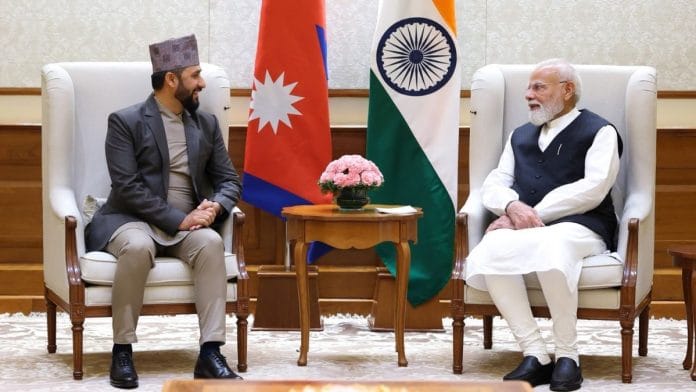


The visit to India by Rabi Lamichhane, chairman of Nepal’s largest ruling party, the Rastriya Swatantra Party (RSP), and former deputy prime minister, at the invitation of India’s ruling Bharatiya Janata Party (BJP), is significant on many fronts. Most importantly, it marks the highest-level engagement between New Delhi and Kathmandu since the new RSP-led government under the leadership of 35-year-old Prime Minister Balendra Shah.
The timing of the trip makes it even more crucial. Lamichhane’s hour-long meeting with Prime Minister Narendra Modi, who was joined by National Security Advisor of India Ajit Doval, Minister of External Affairs S. Jaishankar, and the Foreign Secretary Vikram Misri, reflects the criticality of India’s engagement with the next-door neighbour.
So far, India has been proactively engaging with the new government in Nepal, primarily because it is led by a new leadership, defeating the traditional old guard, which had maintained closer ties with India.
There was also a much-talked-about meeting between Nepal’s new foreign minister, Shishir Khanal, and Jaishankar, in Mauritius at the 9th Indian Ocean Conference. For many Nepal watchers, this was the most promising public-facing engagement between the two countries, since the formation of the new Balendra Shah-led government in Nepal.
However, the postponement of the Indian foreign secretary’s visit to Nepal reflected a cooling in bilateral ties. The trigger was Prime Minister Balen Shah’s government taking a serious objection to the resumption of the Kailash Mansarovar Yatra—a Hindu pilgrimage to Mount Kailash in Tibet, China—via Lipulekh, a territory Nepal continues to unilaterally claim as its own.
At a time when Balen Shah’s visit remains uncertain, what does Rabi Lamichhane’s high-profile visit to India mean?
Kathmandu was to be seen seriously
In an editorial penned by Rabi Lamichhane in an Indian daily, he provides a comprehensive vision of how the new dispensation plans to engage with India, and it’s less about pro-India or anti-India—something that traditional political parties failed to do away with, and more about striking a futuristic cooperation of growth.
He suggests connecting economies and not just borders, where Nepal benefits from India’s economic growth story, and wants India to share the stories of institution building, such as IIT and AIIMS, that could become the key to assuring a bright future for the youth. Lamichhane advocates making development diplomacy the cardinal feature of the bilateral ties, where cooperation in the areas of hydropower graduates to a great new height and is not held hostage to political differences.
Over the past 17 years, traditional political parties increasingly invoked the China card in Nepal, often annoying New Delhi. Former Prime Minister KP Sharma Oli, who was ousted by a Gen Z-led movement in September 2025, made no bones about his China-first policy.
But the new dispensation in Nepal, in Lamichhane’s view, is led by “non-partisan partisan professionals and political novices-achieving a new two-thirds parliamentary majority under four years and electing the world’s youngest Prime Minister.”
“Global curiosity regarding what is happening in Nepal and where the nation is heading is entirely natural. As close neighbours with a shared border of over 1000 miles, this curiosity is even more natural in India,” Lamichhane wrote.
Interestingly, sitting in Kathmandu, sipping some Chhang, a tipsy fermented beverage traditionally prepared by the Newari community, one could hear annoyance in the local chatter about the Indian media’s portrayal of Prime Minister Balendra Shah, primarily his stand on the territorial dispute. The so-called ‘Nepal experts’ sitting in Indian newsrooms possibly have the view that the two neighbours are at ‘war’ and that New Delhi needs to act tough. What Nepal’s new dispensation warrants from India is a change of perspective and a more sincere approach to the relationship. As a matter of fact, governments on both sides know that the differences are not a conflict and they are resolvable.
A two-layer India policy
In his social media posts, Rabi Lamichhane has been more engaging than his senior party colleague and Balen Shah, who has been calculated, sharp, and measured since taking office after a historic victory. Reposting Prime Minister Modi’s post on X (formerly Twitter), Lamichhane wrote, “I share your vision for a future where Nepal and India transcend past constraints to embrace a new era of development diplomacy.”
“By focusing on shared civilisational bonds, digital corridors, and seamless connectivity, we can truly build a partnership defined by progress and mutual trust. RSP looks forward to translating these possibilities into reality for the people of Nepal and India – for our shared prosperity.”
While Balen Shah presents a much tougher outlook for his government, his party’s leadership is taking a warmer, welcoming approach towards India. What Delhi, or to say, Nepal watchers need to understand is that no love is lost in Nepal toward India, and media room graphics do not do any justice to reality. As a benign counsel to folks in Delhi, the supporters of RSP in the alleys of Kathmandu say, “please do not hype a sovereign nation’s domestic, foreign and security affairs as if they are all framed against India, but a intendent affair of a country for its people.”
At the same time, Delhi needs to understand that RSP as a party and RSP-led government under the leadership of Balendra Shah is more organised and stable, as it has no compulsion of coalition like the past governments. It has young energy to be on top of its game and proactive in understanding what Nepal wants. Recently, Nepal’s Finance Minister Swarnim Wagle presented his first annual budget, which has been applauded by the public and leaders alike.
“Sitting in the village courtyard and listening to the erudite Finance Minister’s budget speech feels quite thrilling! The words and presentation are remarkably fresh and captivating!” former Prime Minister Baburam Bhattarai wrote in praise. “In terms of policy, it’s designed to particularly attract the tech-savvy new generation, the private sector, Nepalis living abroad, employees, and so on.”
While the new government has found appreciation so far, and pressed for reforms in the overall governance structure, its ‘India policy’ is ‘two-layer’, where the first layer is Balendra Shah-led protectionist stance, and his party engages with Delhi to convey that “The saga of Ram is complete only when Janakpur and Ayodhya are connected.”
Also read: India must stop watching and start reshaping the WTO’s future. Its interests are at stake
Way forward
From Lamichhane’s India visit and the vision he has put forward for India’s engagement, it’s more about prioritising development cooperation, where initiatives need to graduate more quickly than being held hostage to bilateral differences. Technological, medical and educational exchanges are given the key momentum in the future India-Nepal partnership. What New Delhi needs now is to help Nepal join the journey of advancement and development, and approach bilateral ties in a way that is futuristic and mutually beneficial.
Rishi Gupta is a Commentator on Global Strategic Affairs. Views are personal.
(Edited by Ratan Priya)