




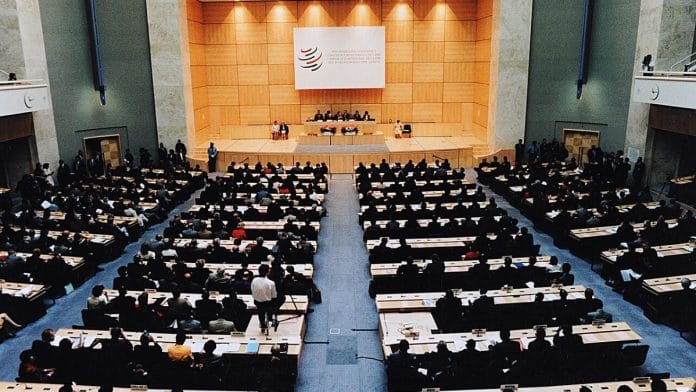

Since its inception in 1995, the World Trade Organization has been a beacon of a new global economic order: a rules-based system that promised predictability, inclusivity, and development opportunities for all nations. Today, that promise stands under strain, as the global trade landscape is fundamentally reshaped by geopolitics, digital disruption, and climate imperatives. India stands at a strategic juncture, ready to redefine its role in this evolving system.
The world that birthed the World Trade Organization (WTO) was one of optimism—a belief that multilateralism could harmonise global commerce. But three decades later, trade is no longer driven solely by tariffs or market access. Instead, it is shaped by strategic competition among great powers, supply-chain resilience, digital sovereignty, and climate imperatives.
The WTO now faces a 2020s reality. Supply chains that were once globalised now fracture into regional blocs. Digital economies defy borders, and climate change demands a rethinking of trade rules.
In short, the WTO no longer sets the stage alone. It is one actor in a far more complex choreography. If it is to survive, it must transform—become more adaptive, more inclusive, and more fit for purpose in an age of geopolitical flux.
India’s evolving trade posture
For India, this transformation is not a passive bystandership but a moment of recalibration. India’s stance toward plurilateralism, once seen as a threat to consensus-based multilateralism, now reflects a nuanced understanding. India has long been a defender of the multilateral system: a vocal proponent of Special and Differential Treatment (S&DT), consensus decision-making, and a broad policy space for development. Yet, India also recognises that global trade rules are being shaped outside the WTO through regional agreements, bilateral deals, and coalitions of the willing.
India’s careful balancing act acknowledges a stark reality: the future of trade governance will be a mosaic, not a monolith. In digital trade, for instance, India has a major stake in crafting global rules given its dominance in IT services. Similarly, India’s agricultural sector remains a vital national interest, and its defence of food security measures is both a moral imperative and a developmental necessity.
The WTO must evolve if it is to remain relevant. This is not just a technical or procedural task; it is a moral and strategic one. The old rulebook was built for a world of stable supply chains and predictable geopolitics. Today, global trade is a battleground for digital dominance, climate adaptation, and supply-chain resilience. Incrementalism, reflected by maintaining the status quo through minor tweaks, will not suffice. Without substantive reform, the WTO risks becoming a museum piece—a relic of a bygone era in a world that demands agility.
Reform must address three imperatives. First, it must restore a credible dispute settlement system. Without a functioning appellate body, the rule of law in trade is replaced by power politics; a danger for developing economies like India, where policy space is vital.
Second, reform must integrate new realities—digital trade rules, climate-linked measures, and supply-chain disruptions into the core governance framework. Third, reform must democratise power. The multilateral system cannot be just the province of rich economies or fast-track coalitions. Developing nations must have a seat at the table, shaping rules, not just adapting to them.
Also read: India’s FDI debate is missing a key factor that can unlock growth—judicial reform
India’s strategic dilemma
India today stands at a pivotal moment in the evolution of the global trading system. For much of the WTO’s history, India’s role has been that of a principled defender of multilateralism, consensus principle, and the development dimension embedded in the system. That role remains important. But in a rapidly fragmenting trade order, it is no longer sufficient.
The uncomfortable reality is that the centre of gravity in global trade rulemaking is shifting. Increasingly, rules are being negotiated outside the multilateral framework through regional trade agreements, bilateral compacts, and plurilateral initiatives among smaller groups of countries. Whether in digital trade, investment facilitation, or supply chain arrangements, the architecture of global commerce is being rewritten in forums where not all countries are present.
India’s long-standing scepticism of plurilateralism is rooted in legitimate concerns. Agreements negotiated among a subset of countries risk eroding the consensus principle and creating a system where rules are shaped by the most powerful, then multilateralised later. For developing economies, this raises a fundamental question of fairness: can a system still claim legitimacy if many of its members are rule-takers rather than rule-makers?
Yet, the strategic risk for India lies at the other extreme. Staying out of these emerging frameworks altogether may preserve policy space in the short term, but it risks ceding influence over the very rules that will govern India’s most dynamic sectors in the long term. In areas such as digital trade, where India is a global leader in IT services, absence from rule-making processes could translate into diminished competitiveness and reduced strategic leverage.
The choice before India, therefore, is not binary. It is a question of navigating between principle and power; retaining its long-standing commitments to equity and inclusivity, while recognising that influence increasingly flows from participation, not distance.
Also read: The Modi paradox in 2026. Complete political domination alongside worsening economic slide
India’s path forward
The answer, therefore, is neither rejection nor acquiescence. It is calibration.
India must adopt a dual-track strategy anchored in both principle and pragmatism. On one track, it must continue to defend the core tenets of the multilateral system, including non-discrimination, consensus-based decision-making, and S&DT. These are not abstract ideals; they are the institutional safeguards that ensure the system remains inclusive and development-oriented.
On the second track, India must engage, selectively but proactively, in plurilateral and emerging rule-making processes where its interests are directly at stake. This is particularly critical in the digital economy, where questions of data governance, cross-border flows, taxation, and platform regulation are rapidly defining the next generation of trade rules. India cannot afford to be a passive observer in these negotiations.
Equally important is coalition-building. India’s strength lies not only in its market size or growth trajectory, but in its credibility as a voice of the developing economies. By working with partners in Africa, ASEAN, and Latin America, India can help shape a more balanced negotiating dynamic, ensuring that new rules reflect development priorities rather than merely advanced economy preferences.
The opportunity before India is clear: to move beyond defensive postures and become an active architect of a reimagined trading system; one that is more adaptive to contemporary realities, more equitable in its outcomes, and more effective in its enforcement.
In a world where the old certainties of globalisation are giving way to fragmentation and contestation, India’s choices will matter, not just for its own economic trajectory, but for the future of the multilateral trading system itself.
Shishir Priyadarshi is President, Chintan Research Foundation. Views are personal.
(Edited by Saptak Datta)