






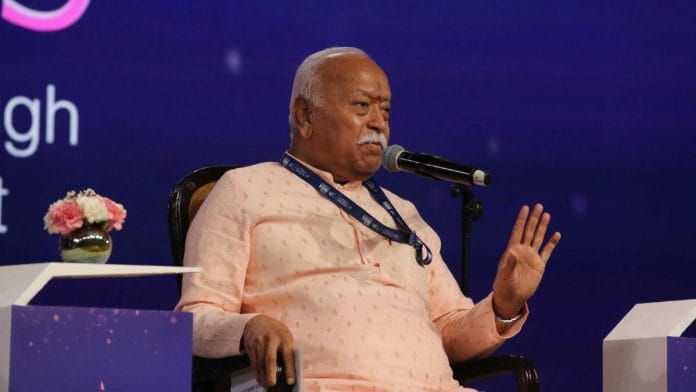


Mohan Bhagwat’s recent remarks on Gen Z and political leadership have once again put the spotlight on the Rashtriya Swayamsevak Sangh’s engagement with a changing India. Speaking at an event in Mumbai while addressing about 2,000 young people, the RSS Sarsanghchalak made it made it clear that young people who participate in agitations should not be branded anti-national. They are, he said, “our own people” and the next generation, and meaningful dialogue requires mutual respect and an understanding of their concerns.
At the same event, Bhagwat indirectly addressed the political leadership, outlining what he called the qualities of a true leader. Leadership, he said, was not about delivering speeches, winning elections or standing in front of people, but about working quietly, sharing success and nurturing future leaders.
This was not the first time Bhagwat had spoken about the need to engage with the Gen Z. In July, while speaking at an event close to Delhi’s Jantar Mantar protest site, he told parents that the biggest challenge before families was connecting with the younger generation through dialogue rather than authority. “Today’s youth need discussion, not dictation,” he said.
Such statements have naturally invited questions about whether the RSS under Bhagwat is becoming a different organisation. But there is an important distinction to be made. What is new in the RSS is not necessarily what it believes, but the way it is communicating those beliefs and engaging with a changing society.
RSS leadership kept the dialogue open
Given the proximity between its leadership and the apex leadership of the Bharatiya Janata Party (BJP), it is possible that such advice has also been offered several times in private meetings. But public interventions by the RSS leadership are not new.
Immediately after the Emergency, when several Opposition parties came together to form the Janata Party and defeated Indira Gandhi, the ban on the RSS was lifted unconditionally and lakhs of its swayamsevaks were released from jail. Then-Sarsanghchalak, Madhukar Dattatraya Deoras, cautioned the new government to “forget and forgive” Indira Gandhi and concentrate on constructive governance rather than exhibiting signs of vendetta. The government did not heed his advice. It resorted to witch-hunting, eventually handing Indira Gandhi the victim card that helped her return to power in less than two years.
Another Sarsanghchalak, K S Sudarshan, a votary of Swadeshi and “Make in India”, had suggested streamlining the education system and incorporating elements of Indianisation. Though the Atal Bihari Vajpayee government followed some of his advice, it was unable to effectively counter the allegations of “saffronisation” and consequently lost the narrative.
As far as outreach to the younger generation is concerned, the RSS can truly boast about its daily shakhas, which attract lakhs of young people, and point to its network of more than a hundred organisations working in almost every aspect of society, many of them engaged in voluntary work. Its present leadership has also repeatedly said that the RSS does not consider the vast majority of Muslims outsiders or minorities.
The organisation’s emphasis on dialogue between communities is not new either. Statements such as the idea that unity between Hindus and Muslims has always existed but needs to be rediscovered, or that Muslims and Christians should accept that all communities collectively constitute one culture, nation and society, reflect an approach that the RSS has articulated before.
The same applies to the organisation’s understanding of Hinduism. The RSS does not consider Hinduism merely a religion and views “Hindu” not simply as a noun but as an adjective, a way of life. This has been part of its core thinking since its formation in 1925.
So, what is new in the RSS under the present leadership?
Also read: Guru RSS is cautioning shishya Modi govt. Bhagwat’s endorsement of Gen Z has an Indira lesson
RSS’ approach towards a changing society
The “new” RSS is not new in its content, core principles or fundamental doctrines outlined by its founder, K B Hedgewar, and elaborated by his successor, M S Golwalkar. The newness lies in the propagation of its core ideology, its approach to contemporary issues, its vocabulary, its methods of outreach, the forums it uses and its adoption of modern communication technologies.
What has changed for the century-old organisation is the way it is engaging with the “New India”.
The agenda of samajik samarasata (social harmony) and the treatment of the family as a prime unit of social significance are not new to those who regularly participate in activities such as the shakha. What is changing is the effort to take these ideas beyond the shakha and into the larger society.
The RSS is now seeking to propagate social harmony, family awakening, environmental awareness, selfhood and self-reliance with cultural pride, and the performance of civic duties through its Panch Parivartan framework.
The century-old RSS will face new challenges. Its core action plan of transforming the nation through transformed individuals — Vyakti Nirman se Rashtra Nirman — continues to guide its work. The shakha will remain its only effective and time-tested action plan for this.
But the RSS is pragmatic enough to recognise that the complexities of the present require it to reach out to larger sections of society.
To that extent, and only to that extent, it is a new RSS.
Seshadri Chari is the former editor of ‘Organiser’. He tweets @seshadrichari. Views are personal.
(Edited by Prashant Dixit)
RSS has been scapegoated by Congress, to hide it’s failings for many decades.
It is standard trope by Congress, whenever they are being questioned for corruption, they make noise on RSS.
In 2014, people were no longer fooled by Congi rhetoric.
RSS has kept BJP in check by ensuring, they change their Presidents.
Congress has no checks and balances against one family capturing the party.
RSS will remain a third-rate organisation promoting puke-worthy socialism under the garb of self reliance.
Anti National. Not to be confused with Telegraph’s Aunty National. A word that is being flung around very loosely. Deeply hurtful. A very, very high bar should be cleared when it is brought into play.