



Each month, Bangladeshi expatriates working in Saudi Arabia, the Gulf, Malaysia, Britain and many other countries send a portion of their earnings back to Bangladesh. In the fiscal year ending June 2026, these remittances totalled $35.6 billion, the highest figure in the nation’s history and a 50 per cent increase from the $23.9 billion recorded two years earlier, according to Bangladesh Bank data.
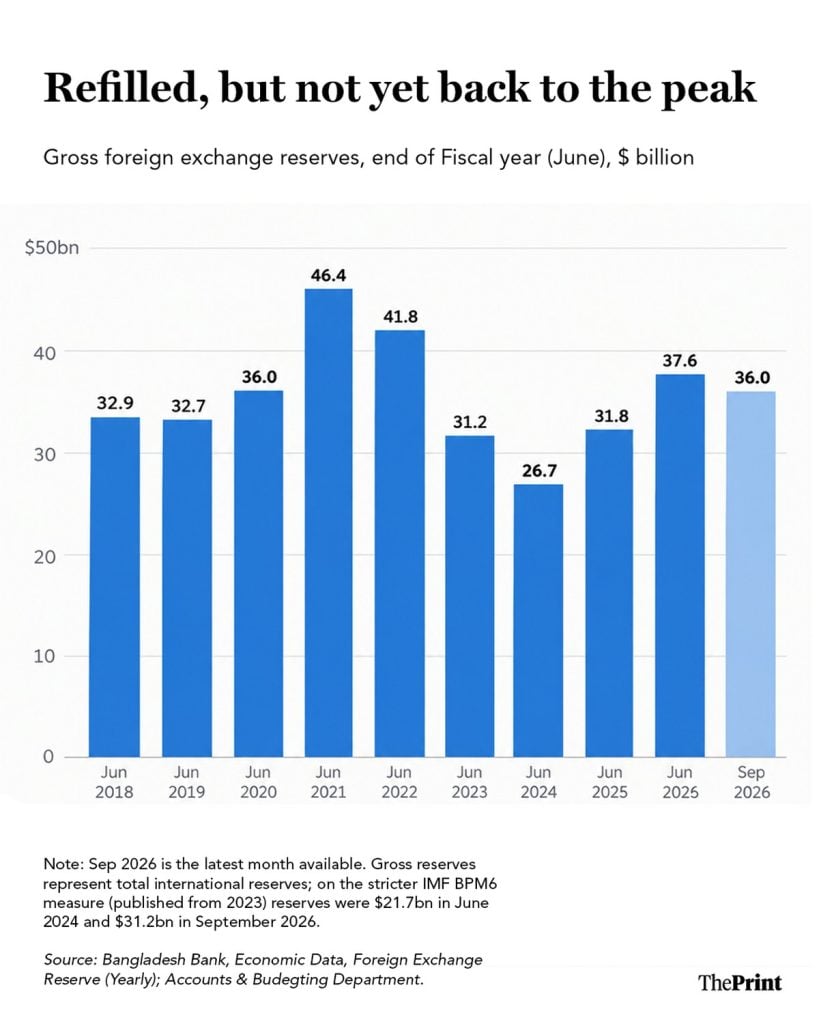
This influx of funds, accrued incrementally through individual work shifts, did much of the work of replenishing the country’s depleted reserves. Gross foreign exchange reserves, which had fallen to $26.7 billion in June 2024, rose to $37.6 billion in June 2026.
At last week’s annual meetings of the International Monetary Fund and World Bank in Bangkok, Bangladesh was back on the IMF’s agenda. It has reportedly requested a new loan package worth between $4.5 billion and $5 billion.
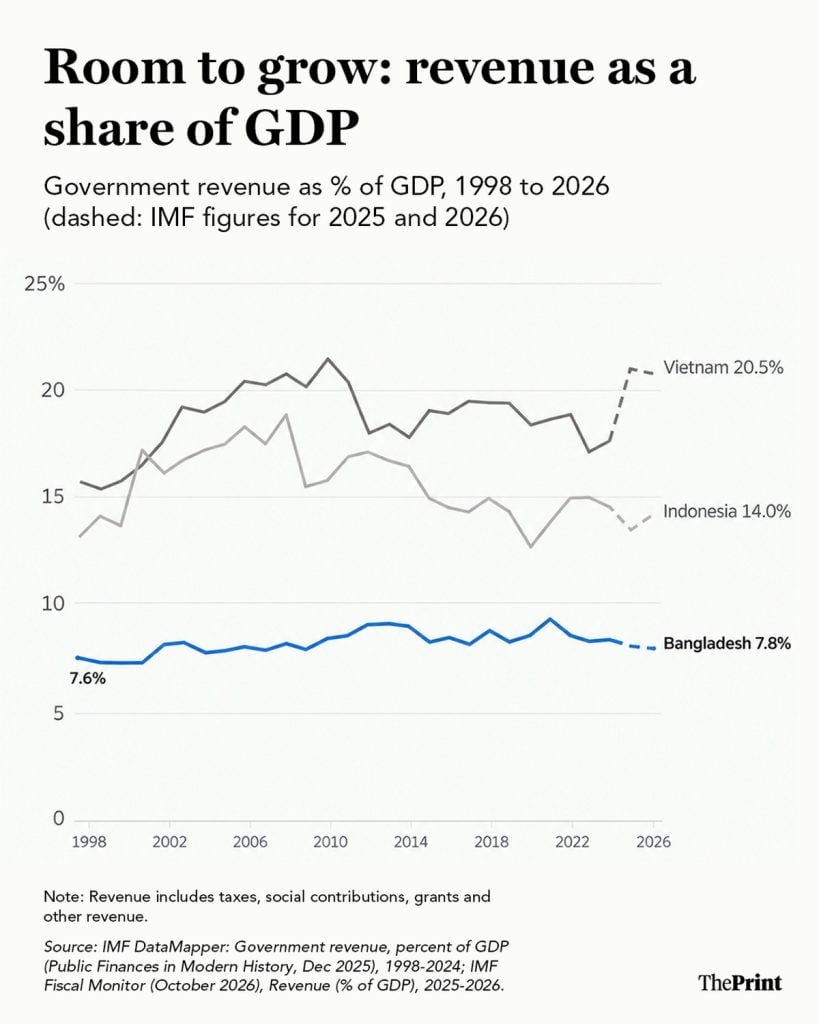
At a press briefing on 15 October, Sonali Jain-Chandra, the IMF’s Asia-Pacific deputy director, noted that Bangladesh’s revenue-to-GDP ratio is among the lowest in the world, at around 7 per cent, and that its financial sector is notably weak.
Although Bangladesh now has more substantial reserves than at any time in the past four years and is no longer experiencing a dollar shortage, the current requirement is to strengthen institutions. Specifically, it needs to establish a banking system that offers loans on sound terms and develop a revenue base broad enough to support its ambitions.
Also Read: What 3 RBI papers reveal about inflation and Indian households
A banking system coming clean
Significant portions of the remittances migrant families receive are deposited in Bangladeshi banks, which then extend these funds as loans. The Bangladesh Bank’s quarterly Banking Sector Update provides insights into subsequent developments.
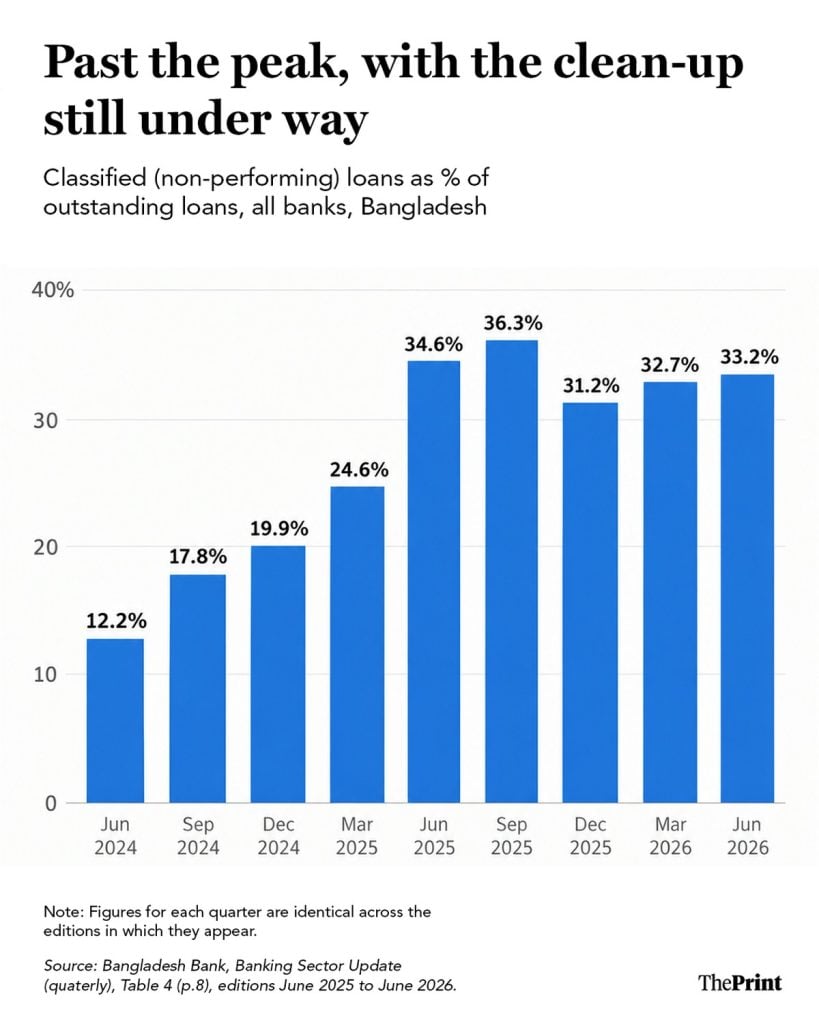
As of June 2024, 12.2 per cent of all outstanding loans were categorised as non-performing. By September 2025, this proportion had escalated to 36.3 per cent, and by June 2026, it remained at approximately one-third.
The increase largely indicates enhanced transparency rather than new deterioration.
This is due to asset-quality reviews conducted since 2024 and stricter loan-classification rules reportedly adopted in 2025, which have brought older problem loans into the records. Identifying a problem is the initial step towards its resolution, and in this regard, Bangladesh has made significant progress.
But this is just the first step. The Hungarian economist János Kornai elucidated decades ago why such problems persist. In his study of unprofitable factories in socialist Hungary during the late 1970s, he observed that these factories rarely closed, attributing this to what he termed the “soft budget constraint”. A borrower who must operate within financial limits acts prudently, whereas one assured of external rescue stops viewing repayment as an obligation and treats it as a negotiable matter.
Although loan rescheduling may be well-intentioned, it can lead to unintended consequences. Therefore, a primary objective of banking reform in Bangladesh should be to re-establish the expectation that borrowers will repay loans according to the agreed terms.
Building a broader revenue base
Kornai noted that fiscal softening can similarly occur through mechanisms such as tax exemptions, deferrals and negotiated concessions, which progressively reduce the revenue base.
IMF data shows that government revenue constituted 7.6 per cent of Bangladesh’s GDP in 1998. The IMF’s October 2026 Fiscal Monitor projects a slight increase to 7.8 per cent for the current year, despite a decade of economic growth ranging from 6 to 8 per cent annually. In comparison, Vietnam, a competitor of Bangladesh in the global garment market, is projected to collect 20.5 per cent.
Bangladesh’s rapid economic growth, despite its constrained fiscal base, presents a substantial opportunity. The country can improve its revenue generation by broadening its existing fiscal base rather than raising tax rates.
Making the constraint bind
If softness is the disease, the cure is to make each constraint hard again, and Kornai’s framework points to four places to start.
First, Bangladesh should stop rescheduling large defaulters’ loans and start resolving them. This necessitates instating a credible, rules-based bank resolution framework to restore banks to a sustainable state of health.
Second, insulate the governance of state-owned banks from political direction. The gap between their 43.2 per cent default rate and the 6.5 per cent rate of foreign banks operating in the same economy shows that the problem is incentives, not geography.
Third, revenue should be raised by withdrawing exemptions and negotiated concessions rather than by raising tax rates. Modernising tax administration would also widen the base while keeping the system fair.
Finally, the flexible exchange rate that has drawn remittances into formal channels should be protected, as the IMF itself has recommended.
Also Read: China’s growth trap—too much building, too little spending, weak firms that won’t die
What Bangkok can and cannot buy
The IMF has recognised a transformation in the nature of the issue. In June, it said the context had “changed substantially” since its 2023 programme, noting that banking weaknesses and low revenue require renewed reform efforts.
The programme had previously stalled due to reform challenges rather than financial concerns, with reports in April indicating that the Fund withheld a $1.3 billion tranche due to unmet benchmarks. The current conditions reported from Dhaka, including deadlines to address weak banks, meet revenue targets and reduce subsidies, aim to enforce constraints that have been lenient for decades.
The IMF’s projections illustrate the consequences of failure: economic growth is expected to slow to 3.5 per cent in 2026-27, with further declines below 3 per cent without decisive reform.
Kornai would have noted the irony that an IMF loan constitutes a rescue, and rescues inherently soften constraints. Migrant workers have already contributed to restoring the reserves. The new programme presents an opportunity for the country to establish institutions that will ensure the sustainability of this hard-won stability.
Bidisha Bhattacharya is ThePrint Consulting Editor (Economics) and an Associate Fellow, Chintan Research Foundation. She tweets @Bidishabh. Views are personal.
(Edited by Asavari Singh)