



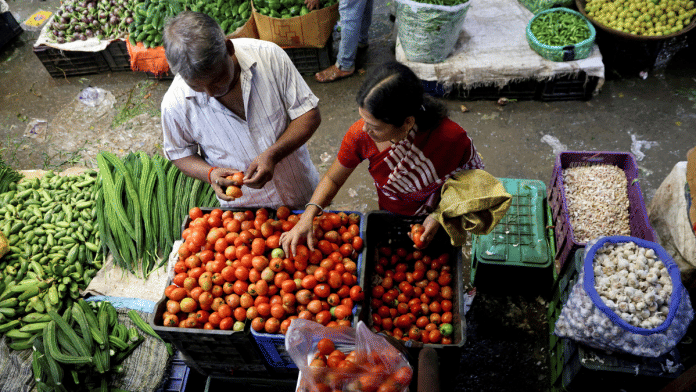
Ask anyone who runs an Indian kitchen how rapidly prices are rising, and they won’t say, “5.54 per cent”. They will say “10 per cent”, reflecting the immediate experience of buying onions, cooking oil, and refilling LPG cylinders. Historically, economists have regarded such responses as charming exaggerations. However, the Reserve Bank of India has considered them as valid data. Recent RBI working papers suggest this approach is justified, indicating that the most accurate inflation forecasts may come not from Mumbai trading rooms but from individuals cooking in Bhopal.
In September, the cost of a home-cooked vegetarian thali rose 10 per cent from the previous year. According to RBI data, by August, 37 per cent of items in the consumer basket were seeing price increases above 4 per cent. On 7 October, the Monetary Policy Committee raised the repo rate to 5.5 per cent, marking the first increase since February 2023. Five days later, the data for September corroborated the earlier assertions: retail inflation increased to 5.54 per cent from 4.83 per cent in August, food inflation rose to 7.74 per cent, and onion prices more than doubled compared to the previous year. The more pertinent question is not the RBI’s actions, but the information it considered before deciding.
A poor thermometer, a superb smoke alarm
Every two months, the RBI surveys approximately 6,000 urban households across 19 cities, inquiring about their perceptions of current and future price increases. According to standard economic theory, these responses are inaccurate because Indian households tend to overestimate inflation, a tendency observed globally. For instance, in Germany, when inflation was at 0.3 per cent, nearly half of the respondents in a survey believed it exceeded 5 per cent. Economists refer to this phenomenon as the “inflation perception conundrum”.
Despite this imprecision, households show a strong instinctual response, often clustering their answers around round numbers such as five, 10, or 15. Linguist Manfred Krifka argued that round numbers convey generalised meanings, and economist Carola Binder showed that such rounding signals uncertainty. When a household in Bhopal reports “10 per cent”, it is not providing a statistical measure but expressing a sense of unease. A 2024 RBI working paper by Purnima Shaw and RK Sinha revealed that these seemingly imprecise round-number responses contain more information about actual inflation than precise figures.
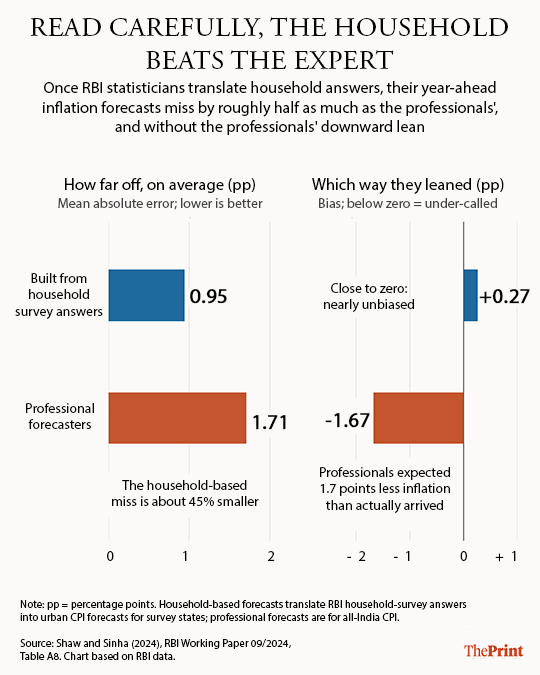
When household responses are carefully translated and aligned with official inflation data, this unease serves as an effective forecast. Between late 2020 and early 2024, forecasts derived from this method deviated from actual inflation by less than 1 per centage point on average, whereas professional forecasts had an average error of 1.7 points, often underestimating inflation.
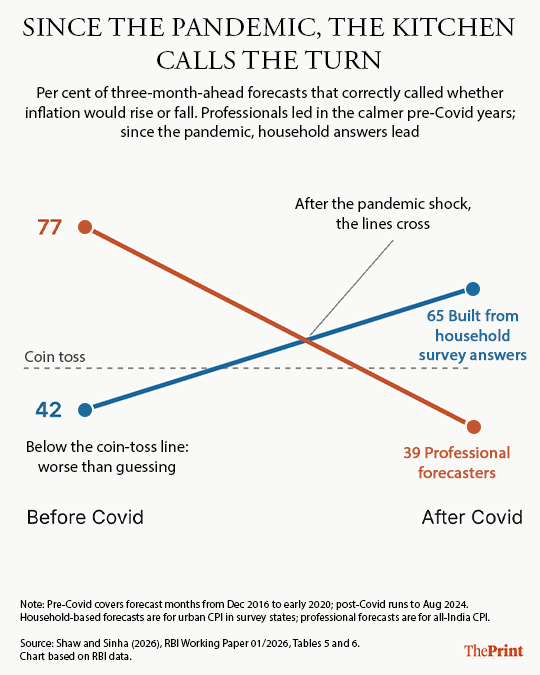
Since the onset of the Covid-19 pandemic, households have shown stronger predictive power for economic trends. Before the pandemic, professional forecasters were better at predicting inflationary movements. However, post-pandemic data indicate that households have surpassed professionals, accurately predicting inflationary trends about 65 per cent of the time, compared with 39 per cent accuracy from professionals.
When the price collectors went silent
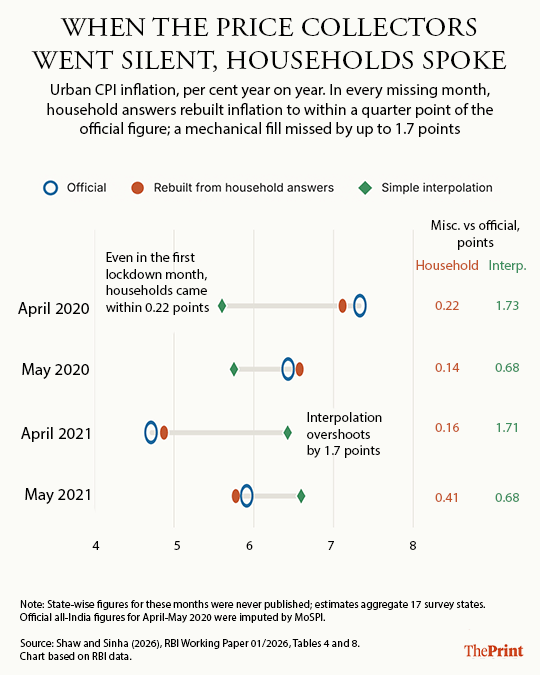
The most compelling evidence emerged during the lockdown’s most challenging months. In April and May 2020, shop closures left insufficient data to compile state-wise inflation figures, creating a gap that persisted for six years. However, the RBI’s household survey continued uninterrupted. In a working paper published last week, Shaw and Sinha used these telephone survey responses to reconstruct the missing months. Their estimates closely aligned with the official all-India series, differing by only about 0.2 percentage points. In an era marked by base-year revisions and data gaps, this household survey serves as a valuable backup for India’s price data, not merely a forecast.
Households perceive economic shifts due to a concept formalised by Phillip Cagan in 1956 during his study of hyperinflation, which Milton Friedman later incorporated into his consumption theory: adaptive expectations. Individuals form future expectations based on current expenditures. Ulrike Malmendier and Stefan Nagel subsequently demonstrated that individuals place significant emphasis on inflation they have personally experienced. In India, such experiences predominantly involve food and fuel. An RBI study from 2022 found that items with minimal weight in the official consumer basket, such as pulses or spices, can disproportionately influence household expectations because they feature prominently in daily consumption.
This is exactly why the RBI must not overlook the implications of household inflation expectations. A study indicates that when households anticipate higher inflation, they tend to reduce their investments in bank fixed deposits, as evidenced by the high-inflation period of 2012-13, during which funds shifted toward gold and property. Irving Fisher described this phenomenon nearly a century ago, noting that a saver’s real earnings depend on the interest rate minus expected inflation, rather than the inflation rate recorded by statistical offices. Current data show this financial cushion is shrinking. In August, new fixed deposits offered an interest rate of 5.67 per cent, while households surveyed in July anticipated a 9.4 per cent increase in prices over the following year. Consequently, in practical terms, fixed deposits are yielding negative returns.
Despite this, a significant shift in savings behaviour has not yet occurred. Term deposits increased from 55 to nearly 62 per cent of all bank deposits between March 2022 and March 2026. Additionally, the surge in gold ETF inflows in August is attributed more to geopolitical tensions in the Middle East and gold’s market rally than to concerned savers. However, conditions for a shift are emerging, with rising food prices as an initial factor that could reduce funds available for loans essential to factory construction and small-business financing. The RBI’s decision to increase the repo rate, which is expected to eventually raise deposit rates, aims to restore this financial cushion before household sentiment solidifies into a broader economic belief.
Also read: Neha Bora, Ratna Singh and a new summer of women’s discontent
Now the kitchen must read the RBI
For several decades, central bank communication has predominantly entailed interactions between the governor and the bond market. This discourse was theoretically framed by Michael Woodford, who, alongside Robert Hall, was awarded this year’s Nobel Prize in Economics. Woodford posited two decades ago that for a central bank, “not only do expectations about policy matter, but, at least under current conditions, very little else matters”. However, recent data from India suggest the need to expand this communication to a broader audience. Research by Olivier Coibion, Yuriy Gorodnichenko, and Michael Weber indicates that households are responsive to central bank communications when conveyed in accessible language. Furthermore, researchers at the RBI have advocated for direct communication with households.
Over the past 20 years, the RBI has developed an understanding of India’s household economic conditions. The current challenge is ensuring households can understand the RBI’s communications. The effectiveness of monetary policy is not determined at the moment of a repo rate adjustment on Mint Street. Instead, it is realised over time, when individuals anticipate stable prices, such as the cost of an LPG cylinder, based on previous experiences. Central bankers call these anchored expectations, while an Indian household sees it as peace of mind.
Bidisha Bhattacharya is ThePrint Consulting Editor (Economics) and an Associate Fellow, Chintan Research Foundation. She tweets @Bidishabh. Views are personal.
(Edited by Prasanna Bachchhav)