


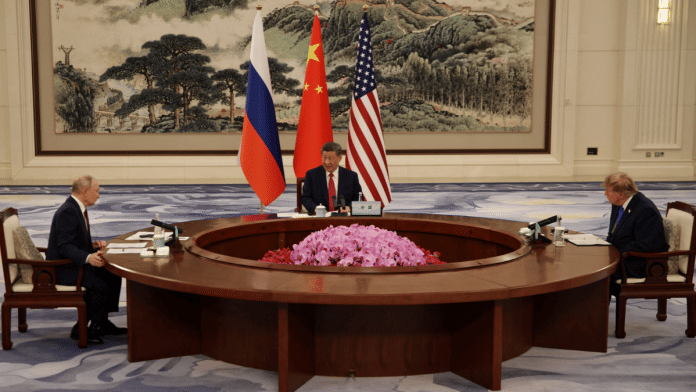
Summitry among nations, or more specifically, great-power summits has always been a mix of substance and optics; and the two have rarely corresponded neatly. Diplomatic history is replete with “stage-sharing” among powers whose capabilities, vulnerabilities and ambitions were anything but equal.
Shenzhen is the latest reminder: the so-called G3 concluded with a loosely worded peace declaration, offering little obligation to advance actual peace and end wars.
The gathering of Presidents Donald Trump, Xi Jinping and Vladimir Putin—leaders of three consequential nations—on the sidelines of the Asia-Pacific Economic Cooperation (APEC) summit gained more attention than the main event itself. It revived speculation about a G3, a new concert of great powers and, inevitably, three powerful men doing a Yalta 2.0 on the rest of us.
The outcome was a four-point Declaration toward Peace promising dialogue on nuclear risks, stable energy supplies, United Nations reform and respect for state consent and official immunities in international criminal jurisdiction. None was a binding agreement. Conspicuously absent were concrete arrangements on Ukraine or Iran, nuclear-arms reductions or a lasting G3 cooperation mechanism.
Discussions on nuclear arms control still provide plausible substantive justification for the trilateral engagement. New Strategic Arms Reduction Treaty (START) expired in February 2026, removing the last binding bilateral limits on American and Russian strategic nuclear arsenals.
Beijing, meanwhile, with its comparatively smaller but growing nuclear arsenal, has little incentive to accept numerical restrictions formalising its nuclear inferiority, all while Washington and Moscow remain concerned about its expansion.
The pledge to pursue nuclear-risk dialogue should be welcomed. But without targets, verification arrangements or a timetable, it can hardly be called an arms-control breakthrough.
Such mismatch between expectation and reality is revealing. It reflects not merely the difficulty of negotiating among competing powers, but the absence of a common vision of the international order they ostensibly seek to manage.
APEC is not G3
There is a distinction between APEC’s economic agenda and G3’s spectacle of great-power diplomacy.
Chaired by China this year, APEC’s 21 economies account for 61.6 per cent of world GDP. Amid tariffs, technological restrictions, industrial subsidies and geopolitical competition, Beijing projected itself as a champion of economic openness.
Shenzhen was an appropriate stage. Once associated with low-cost manufacturing, the city now embodies China’s extraordinary industrial and technological strength. China also pledged $20 million to support practical APEC cooperation and announced a Centre for Asia-Pacific Community Studies in the city. Xi further renewed calls for a Free Trade Area of the Asia-Pacific (FTAAP), alongside cooperation in artificial intelligence, digital trade, cross-border data flows, industrial supply chains and clean energy.
The FTAAP is hardly new. First advanced as a long-term aspiration in 2006, it has remained elusive despite the 2014 Beijing Roadmap.
APEC nevertheless adopted its Shenzhen Outlook as well as documents on trade, connectivity and innovation. These provide a basis for cooperation, if nothing pathbreaking. Yet, there is a paradox in championing economic integration when major economies are weaponising their interdependence.
Also Read: Quad’s China strategy has limits. India knows it cannot depend on the US
The optics of (Un)equality
Xi personally welcomed Trump at Shenzhen airport, an exceptional gesture that contrasted with Putin’s reception by Cai Qi, one of China’s senior-most political officials. In photographs, too, Trump and Xi were next to each other.
But diplomatic protocol is just one part. For Trump’s critics, the imagery reinforced the impression of an American president enamoured by personal diplomacy and easily seduced by even the most basic flattery. And yet, it also showed that Xi considered his American counterpart the only true peer.
Both interpretations have merit. Still, the underlying hierarchy is hard to dispute. China’s principal strategic reference point is America; the two compete across economic, military, technological and financial domains on a scale Russia cannot match.
The Trump-Xi bilateral was arguably the most consequential meeting. Following Xi’s September visit to Washington, both sides sought to sustain a “comprehensive strategic stability”—managing, not overcoming, structural G2 competition. The leaders will be meeting again at the Miami G20 on 14–15 December.
As expected, there was no breakthrough on the hardest trade and technology disputes. The US-China trade truce expires on 10 January 2027, 26 days after the Miami G20 concludes; meanwhile, disagreements over semiconductors, critical minerals, market access and Taiwan continue.
On the other hand, during the 18 November bilateral, Xi and Putin reaffirmed strategic partnership and multipolarity. Beijing remained restrained on Ukraine, and its official readout offered no settlement initiative.
By and large, the meeting showed diplomatic engagement, not reconciliation on the most pressing disputes.
Putin’s diplomatic victory—and its limits
For Putin, Shenzhen was already something of a victory even before the G3 trilateral began.
After nine years, he returned to an APEC leaders’ gathering and its family photograph. More importantly, he was welcomed alongside Trump and Xi without making any major corresponding concession on Ukraine.
Trump’s red-carpet welcome for Putin at their August 2025 Alaska summit was another conspicuous moment of US recognition.
Yet, how many photographs does it take to produce a strategic victory?
Nearly five years after Russia’s full-scale invasion, Ukraine remains an unfinished war. Moscow has demonstrated formidable doggedness and military adaptation, but has failed to achieve the decisive political outcome, remaining mired in an attritional and pyrrhic pursuit.
Russia’s central bank projects just 0.5–1 per cent growth in 2026, with inflation and borrowing costs elevated. Meanwhile, Moscow’s dependence on Chinese markets, industrial inputs and technology has deepened, creating a more asymmetric relationship than Putin would wish.
That said, there were at least four discernible calculations behind Moscow’s pursuit of a trilateral: restoring great-power status, securing American acquiescence in a favourable Ukrainian settlement, reducing dependence on China by engaging Washington, and reopening possibilities for Western investment, technology and sanctions relief.
Shenzhen delivered on the first, but little on the remaining three.
Ukraine was not mentioned in the declaration. There was no sanctions relief and no economic arrangement genuinely capable of reducing Russia’s dependence on Beijing either.
Russia’s nuclear arsenal, geography, resources and permanent UN Security Council seat make it impossible to disregard. The declaration’s language on international criminal jurisdiction is also politically significant for Putin, who faces an arrest warrant issued by the International Criminal Court. Yet, it offered no concrete UN reform programme or conflict-settlement framework.
Essentially, nuclear weapons and territorial conquests cannot substitute for the broader foundations of comprehensive national power.
Moreover, the G3 is no equilateral triangle. Its geometry hardly withstands reasonable scrutiny beyond nuclear arsenals, although aspirations to redraw spheres of influence deserve attention.
The ghost of Yalta
More revealing than G3’s aspiration for another Yalta is the ease with which many in the world embrace its possibility.
It tells us something about familiar strategic tropes. Every rising power invokes the Thucydides Trap. Every territorial concession threatens another Munich. Every great power confrontation summons versions of a new Cold War. And whenever three powerful leaders assemble, Yalta inevitably makes a comeback.
Historical memory is indispensable to geopolitical analysis. But familiar templates cannot substitute for explanation or capture the sheer complexity of today’s world.
Yalta in February 1945 was negotiated against the backdrop of an approaching Allied victory. Soviet armies had already established control over much of Eastern Europe. Whatever the moral and political consequences, the conference recognised an emerging distribution of power created by war.
Putin, by contrast, seeks diplomatic acceptance of outcomes Russia has not conclusively secured on the battlefield.
More fundamentally, Washington, Beijing and Moscow possess neither a shared vision of world order nor compatible interests across their principal theatres.
Trump seeks to preserve Trumpian advantages while renegotiating the costs of leadership. Xi wants recognition of China’s economic and strategic weight without inheriting the responsibilities and costs of American hegemony. Putin wants a privileged influence over European security and recognition of a military and nuclear power whose destructive capabilities far exceed Russia’s economic weight.
Their interests overlap selectively, but their ambitions do not constitute a common geopolitical or geoeconomic vision.
The summit’s modest outcome showed this limitation.
Also Read: Beijing is bringing Trump and Putin together. The Chinese say it’s a major diplomatic milestone
Trade, technology and troubled truces
The more consequential realities of Shenzhen lie beneath the declarations—in trade, technology and troubled truces.
Consider the fragility of the US–China trade truce.
According to a recent study by the Center for Strategic and International Studies, average monthly American imports of Chinese rare-earth compounds and metals during the eleven months following the October 2025 Busan agreement remained almost 75 per cent below normal.
The latest controversy surrounding Nvidia’s former CEO Jensen Huang and his affair with alleged Chinese’s spy, Alice Huang, provides another illustration. Allegations concerning overseas intermediaries and access to advanced American AI computing capabilities have exposed the difficulty of separating commercial technological networks from national security.
Nvidia, meanwhile, has stopped shipments of certain US-approved advanced AI processors to China, casting uncertainty over arrangements intended to reconcile American commercial interests with strategic restrictions.
Washington wants to retain its advanced-computing lead without strengthening a competitor. Beijing wants access to American technology while developing its own chips. China also wields leverage through critical-mineral processing, manufacturing and supply chains.
US chip restrictions press Chinese substitution; Chinese rare-earth controls spur diversification elsewhere; Western sanctions redirect Russia’s energy networks. Each effort to exploit dependence encourages others to reduce it, shifting production and critical supply chains.
This is the paradox of weaponised interdependence.
The networks that facilitate globalisation have become instruments of coercion. Yet, every attempt to exploit dependence also generates proportional incentives to escape it.
On 15 November, just before APEC, ten countries, including India, Japan, Australia and the US, signed the San Francisco Declaration under the existing Pax Silica initiative. It seeks to secure AI infrastructure, critical supply chains and sensitive technologies through trusted partnerships and working groups.
But don’t dismiss Shenzhen
Yet Shenzhen cannot be dismissed as theatre alone; the responses it provokes elsewhere are consequential.
The prospect of Washington, Beijing and Moscow negotiating others’ security without them unsettles allies.
Europe will scrutinise discussions on Ukraine; Japan and Indo-Pacific partners will watch for regional bargains. How the G3 Yalta moment juxtaposes initiatives such as the Quad, unless rendering it irrelevant, remains unsettled.
India, too, has its own reasons to pay attention.
There is a tension between the economic geography of the Asia-Pacific and the strategic geography of the Indo-Pacific. India remains outside APEC, even as it becomes increasingly consequential to Indo-Pacific security and technological partnerships such as Pax Silica.
India would welcome a better tempo in US-Russia relations, but neither an exclusive US-China understanding nor an imaginary G3 serves India’s strategic interests.
Anxiety about great-power bargaining may accelerate military modernisation, economic diversification and newer geometries of deterrence.
This makes Shenzhen potentially consequential without making it another Yalta.
The G3 spectacle reinforces perceptions that the US-led liberal order is dying. But eroding an existing order is not the same as constructing a credible alternative.
A great-power concert requires a shared political and institutional framework. Washington, Beijing and Moscow have none: their capabilities are too uneven, interests too incongruous and expectations of leadership too different.
A concert requires more than powerful men. It requires a common score.
Swasti Rao is a Consulting Editor (International and Strategic Affairs) at ThePrint. She tweets @swasrao. Views are personal.
(Edited by Insha Jalil Waziri)