




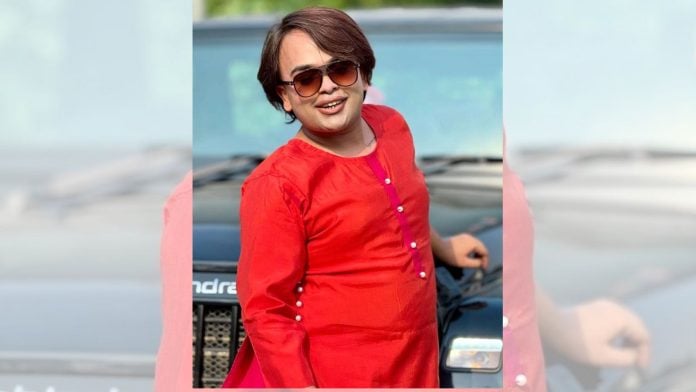

In India, the crime of being unapologetically yourself can become your death sentence.
It’s a struggle to understand who exactly was offended so grievously by Mad Sandhu, the LGBT make-up artist and influencer who was killed by two motorcycle-riding assailants on 3 October in Amritsar. In the last fortnight of his life, 30-year-old Sandhu’s Instagram feed is like the innocuous diary of any Tier-II-city entrepreneur: lip-sync clips, HydraFacial offers for Manelane, the unisex salon he ran in the city, and “GRWMAD” videos.
These offer a little glimpse into the life of the joyful young man. A few days ago, dressed in a flowy salwar-kameez, Mad Sandhu, whose real name was Madhusudan, posted a reel to “Gutt farhu koi daler gabru”, an invitation to a brave Punjabi lad to grab hold of his braid. In the video, liked by 23,000 people, he sashays around his Thar, a possession he was undoubtedly very proud of. When Sandhu had bought the car a few months ago, it had — somehow — immediately emasculated Punjab’s strapping young men. One had even called a Mahindra dealership to express his incredulity and said, “How could you sell it to him? I won’t call it a ‘man’ car anymore, it’s a gay car. Phitte moonh.”
The controversy seemed to have had little effect on Sandhu, whose last reels feature the car. In another video, he films a makeup check in the Thar, set to a Kulwinder Billa song with the lines, “Oh rakh haunsla, ve jatta rakh haunsla, fikran na kar mutiyaar diyan” — keep your courage, young man, don’t worry about your girl. A week later, Sandhu was shot at close range when he went to collect the Thar from a car wash on Loharka Road. He died on his way to Fortis Hospital.
The thekedaars of culture
Sandhu is the third influencer to have been murdered in the last 16 months in Punjab. In July this year, 28-year-old Manjeet Kaur, an influencer from Kharar, was assaulted and tied to a tree by her acquaintances, who then set her on fire. Kaur died of her injuries two months later in Chandigarh, her statement still unrecorded by the police.
In June 2025, Kanchan Kumari, who went by the moniker Kamal Kaur Bhabhi, was strangled to death allegedly by Amritpal Singh Mehron, a self-styled radical leader, who labelled himself a “Nihang” Sikh. Mehron had been threatening Kumari over her provocative content for a while, and after her death, had stated that he didn’t care about the consequences — before bravely fleeing to the UAE to escape arrest. Several prominent voices then — including singer Mika Singh and a Nihang leader — had questioned this moral policing and targeting of social media influencers.
Did that change the views of Punjab’s bigots? Did it put a pin in their virtuous campaigns against “obscenity”? Apparently not. A few months ago, a Nihang jathedar had reportedly warned Sandhu that his appearance and content were a corrupting influence on Punjab’s culture and its youth. It prompted Sandhu to issue a clarification saying he had changed and would no longer repeat past mistakes.
While the police are yet to establish whether threats from the religious outfit — or those from two separate gangsters with the same sententious aims — have anything to do with Sandhu’s killing, the justification for it is an idea that has long been in circulation. Over the last few years, the thekedaars of Punjab’s culture have gone to war. And each of their quarries has been unarmed and unprotected.
In Sandhu’s case, the enemy was a queer man minding his own business. According to his father, Sandhu was scheduled to join Bigg Boss as a wildcard entrant, later in October. Last year, he had walked the path the custodians of Punjab had laid out for him: He backed the cancellation of Amritsar’s Pride parade, appealing to the LGBT community with, “If society does not want to accept these things right now, or if it isn’t ready for them yet, then we shouldn’t force it.”
There is little that Sandhu could have done to receive the approval of Punjab’s thekedaars, because what offended them was Sandhu himself. The state is now teeming with self-appointed wardens determined to preserve and protect the community’s honour. There is Qaum De Rakhe, which Mehron belonged to. There’s Tarna Dal 96 Crori, which descended on Ludhiana’s Rakh Bagh in July to “counsel” couples and women wearing sleeveless tops.
A few days prior, a mob of 20 men led by Manpreet Singh Khalsa — reportedly the same jathedar who threatened Sandhu — barged into the Ludhiana home of Ranjit Kaur, better known to her followers as Bhabhi Chummewali. The mob made her and her husband apologise on camera; Khalsa later filed an obscenity complaint against the couple under the IT Act. A long list of other social media influencers have bent the knee: Deepika Luthra, who was forced to bow to a kirpan in 2024; Preet Jatti, who was threatened over astrology videos.
Also read: Tattoos, piercings, hair colour: The absolute joy and terror of presenting queer
What’s natural or unnatural?
The reigning sentiment on Punjabi social media seems to be that this righteous army has rarely, say, raided a chitta den or breathed the same fire against those accused of sexual assault. But it’s small content creators — mostly women and gender minorities — that have to bear the full weight of the panth. And any amorphous definition of culture becomes a licence for any man to kill or unleash violence.
Amandeep Sandhu, author of Panjab: Journeys Through Fault Lines, has no patience with this brand of piety. “Punjab is spoiled by drugs, the agrarian crisis, unemployment, the flight of its youth to other countries,” he told me, “But you can’t tell someone how to live. Nothing is natural or unnatural, because then you have to ask, is caste natural? Is religion natural?”
Sandhu points out that those who believe that queer people are “destroying” Punjab’s culture ought to remember that this is a land that has never proscribed homosexuality. “In the Sikh imagination, Akal Purakh (the eternal, timeless being) is denoted as ‘he’, and we are all his soul-brides,” he said. “Divinity rests in all of us. If the first Panj Piyaras could come from all parts of the country, then who is to say who belongs and who doesn’t? Which Sikh will relate to the killing of another person?”
But, Sandhu said, people are so frustrated and angry that they look for the weakest targets.
He said that a panth that once rejected ritual, purity, and hierarchy is now busy policing all of it. One of the core precepts of the Sikh faith is “sarbat da bhala”, or the welfare of all, which also guides the concept of sewa. Mad Sandhu followed it: In August 2025, when 2,000 villages in Punjab were flooded, he was on the ground, distributing aid and pledging proceeds from his salon toward relief efforts. This is the man accused of spoiling the state’s culture.
Mad Sandhu clearly loved Punjab. Too bad Punjab couldn’t love him back.
Karanjeet Kaur is a journalist, former editor of Arré, and a partner at TWO Design. She tweets @Kaju_Katri. Views are personal.
(Edited by Aamaan Alam Khan)