





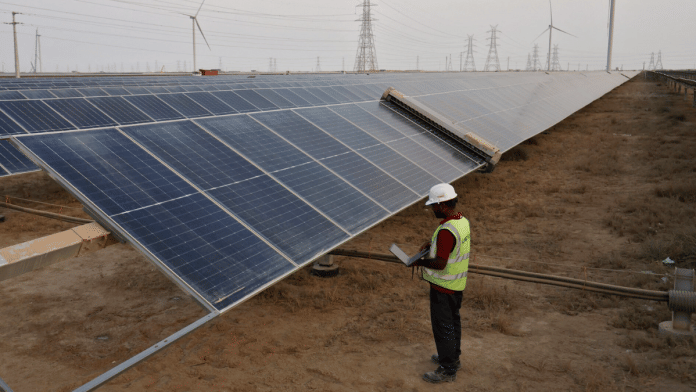

India now ranks third globally on installed renewable energy capacity. As of December 2025, installed capacity stood at 250 GW. In FY2026, it added around 55 GW of renewable capacity, of which 44.6 GW was solar, well above the 28.72 GW of renewable capacity and 23.8 GW of solar added in FY2025.
This raises two questions: what might explain these increases, and are they likely to continue?
What might explain the growth?
While the exact reasons may not be known, we think that three policy features expedited project completion in the previous fiscal year. The first of these is the interstate transmission system (ISTS) waiver, which exempts renewable energy developers from paying ISTS charges. This meant that solar plants in (say) Rajasthan could supply electricity to consumers in (say) Delhi without paying the transmission costs. The full waiver ended in June 2025, after which it is expected to be reduced by 25 per cent each year over the next four years. As a result, developers were incentivised to commission projects before the deadline to lock in lower transmission costs.
A second important feature of the policy landscape is the Approved List of Models and Manufacturers (ALMM) framework, which specifies the solar module and cell manufacturers approved by the Ministry of New and Renewable Energy for use in solar projects in India. The first list was published in 2021, and the second came into force in June 2026, raising concerns regarding the availability of domestic cells and a potential increase in procurement costs for developers. Anticipation of these requirements could have led to a spurt in completion rates in previous years, although the government has since extended the compliance deadline to 31 December 2026 for certain categories of projects.
A third reason is the state-driven push under the PM Surya Ghar Yojana, which provides incentives for residential rooftop solar installations. In FY2026, PM Surya Ghar contributed 8.7 GW in installed capacity.
Also read: CJP impact — BJP’s narrative hegemony dented, the pall of fear lifted
Is the solar boom likely to continue?
According to data from the Central Electricity Authority, solar capacity additions fell from 6.7 GW in March 2026 to around 4 GW in April and 3.2 GW in May. In June, however, solar capacity was 5.1 GW, driven by the boom in rooftop solar, without which the overall growth would be less. In the first quarter of FY2027, rooftop solar added about 5 GW, almost matching ground-mounted solar additions over the same period. Ground-mounted solar panels, which are built directly on open land rather than on rooftops, have declined as compared to last year.
A similar trend is visible when we look at project developments. In 2025, solar tenders declined by 45 per cent year-on-year, while solar auctions fell by 57 per cent. The slowdown continued in 2026, with solar tenders in the first quarter amounting to only around 6 GW, a 68 per cent fall compared to the same period in the previous year.
Another source for understanding longer-term trends of projects in the pipeline is the data on electricity generation projects from the CapEx database maintained by the Centre for Monitoring Indian Economy (CMIE). This also shows a decline in implemented solar capacity: from 44.5 GW in FY2024 to 31.6 GW in FY2025 and 15.3 GW in FY2026. These are projects that have secured tenders, signed PPAs, or have begun construction, and hence are likely to be commissioned. These estimates exclude hybrid projects due to our limited ability to isolate solar capacity from them. While the CMIE data may not cover all solar projects exhaustively, the trends remain reliable.
Taken together, these indicators suggest that the gradual withdrawal of the ISTS waiver; uncertainty around domestic manufacturing requirements; transmission and evacuation constraints; and increasing instances of renewable energy curtailment—partly driven by insufficient storage—have contributed to a more challenging investment environment. Developers have also raised concerns that aggressive bidding in tenders is pushing prices to levels that may not be sustainable, increasing risks of project delay and cancellations.
Also read: Myanmar is reaching out to India. New Delhi shouldn’t squander the opportunity
What could FY2027 look like?
We conducted a simple back-of-the-envelope estimate of the capacity additions for FY2027 based on ongoing projects, government programmes, and industry forecasts.
We assumed that additions under PM Surya Ghar would remain at the levels reached in the first quarter. On this basis, rooftop solar would reach about 20 GW in FY2027. For the industrial segment, estimates from sources suggest around 10 GW of new capacity would be added during this year.
For utility-scale projects, which are large ground-mounted projects directly supplying to the grid, we referred to the dataset from CMIE CapEx. In a related paper, Borah et al (2026) found that solar projects below 100 MW take a median of around 1.2 years to be commissioned after they begin implementation, while larger projects take around 3.5 years. To remain conservative, we assumed completion periods of two years for projects below 100 MW and four years for those above 100 MW.
Next, to obtain a rough estimate of FY2027 additions, we used historical completion rates from the CMIE database. For small solar projects, we calculated the share of capacity implemented in FY2024 that was commissioned by FY2026. For large projects, we used the corresponding completion rate for projects implemented in FY2023. Applying these historical completion rates to small projects implemented in FY2025 and large projects implemented in FY2024 provided a rough estimate of the capacity likely to be commissioned by FY2027: around 13 GW of utility-scale solar.
Together with PM Surya Ghar and the industrial segment, this would amount to roughly 43 GW of solar additions in FY2027. Allowing for some deviations from these predictions, we should expect about 40-45 GW of solar additions in FY2027 with about half coming from rooftop solar.
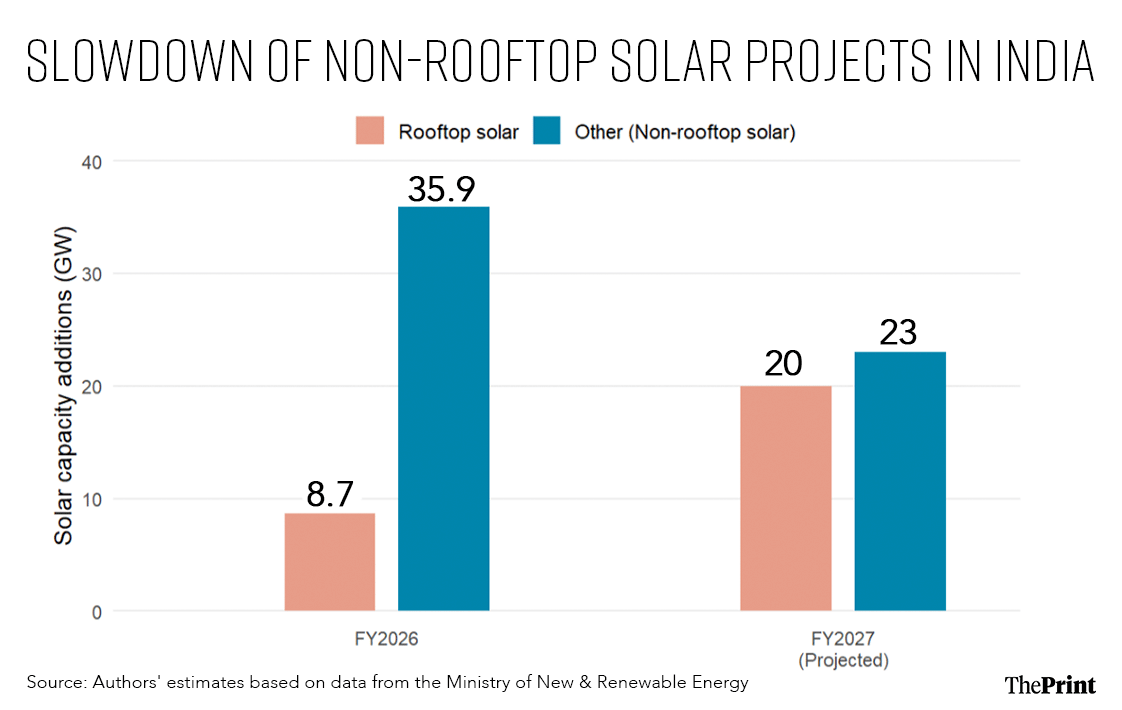
While these rough estimates should be interpreted as indicative rather than precise forecasts, they point to a slowdown in the utility-scale projects from record additions seen in FY2026. The recent slowdown in tenders, auctions, and project development, alongside unresolved issues around curtailment of renewable energy and the lag in developing transmission infrastructure, points to a weakening pipeline of utility-scale projects. An increasing share of rooftop solar has important implications for grid management and DISCOM financial health. If India is to sustain the pace of clean energy deployment, it will need to focus beyond headline capacity numbers. It must prioritise a steady and sustainable flow of investment into the pipeline, and that requires designing a grid robust yet flexible enough to integrate and absorb a growing share of renewable energy.
Rakesh Kacker is a former Secretary, Government of India, and member of the Advisory Board at TrustBridge Rule of Law Foundation. Renuka Sane and Upasa Borah are researchers at TrustBridge. Views are personal.
(Edited by Prasanna Bachchhav)