






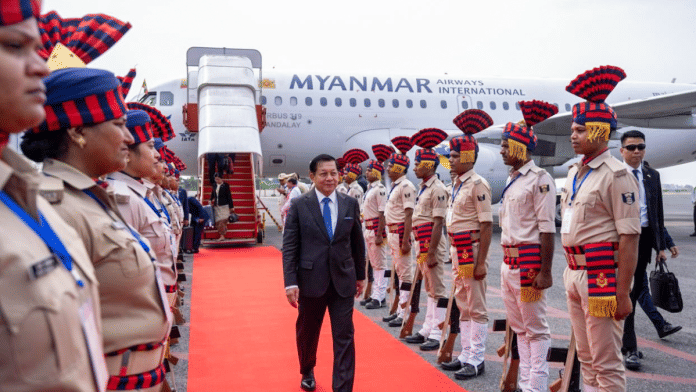


The three-day lecture series on constitutionalism and federalism, held in Naypyitaw from 16 to 18 July under the aegis of the Myanmar National Solidarity and Peacemaking Negotiation Committee in collaboration with the Indian embassy, was an important step in furthering India-Myanmar ties. It was the latest in a continuing bilateral dialogue on constitutionalism, following two earlier lecture series and two workshops held since 2023. More than 100 participants—including members of parliament, representatives of ethnic organisations, officials from Myanmar ministries, civil society groups, the Indian Council of World Affairs and the Indian embassy—took part in the discussions. The timing was key, coming just a few weeks after Myanmar President U Min Aung Hlaing’s five-day official visit to India in May-June.
It was Hlaing’s first foreign visit after taking over as President. He could have chosen China, Russia or an ASEAN country to visit first, underscoring the political and strategic importance of that choice. Prime Minister Narendra Modi publicly noted that India was honoured by this decision.
President Hlaing was accompanied by several ministers and the governor of Myanmar’s Central Bank. A substantial business delegation represented agriculture, pharmaceuticals, banking, energy, construction, information technology, communications, logistics and trade. The visit provided a political mandate for ministries, security agencies, financial institutions and businesses on both sides to move the relationship forward. It was also significant that the President visited Mumbai for meetings with political and business leaders and toured the NTPC Energy Technology Research Alliance (NETRA) facility in Greater Noida.
These engagements demonstrated Myanmar’s interest in Indian investment, energy technology, banking practices, renewable energy, industrial development and private-sector cooperation. India provides Myanmar with access to one of the world’s largest markets, advanced educational and healthcare institutions, affordable technology and a development partnership that does not challenge Myanmar’s sovereignty.
President Hlaing then travelled to China, where the two countries signed 18 agreements and memoranda covering trade, infrastructure, security, health, science, technology and development cooperation. However, these agreements should not be interpreted as evidence of complete trust between Myanmar and China. Myanmar’s engagement with Beijing is driven largely by geographical necessity, economic dependence and the need to manage a powerful neighbour rather than by unqualified strategic confidence. Both the Myanmar establishment and substantial sections of its population continue to harbour deep reservations regarding what they perceive as the predatory character of Chinese involvement.
These concerns arise from pressure to revive the highly unpopular Myitsone Dam—whose original design envisaged exporting about 90 per cent of its electricity to China while Myanmar bore the displacement and environmental costs—from the extensive extraction of rare-earth minerals in Kachin State by largely Chinese-operated enterprises, and from the resulting pollution of forests, farmland and water sources. Suspicion is reinforced by China’s simultaneous dealings with the central government and powerful Ethnic Armed Organisations (EAOs), which provide Beijing with considerable influence over Myanmar’s internal security and border affairs.
Min Aung Hlaing’s China visit was, therefore, an exercise in pragmatic diplomacy rather than an embrace based on trust. Nor did it diminish India’s importance. By visiting India first, Myanmar signalled that it values India as an independent, culturally connected and comparatively non-extractive partner that can help it diversify its external relationships, reduce excessive dependence on China and preserve its strategic autonomy.
Also read: Myanmar wants to distance from China. India offers a relationship without domination
The lecture series at Naypyitaw
Against this geopolitical backdrop, the Myanmar National Solidarity and Peacemaking Negotiation Committee (NSPNC)—the body responsible for implementing ceasefire agreements, advancing the Nationwide Ceasefire Agreement (NCA), facilitating discussions on federalism and constitutional reform, and coordinating humanitarian and developmental efforts in conflict-affected regions—organised, with the support of the Centre for Peace and Reconciliation, Myanmar, a lecture series that offered valuable insights into how the country’s policymakers, ethnic organisations and political representatives are thinking about Myanmar’s constitutional future.
Four Indian speakers (including myself) drew on India’s constitutional experience to discuss its federal structure, the unitary features of Indian federalism, the powers and role of the legislature, executive and judiciary, democratic institutions in constitutional governance, and constitutional amendments. All eight presentations over two days aroused immense interest and prompted a large number of questions. Discussions ranged from the merits of a unitary system with greater powers vested in the Centre to a federal structure that gives states greater autonomy. There was a clear sense that states are seeking greater power and autonomy in a federal structure, while the Centre wants to make the Constitution more unitary in nature for fear of losing control over the states.
A high degree of emphasis was on the position of the governor, with questions about their powers, limitations, and the advantages and disadvantages of having a governor. Incidentally, in Myanmar, the states (in the peripheral outskirts where non-Bamars live) and regions (the heartland where Bamars, who constitute 68 per cent of the country’s population, live) have no governors. The necessity for a governor in a state to act as a constitutional guardrail cannot be overemphasised; Myanmar could look at a constitutional amendment to create this institution, learning from the Indian experience.
Under Article 261 of Myanmar’s 2008 Constitution, the chief minister is currently the head of a state or region. Under this Article, the president selects a suitable representative from the relevant state Hluttaw or regional Hluttaw and the chief minister remains responsible to the president. This arrangement combines two different roles in one office—that of the constitutional head of the state and the head of its political government—and concentrates executive power at the national level rather than allowing local assemblies to choose their own regional leaders. Ethnic minority political parties and federal advocates strongly criticise Section 261, arguing it prevents local parties that win regional majorities from governing their own areas. Amending Section 261 to let regional Hluttaws elect or appoint their own chief ministers has been a persistent point of contention and negotiation across successive administrations and peace panels.
The audience was also extremely curious to learn more about the Mizoram model. Given that it borders Myanmar’s Chin State, which has been severely affected by violence as a consequence of the conflict between the Tatmadaw and multiple Chin groups, and given the common ethnicity and shared sense of brotherhood among people on both sides of the border, most wanted to know about the transformation of Mizoram from a state that was severely affected by insurgency for two decades to one of India’s most peaceful states with one of the highest literacy rates. Going forward, once peace is restored in Myanmar, the replication of the Mizoram model is possible in the Chin and Rakhine states if power is handed over to the Chin groups and the Arakan Army, which currently control most parts of these states.
Also read: Min Aung Hlaing’s rise in Myanmar matters to India—he is closer to New Delhi than Beijing
India and Indians must understand Myanmar
It is a pity that there is very little awareness about Myanmar in India and it is frequently neglected in Indian public discourse. Many Indians view it only through isolated subjects—military rule, insurgent camps, refugees, narcotics or Chinese influence. Such an understanding is inadequate. Not only is Myanmar the land bridge for our Act East Policy (which is where our future lies), but it is also a country in our neighbourhood where there is a great amount of goodwill and trust for Indians. What is also not known to many is that India shares its largest maritime boundary with Myanmar — 593 nautical miles (1,098 km). Myanmar is, therefore, important to the security of the Bay of Bengal and India’s eastern maritime approaches, including the Andaman and Nicobar Islands.
The security of Arunachal Pradesh, Nagaland, Manipur and Mizoram is inseparable from developments across the border. Insurgent activity, narcotics, arms trafficking, refugee movements and ethnic conflict do not remain confined by an international boundary. A stable and friendly Myanmar prevents India’s Northeast from becoming strategically isolated and excessively vulnerable to external influence.
Myanmar shares a civilisational relationship with India that extends beyond government-to-government diplomacy. Incidentally, Myanmar does not have a Free Movement Regime (FMR) with any of its other four neighbours. The Indian government did announce the scrapping of the FMR, but on closer examination, this amounts only to a slight modification of the regime. The international boundary between the two countries will see 43 regulated entry and exit points, along with a border fence that will be a combination of physical and smart fencing. Over a lakh people have already moved across both sides of the border since the announcement to do away with the FMR. This reality needs to be understood by all.
India must therefore invest in a deeper national understanding of Myanmar. Indian universities should establish Myanmar studies programmes. More Indian officials, military officers, diplomats and researchers should learn the Burmese language and study Myanmar’s ethnic communities. Universities in Northeast India should build partnerships with institutions in Mandalay, Yangon, Naypyitaw and other regions.
Indian businesses need better information about Myanmar’s markets and regulations. Indian media should maintain stronger reporting networks inside the country. Buddhist organisations, universities, medical institutions and cultural bodies should become active participants in the relationship. India should maintain formal engagement with Myanmar’s government while also expanding humanitarian, academic, cultural and developmental engagement with ethnic communities, civil society and other relevant stakeholders. This approach would protect India’s interests without appearing to interfere in Myanmar’s internal political processes.
The exchange of views between the Indian speakers and a broad cross-section of Myanmar’s society and government helped both sides understand each other better. It was another small but meaningful step in strengthening ties between the two countries. Prior to this exchange, it is learnt that the Myanmar government had been intensely studying the constitutional models of Switzerland, the United States and Germany.
The biggest gain from this exchange, therefore, as one of the attendees stated, was the realisation within Myanmar that, if any amendments are to be made to the 2008 Constitution, they should draw upon Indian experiences of constitutionalism and federalism. Besides, the two countries have much in common, particularly their diverse populations and unstable border regions, which both understand well. Our shared culture, history and geography further cement that.
Lt Gen Pradeep C Nair (Retd) is the former Director General of Assam Rifles. He is currently the Vice Chancellor of St Mary’s Rehabilitation University, Hyderabad. He tweets @LtGenPCN. Views are personal.
(Edited by Prashant Dixit)