



A Chinese spy this week is making headlines and inspiring memes, amid a scandal in the tech world. This raises the question: how did Indian spies get around sanctions and borders in earlier times?
From the 1500s to the 1700s, several strange Indian characters appear in Chinese records. Some, we are told, were nine feet tall with long white beards. Others could contort their bodies in strange ways. A few were arrested for suspicious activity, from having multiple wives to transporting huge amounts of gold.
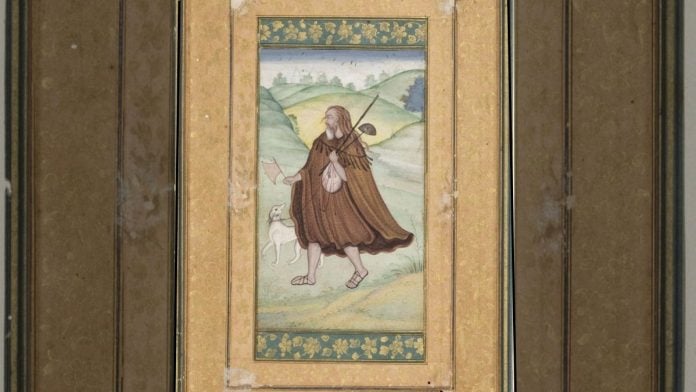
Most of them were recorded as Buddhist ‘arhats’ or ‘acharyas’, but in reality they were something stranger: Hindu yogis and gosains far from home, simultaneously pilgrims, merchants, and diplomats.
The travelling gosain
In 1688, a Han Chinese official named Zhang Pengge found himself on the border of Mongolia, to meet with Russian envoys. In his records, he noted with astonishment several dark-skinned foreigners whose “bodies and bones were flexible; they could put their feet on their heads, and put their heads through their armpits”.
Only one could speak Chinese, and he told the official that he had travelled for years seeking a living Buddha: first on the holy peaks of China, then at the court of the Dalai Lama, and finally the Jebtsundamba Lama of Mongolia.
“He trod the distant wastes to go see him, but he also proved not to be one,” states Pengge in his records. His luggage had been stolen in a Dzunghar Mongol attack, and his group scattered. The official asked him if he still believed there was a Buddha in this world. “Only today,” laughed the monk, “have I come to know there is none”.
This strange account is one among several discussed by historian Matthew Mosca in his paper “Indian Mendicants in Ming and Qing China: A Preliminary Study.” From the 1500s onwards, well after the end of Buddhism in India, Chinese officials continued to note the arrival of Indian mendicants who claimed to be seeking Buddhist holy sites. Mosca argues that these figures were most likely gosains—primarily Shaiva, and occasionally Vaishnava, ascetic initiates.
We have run into these figures several times in Thinking Medieval, where we explored their early connections to political power and their military might, available to the highest bidder.
“In India, gosains blended religious and commercial activities: travelling as pilgrims, they could undertake long-distance trade; residing in monasteries, they were able to take on the role of landlord, moneylender, and trader,” Mosca writes.
In the 1600s and 1700s, gosains, like the infamous Anupgiri or Himmat Bahadur (1734–1804), accumulated great wealth and power, playing off the Marathas, Mughals, and the East India Company.
Several hundred gosains, according to Mosca, arrived in Tibet annually, where there was a thriving market for coral, pearls, indigo, and tobacco from India. From here, many chose to make the journey into China. While India was no longer an active participant in the Buddhist world, Chinese authorities and patrons still possessed a favourable stereotype of Indian Buddhist masters, arhats or acharyas. They were memorialised through stories and paintings of figures like Bodhidharma, the legendary Indian founder of Chinese Zen (Chan) Buddhism.
Whatever their motivations, Indian mendicants could reliably get a travel permit by claiming to be Buddhist masters. In one case in 1750, the governor-general of Liang-Guang reported that four ‘arhats’ had been arrested with two kilogrammes of gold and 34 kilogrammes of silver.
The senior-most of them attested that he had two Chinese wives, and three sons with the first. He had stayed in Beijing for years, in the Baita temple. He owned a house, paid taxes, and was registered with a magistrate near Chengdu. He told the authorities he was carrying so much currency in order to pay off his debts and purchase goods in Guangzhou. A local shopkeeper was able to attest to his character and said that the Indians had stayed with him before; the group was eventually released to continue their business.
Diplomat, merchant, and banker
The most remarkable of these figures was Purangir Gosain, who made several journeys between Tibet, China and Bengal in the late 1700s. He was a Brahmin initiate of the Giri Dashanamis, who typically went about in loincloth, ochre wrap and tiger skin, donning a tunic and turban on public occasions.
In 1774, after the British East India Company repelled a Bhutanese invasion of Cooch Behar, Purangir arrived at the court of governor-general Warren Hastings bearing a letter from the Panchen Lama. For the next decade, he would serve as the trusted intermediary between the Panchen Lama and the Company, accompanying messages, gifts and envoys in both directions. He frequently served as an ambassador himself.
At the Lama’s request, the company granted Purangir a substantial swathe of land to build a monastery and resting-house for Tibetans at Bhot Bagan Moth, near Calcutta. Here Purangir hosted pilgrims and merchant caravans. Gold was frequently sent to him by Tibetan partners to sell in Calcutta. Whatever profits he made were reinvested in charity, bolstering his trustworthy reputation. In 1778–80 he accompanied the Panchen Lama all the way to Beijing, where he met the Qianlong Emperor of the Qing Dynasty — at the time the most powerful man on Earth.
Purangir’s celebrity and properties, coupled with his long absences, led to problems. During one of his journeys, a zamindar seized a portion of his lands. And in 1795, dacoits attacked his monastery. Though he attempted to defend himself with a sword, he was speared. The governor-general sent his own personal physician, but after a lingering agony of 37 hours, the mendicant-ambassador passed away.
His death came when India’s international mendicant travel was ending once and for all, to be replaced with mercantile expansion under British auspices. Mosca writes that Tibetan Buddhism fell out of favour at the Qing court after the 1792 Gurkha War; anti-Christian sentiment was extended to all foreigners; and the growth of sea trade, borne by Parsi merchants, eroded the profits of overland travellers. In the coming decades, recruited by the East India Company, Indian mendicants would transition into spies and surveyors entwined with the Great Game between Russia and Britain in the Himalayas.
Anirudh Kanisetti is a public historian. He is the author of ‘Lords of Earth and Sea: A History of the Chola Empire’ and the award-winning ‘Lords of the Deccan’. He hosts the Echoes of India and Yuddha podcasts. He tweets @AKanisetti and is on Instagram @anirbuddha.
This article is a part of the ‘Thinking Medieval‘ series that takes a deep dive into India’s medieval culture, politics, and history.
(Edited by Saptak Datta)