



In 2025, photographs from fresh surveys conducted by the Archaeological Survey of India at Gomti Creek, an estuary near Gujarat’s Dwarka, signalled what appeared to be the revival of the institute’s long-dormant Underwater Archaeology wing. Until 2018, the wing was housed within the Red Fort Complex. For much of its existence, however, it remained largely inactive with limited staff, occupying little more than an empty office. Tucked away in a corner of the administrative section of the Red Fort, the underwater team remained almost unnoticed. Following the relocation of the offices to Greater Noida and INA, it seemed to have disappeared altogether in the administrative transition.
The photograph, featuring former Additional Director General Alok Tripathi, Director HKNayak and three women archaeologists at Gomti Creek, offered a visible indication that the long-neglected unit might finally be returning to active work. The developments were accompanied by financial commitment from the Ministry of Culture. On 30 July 2026, Union Minister Gajendra Singh Shekhawat announced an allocation of Rs 1.41 crore for marine archaeology, out of which Rs. 75.4 lakh was allocated for the year 2025-26 and Rs. 66.5 lakh for the year 2026-27.
The renewed activity is not confined to Dwarka and other such areas. Underwater explorations and excavations have also been initiated or proposed at Mahabalipuram and Karaikal. The National Institute of Oceanography (CSIR-NIO) received an allocation of Rs 20 lakhs for investigations at Bet Dwarka, Chhari and Gangata Bet. Meanwhile, the Tamil Nadu State Department of Archaeology was granted permission to undertake underwater explorations and excavations at Poompuhar, an important port settlement near Mayiladuthurai.
In recent public memory, underwater archaeology has become almost synonymous with Dwarka. The site occupied an important place in the history of marine and underwater archaeological research in the country. However, India’s underwater archaeological landscape that extends far beyond Dwarka. From Poompuhar, the submerged remains along the Tamil Nadu coast is expanding the existing body of knowledge about the country and even the subcontinent’s maritime past.
Yet, the renewed announcements and field investigations also bring some persistent questions into focus. Is the revival of underwater archaeology being accompanied by the institutional capacity required to sustain it? Is the present funding sufficient to support long-term research, specialised equipment, conservation and training? Most importantly, what happens to these initiatives when the administration and political inclination change? What lessons should we learn from the administrative abandonment which lasted over two decades?
Away from the Centre
The answer, perhaps, lies in decentralisation and institutional collaboration. One of the earliest examples of this approach can be traced to 1981, when the Tamil Nadu Department of Archaeology collaborated with the National Institute of Oceanography to undertake preliminary explorations in the region.
Poompuhar, also known as Kaveri Poompattinam, Puhar, and Kaveripattinam, was a major port where the Kaveri River joins the Bay of Bengal. It also served as the royal residence and capital of early Chola kings. As a significant port, it finds mention in Sangam literature, which recorded its grandeur and architecture. It was a gateway to the world as travellers and traders from Rome, Greece, Egypt and China would arrive at this port.
The literature also mentions how this ancient city, dated to the third century BCE, gradually lost its importance and was submerged due to sea erosion. According to the Tamil Buddhist epic Manimekhalai, the city is said to have been engulfed by the sea. Eventually, the population migrated inland to the present-day Poompuhar as sea levels kept rising. For thousands of years, the port vanished not only from land, but also from memory.
For a while, its location was debated, until the 1960s, when KV Soundararajan excavated the modern-day Poompuhar and recovered artefacts, including Roman pottery and Chola-period artefacts, and wharf structures. Soundararajan confirmed the presence of an archaeological site that corresponded to the timeline mentioned in various ancient literary sources.
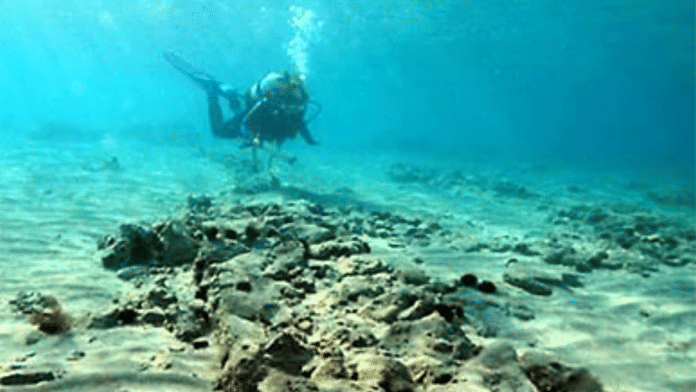
The underwater explorations began two decades later in 1981 by the Tamil Nadu State Department of Archaeology in collaboration with CSIR-National Institute of Oceanography, Goa. Initial underwater investigations recorded structural evidence; however, in 1990, a shipwreck was found opposite Vanagiri in a sonar survey. The following year, a “U” shaped structure was found at a 23-meter depth about 5.5 km from the mouth of the Kaveri River. In later surveys, it was measured at 40 meters in length and 16 meters in width and was covered with sand sediments and fishing nets.
The underwater surveys continued from 1997 until 2025, when the underwater and marine archaeology endeavours revived, just like in the case of Dwarka.
A dedicated team of archaeologists headed by senior and eminent archaeologist K Rajan and joint-director VP Yatheesh Kumar has recently found torpedo jars for the first time. The torpedo jars are handleless jars with a cylindrical body, used mostly to transport liquid commodities including wine, oil and vinegar across the Persian Gulf and the Indian Ocean. This evidence points to a significant trade link between the two regions. Other artefacts recovered include glazed pottery, which consolidates the association with Persian Gulf trade.
Interestingly, cord/paddle impressed pottery found at Poompuhar points to a domestic connection as well. According to archaeologists, this is associated with a connection between present-day Tamil Nadu and the Gangetic plains. The underwater endeavours are set to continue in the following field seasons.
Also Read: The Indus Valley Civilisation declined. Its crops survived and adapted
Need for capacity building
There is a fundamental difference between terrestrial and underwater archaeology. The aim is the same, which is to understand the past through material culture, but the methods differ.
The tools and techniques used in underwater archaeology require specialised training and constant upgrading as these differ from the tools used in terrestrial excavations. Unlike field explorations and village-to-village surveys, the sites in underwater archaeology are located using sonar and magnetometry. Instead of physical drafting and drone shots, recording is done by photogrammetry, due to limited time and poor visibility. Excavations require airlifts and careful control of silt and recovered material, especially waterlogged wood or corroded metal, which begins to decay the moment it leaves water. None of this can be learnt on traditional terrestrial excavations. It needs specialised training and constant upgrading of skills, along with close collaboration between archaeologists, divers, conservators and experts in marine, nautical and maritime archaeology.
Against this, the revival looks modest. It’s true that funds are required for every project but is it sufficient? The harder question is what will happen if the political scenario changes. A budget line can be cut at any moment, so spending crores is the bare minimum the Ministry of Culture can do. What lasts are institutions and a legal mandate, not funds.
In the case of the Tamil Nadu State Department of Archaeology, the system is established to provide stability. Besides state departments, there are universities and departments, including the Department of Maritime History and Marine Archaeology at Tamil University and the Indian Maritime University, which have played a significant role in capacity building, a gradual process.
Since this is just one state, we must now look at policies that can work on a national and global level irrespective of political change. How will the system, which is the Archaeological Survey of India in this case, function?
The training school advertised last year also didn’t materialise as planned. The Centre’s very own Institute of Archaeology lacks a dedicated course on underwater and marine archaeology. In fact, the majority of the university departments teaching archaeology in India don’t have a dedicated course on underwater archaeology. Without a pipeline of trained people, no allocation, however large, can be sustained.
Disha Ahluwalia is an archaeologist. She tweets @ahluwaliadisha. Views are personal.
(Edited by Insha Jalil Waziri)