






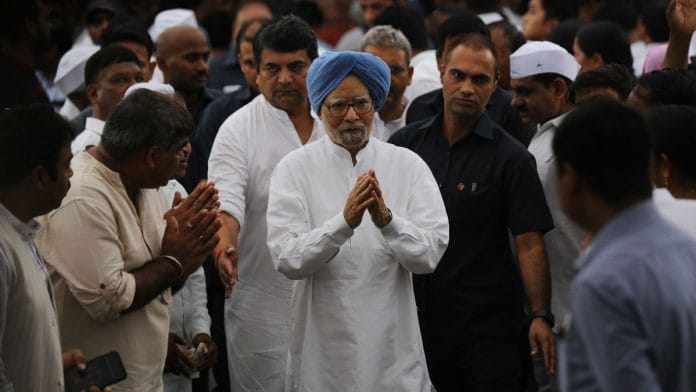

There was a little bit of Manmohan Singh at the Jantar Mantar youth protests that brought down a Union minister last month. It was undoubtedly the most significant challenge the BJP-led government has faced in years. The former Prime Minister was there in the repeated chants of “bure din waapis do”, a taunt at Narendra Modi’s much-vaunted promises of “achhe din”.
He was there in the reception that the protesting youngsters were met with, a complete contrast from his own pleas of leniency toward the JNU students that had shown him black flags in 2005. And he was there in placards tartly announcing the date on which an Indian PM last stood in front of the press and took questions, i.e. 3 January 2014, toted by someone who would have been a child then.
Watching that press conference today is an exercise in realising how far India’s political culture has shifted. Singh is calm and composed, though maybe a little heartbroken as he answered, by one account, at least 62 unscripted questions from 100 journalists. He acknowledges with grace the failures of his government, while simultaneously praising the power of Indian democracy and the robustness of its institutions that allowed the people to elect a different leader.
Asked once more about being a weak PM who had let his ministers help themselves, he had famously said, “I do not believe that I have been a weak Prime Minister… I honestly believe that history will be kinder to me than the contemporary media or, for that matter, the Opposition parties in Parliament.”
Every single comment on that video, uploaded after he died in 2024, exhibits a twinge of nostalgia. There is a clear fondness for the man and his policies, but also the penitential acknowledgement of the cruelty of the atmosphere of the last days of his reign.
One of the comments states: “To begin with trolling him for his appearance and his patience and his policies, to now seeing comments everywhere about how all will miss him, there’s a kind of poetry in there somewhere. He was right about one thing – history will be kinder to him than the contemporary (lapdog) media in 2014.”
‘Country can give me my punishment’
On 29 July, four days after the students induced then Union Education Minister Dharmendra Pradhan’s resignation, three judges of the Supreme Court got around to agreeing with Singh.
For anyone who wasn’t around to witness the end of the second term of UPA, it is difficult to convey the amplitude of “Coalgate”, one of the many scams that dogged the government. In August 2012, the Comptroller and Auditor General (CAG) laid a report before Parliament, alleging that 57 coal blocks had been handed to private companies through a discretionary and opaque screening process, against the coal ministry’s own advice that they be auctioned. The CAG put the presumptive loss to the exchequer at a whopping Rs 1.86 lakh crore.
The monsoon session that year sat for 19 days, but functioned only for six. The BJP, then in the Opposition, spent the other 13 days demanding Singh’s resignation. In September 2014, the Supreme Court cancelled 214 coal block allocations in a single order.
Additionally, a case that would follow Singh personally since he held the coal portfolio was the Talabira-2 allocation. In 2005, the 25th Screening Committee had recommended that Talabira-2 be allocated to Neyveli Lignite Corporation, a public sector company that was planning a 2,000 MW power plant. Industrialist Kumar Mangalam Birla had then written to the Prime Minister’s Office for consideration. The coal secretary, PC Parakh, proposed a joint venture that would make room for Birla’s Hindalco alongside the state-owned companies. Despite the reservations of two officials in the PMO, Singh signed the file.
The case was promptly handed to the CBI, which investigated and found nothing to prosecute. It filed a closure report in August 2014, followed by a second one in October 2014. However, in March 2015, Special Judge Bharat Parashar declined to accept either of the CBI’s reports and summoned Singh alongside Birla, Parakh, Hindalco and two of its executives.
After the Supreme Court got involved, the case lingered. It witnessed two general elections. It was still lingering in December 2024, when Singh died at 92, and it is only now — 19 months after his death — that the bench finally said, “We are satisfied that there was no reason for the learned Judge to turn down the closure reports of the CBI and take cognisance.”
Back in 2012, Singh had declared that he would give up his public life if there was even an iota of truth to the allegations of corruption against him.
“The country can give me my punishment,” he had said. Even before the charges could be proved, the country happily obliged.
The coal allocation scam had only blackened the stain left by other scams: the 2G spectrum scam, which unfolded in 2009 with its notional loss of Rs 1.76 lakh crore; the Commonwealth Games scam of 2010, which cost the exchequer Rs 70,000 crore. It all contributed to the origins of the idea of a “weak” prime minister, a decent man held hostage by his allies and his own cabinet.
Also read: Students’ battle over paper leaks is becoming a caste war
From ‘underachiever’ to ‘tragic figure’
It was an idea that took seed and probably still cannot be dislodged. In July 2012, TIME put Singh on its Asia cover, labelling him The Underachiever, in a profile that found him unable to control his ministers and unwilling to spend on reform. Later that year, the Washington Post called him a “tragic figure”, quoting his own former media adviser, Sanjaya Baru, who suggested that he had gone from an object of respect to one of ridicule.
At home, the media delighted in these characterisations, while the Opposition invented epithets of its own: “Maunmohan”, or “Night watchman”, or “the weakest prime minister India ever had”. So often were these opinions repeated that they turned into fact.
The simmering resentment against a party of dynasts and ineffectual leaders found willing friends in the 24-hour news studio, and the studiedly apolitical India Against Corruption movement that drew participants from across the spectrum. Their weapons — hunger strikes and marches — employed to demand more probity in public life, dovetailed neatly with the staggering scam figures that no one could make sense of.
Figures so large that they defied explanation, and would later be labelled “at best a mathematical guess” by the CAG’s own director general. Long after Singh’s genteel ways lost the perception war, all 17 accused in the 2G trial would be acquitted.
None of which is to say the anger was manufactured. UPA-II was a poor government that deserved several of the criticisms it drew. Food inflation ran in double digits for months at a stretch. A steady growth rate of 9 per cent, treated somewhat like an Indian birthright, continued to slide. In August 2013, the rupee fell to nearly 69 to the dollar, which, in hindsight, seems ridiculous. A real policy paralysis greeted a general air of hopelessness in a population hankering for a change.
We’ve witnessed a return of that appetite in this last fortnight. Probity, propriety, accountability… words that were bandied about freely during Singh’s tenure, that have since gone out of vogue in Indian public life. What the last two weeks have restored is the knowledge that a demand can be placed on power, and that power can be made to answer.
That euphoria, however, has meant that Singh’s clean chit has slipped under the radar almost entirely. What has survived of him is a fondness for the man that would still embarrass some of us, coloured by a little bit of regret. In those years, the worst thing we could find to say about a PM was that he was too quiet. History has indeed been kinder to him, which is more than we can say about ourselves.
Karanjeet Kaur is a journalist and a partner at TWO Design. She tweets @Kaju_Katri. Views are personal.
(Edited by Saptak Datta)
As terrible as things become towards the end of UPA II, it cannot compare to what we have been reduced to now. Our Press Freedom Index and Passport Index have gone down, the value of the Rupee has almost halved (and to imagine, the current PM was making fun of it back then!), and then the raids etc against opposition or critics and so on. As for unscripted questions, just one from Karan Thapar was enough for the 56″-chested strongman to run away with his tail between his legs.
The India-US nuclear agreement that was signed during PM Singh’s tenure was a landmark deal, not least because the US had had to pass the Hyde Act with bipartisan support in both the Congress (for the bhakts’ benefit, Congress is the House of Representatives in the US, not a party) and the Senate. India was able to get a waiver from the NSG and not have to sign the NPT. At home, the UPA had to get enough members on the floor to agree on the deal. All of this makes for fascinating reading (the current party in power and its people have a serious deficiency in that area). Since BJP have always had a majority or close to a majority, they believe in ramming bills or ordinances through the parliament and not in debating and developing consensus, which is fundamental to a democracy. This either hurts the economy badly (as demonitisation and botched GST did) or leads to protests (as the farm law bills, Agniveer etc did). If they really cared about the people and about democracy, they would try to develop consensus and make appropriate changes so that everyone could be on board.
Even Aadhar and UPI, which the current government keeps beating its drums on and putting its own photos on was initiated during PM Singh’s tenure. It’s good to know that history has, indeed, been kinder to him, and many of the scams that dogged him, and which he claimed were false, have been proven so by the courts. I only wish he were alive to see the courts clear his name. He was a properly educated, well-read, gentlemanly statesman, unlike the current crop of illiterates at the helm of power.
Maun Modi asked for fifty days to bring back all the black money, after demonetisation. He said he’d subject himself to punishment after that. The nation is still waiting. As is it for 15 lacs in every bank account. From the PM to the peon, everyone in the party is a liar.
No patriotic Indian misses Manmohan Singh.
Only Khalistanis and their sympathisers miss him.
Unfortunately, Ms. Karanjeet Kaur is one of them.
What is even more unfortunate is that Mr. Shekhar Gupta allows her to use his media platform to spread her gospel.
And he has the gall to ask for our subscription money – all the while promising us ‘unhyphenated’ journalism.
Manmohan Singh was surely a well educated and competent Finance Minister.
As Prime Minister he was simply puppet of Sonia Gandhi. – presiding over loot of public money as the Congress and the Gandhis filled their coffers.
For some strange reason, the Hindu-hating Modi-hating West-aping Indian “liberals” like to reminisce about Singh.
The same “accountable” PM who let Sonia Gandhi demean the office of PM by running the govt herself, and turned a blind eye to mammoth scams and policy paralysis? Wasn’t that dereliction of oath of office?
Yes. He was held accountable for policy paralysis, third-rate socialist schemes of Medha Patkar of national advisory council, astronomical cost of land acquisition, double-digit inflation, divisive statement of minorities have first claim on resources, and Keynesian quackery. The nation will remain grateful to him for his contribution to economic liberalisation of 1991 and the resulting cut in poverty including deaths due to socialism.
A modest man with much to be immodest about.
On 26 / 11 We saw how citizens of Mumbai were hunted and killed. We also saw Manmohan’s Singhs strategic patience and its fruits i.e. Pahalgam, Uri, Balakot. Accountability is not merely apologizing or explaining one’s wrong actions. Sometimes it is to have the heart to do something risky to protect the nation. Be it the demonized demonetization which was completely subsumed by UPI now(also monitored transactions) or hitting Pakistan, Manmohan Singh lacked the will and courage to do what was right.
MMS exposed pakistan on a global stage and had a president of the US call it a sponsor of terrorism unlike today where it is known by president favorite field Marshall that too after our top leader campaigned for him.
MMS is not responsible for removing security in Pahalgam for terrorists to come in, or declining air travel to solders in Uri or strategic missteps in Balankot. Learn to put the blame at the right doorstep. During MMS time Pakistan was globally shamed and exposed todsy we have to send delegations of leader to sing and dance on our tax payer money to convince others.
UPI was devised during MMS time and if he was there we would not havr to lose 100 people standing in lin3s to get their own money because of a bad policy not even the people who did it speak about.
Nobody misses Manmohan Singh – the Prime Minister of India – with the exception of Ms. Karanjeet Kaur and, maybe, Sonia Gandhi.
But yes, we all do miss dearly Manmohan Singh – the visionary Finance Minister.