




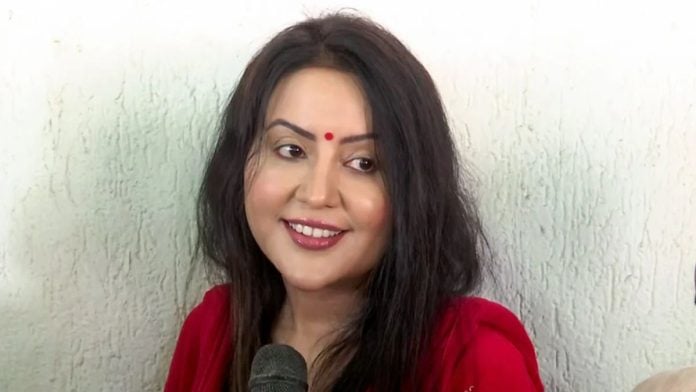

Two years ago, Devendra Fadnavis accused the Congress’ “troll army” of targeting his wife. Reacting to Congress leader Kanhaiya Kumar’s comments about Amruta Fadnavis’ Instagram reels, the then Maharashtra deputy chief minister said he was unsurprised by the Congress’ behaviour and suggested, “Chullu bhar paani mein doob marna chahiye.” This roughly translates to ‘they should be ashamed’. Over the last few days, however, Fadnavis has found a new target — his own party’s base.
In videos reportedly from Ahilyanagar, a central-western city in Maharashtra, young children can be seen hitting flex posters of Amruta with chappals and setting them on fire, as a gang of giggling young men look on. In others, schoolgirls appear to be demonstrating with their crocs. Saffron-clad men have criticised her lifestyle from the stage. All because Fadnavis said that she supports an inclusive garba — even as the Vishwa Hindu Parishad (VHP) and her husband’s party have issued calls to bar Muslims from garba and dandiya venues across Maharashtra.
Speaking to reporters outside a Shiva Temple in Chandrapur a few weeks ago, Amruta said that Hindu festivals were inherently inclusive and anyone should be allowed to enjoy them.
“I am going to be the most-trolled political wife over this issue,” she said. “But as a social activist, in my personal capacity, I can say that our festivals like Navratri and Garba are universally loved. So whoever wants to attend these with faith and devotion should not be discriminated against based on their religion.”
This has put her on a collision course with the party’s stance, especially Maharashtra minister Nitesh Rane, who has alleged that incidents of “love jihad” increase during such festivals. Rane, who has built a career on inflammatory speeches, has called for mandatory identity checks for attendees, who should also recite the Hanuman Chalisa.
Limits of a political wife
In a state where open bigotry has become acceptable, a Hindu woman speaking at a Hindu temple about inclusivity in a Hindu festival counts as provocation. Since she made those remarks, Amruta has faced a malevolent onslaught on social media from the very people who support the BJP, and that’s saying something for a woman routinely trolled for her appearance and musical ambitions. It didn’t even matter that in the same interview, Fadnavis acknowledged “love jihad”: She advocated for strong laws and suggested that Hindu women be counselled and educated about their “sanskruti”.
Maharashtra Cyber Police have now asked X to provide information about several accounts that criticised Amruta, under Section 94 of the BNSS. The notice states that the posts contain “defamatory allegations, offensive remarks, and content capable of outraging the dignity of women and provoking public sentiments”.
A Medianama report found that most of the users in the notice seemed to have deleted their remarks, but the ones that were still accessible “contained sexist and communal language, as well as references to ‘love jihad.’”
For well over a decade, Amruta has been treated like a punchline that finds an audience across ideological leanings. The opposition believes her musical career is a vanity project that benefits from her husband’s office. Her husband’s supporters, meanwhile, bristle at her inability to fit into the mould of the silent, obedient political wife. The day she launches a music video or shows up at an event in athleisure co-ords, the comments close ranks. The shared belief is that a CM’s wife ought to clean beaches in something more sanskari.
Some of the commentary Amruta invites is earned: Her appetite for selfies, to the exclusion of her own safety and others’ discomfort, is now public record. She has twice anointed PM Narendra Modi the Father of the Nation. Allegations have also surfaced that the Maharashtra government favoured Axis Bank, where Fadnavis held an executive position until earlier this year. Some say it is plain misogyny.
This also isn’t the first time the right wing’s patience with her has worn thin. In 2017, Hindutva accounts accused her of doing the missionaries’ work by promoting “Be Santa”, a Christmas gift drive for underprivileged children. The garba remarks have sealed the deal. The opposition, the BJP’s base, the left, and the right now want the same thing from her: to be less visible, and, indeed, less audible.
But why are demands to remain silent or dress like the national bahu placed on a woman who does not hold office and is not answerable to any voters? Does being a CM’s wife come with a gag order?
Also read: Neha Bora must file a peace bond. Gen Z should demand it as an act of good faith
An open defiance
Amruta, for her part, has been largely unfazed by these jibes.
“Trolling makes me laugh,” she said in a recent interview. Amruta is a departure from a “model” political spouse in several ways. In 2014, when her husband became the CM for the first time, the customary expectation was that she would rearrange her life – maybe handle her husband’s constituency, be seen but not heard. Instead, she famously told a newspaper that she intended to keep her job.
“I have worked hard to get here. I will always keep working because I, too, want to grow intellectually. It is a strong point of my identity,” she’d said.
By the standards of Indian political wives, this was open defiance. The handful of women who have stepped out of their husbands’ shadows have been punished for it.
In 1997, when a CBI chargesheet in the fodder scam forced Bihar CM Lalu Prasad Yadav to resign, he installed his wife in the seat. Rabri Devi, who had no political experience or formal schooling and had, until then, raised the couple’s nine children, became the national laughingstock overnight. Rabri Devi might have been Yadav’s seat-warmer, but the contempt she drew was very classist in nature: Her language, her ghoonghat, and her mannerisms were mocked relentlessly by Delhi media. Rabri Devi is now a politician in her own right, but the ridicule continues.
Sonia Gandhi’s entry into public life has been met with similar scorn. Everything from her Italian birth to her accent to her religion has been attacked in the most personal terms possible. Gandhi’s response has been to ration her speech and public appearances, and even to decline political office.
No one would accuse Amruta Fadnavis of that, who has chosen to speak at every opportunity. And that’s why she has few precedents in Indian politics. She does call to mind Martha Mitchell. The substantially “dangerous” wife of John Mitchell, Richard Nixon’s Attorney General, was a conservative socialite who often gave reporters her unfiltered opinions. Mitchell became a focal point of the Watergate scandal when she refused to keep quiet about the details and stay on message.
Amruta’s reasonable remarks, however, are a storm in a teacup. Unlike Mitchell, Fadnavis and her husband are a united front. The party and its base may disapprove of what she has to say, but he will defend to the death her right to say it.
Karanjeet Kaur is a journalist and a partner at TWO Design. She tweets @Kaju_Katri. Views are personal.
(Edited by Saptak Datta)