





It has been an interesting week, where we celebrated the destruction of evil on Dussehra. On the work front, I had a busy few days engaging with the youth at various occasions, members of a generation that has been given the ubiquitous moniker, Gen Z. I spent the week attending lectures and events where I interacted with this phenomenal generation of thinkers, movers, shakers, and dynamic changemakers.
But two questions have been nagging at me. Who is Gen Z, and who has the right to confine an entire age group into a conflict-ridden, limiting box? The idea of a ‘Gen X’ was popularised by Douglas Coupland’s 1991 book, Generation X. The generation that followed, born between 1981 and 1996, was labelled ‘millennial’, the figurative ‘Gen Y’ in the series. Our current cohort of young people has been named Gen Z, a demographic group born between 1997 and 2012.
In my interactions at universities, public forums, and schools, I am always pleasantly surprised to see the dynamism, drive, and positive discourse that resonates from India’s youth. The talent in so-called Gen Z is astounding. It includes AI and tech founders such as Devan Chandrashekharan, head of Kochi-based Fuselage Innovations; Mukul Chabra, who founded Scrap Uncle; Vaibhav Kaushik, CEO of fueling app Nawgati; and 20-year-old Bittu Tabahi, who cleaned up the Ajnar River. Then there are Gen Z sportspersons such as D Gukesh, the youngest undisputed chess champion in 2024 at 18; Manu Bhaker, the first Indian to win two medals at the Olympic Games; and Sheetal Devi, who won two medals at the Asian Para Games 2026.
I would not call this amazing generation Gen Z. It has the potential to take India to a new dawn of greatness. Therefore, our young people ought to be called the ‘Amrit Kal ki Amrit Peedhi’ or the Golden Generation. It is a stakeholder in a developed India and is willing to work hard for the future of our motherland, Bharat.
Lead by example
It is interesting to note that the so-called Gen Z protests are being fronted by ageing leaders who are constantly searching for new conflicts to remain relevant in the eyes of the youth. On one hand, we have Rahul Gandhi, a has-been leader whose dynastic party is desperately touting him as the next youth icon. A 56-year-old gentleman can hardly be a ‘youth leader’. Gandhi has lost three elections for his party to the original aam aadmi (common man), Narendra Modi. The data is clear. In every general election since 2014, the Bharatiya electorate has rejected Congress. And this so-called youth icon, tired of playing the waiting game, has now resorted to creating anarchy to unseat a democratically elected people’s government.
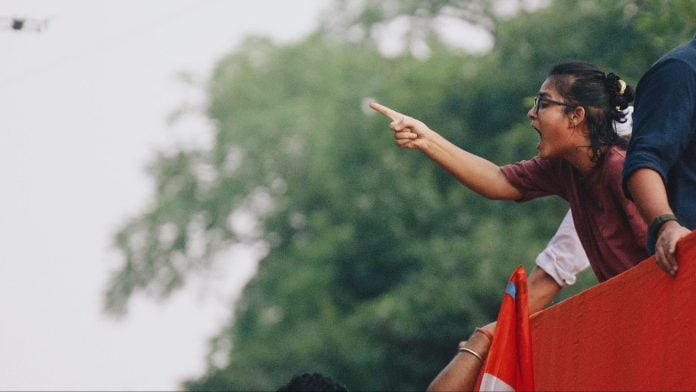
Let’s come to the satirical Cockroach Janta Party (CJP), whose founder misquoted CJI Surya Kant to appropriate a sobriquet. The CJP’s spokespersons, Saurav Das and Asutosh Ranka, are aged 27 and 31, respectively. Das barely fits the Gen Z age bracket, but Ranka most certainly does not. Similarly, the 29-year-old president of AISA, Neha Bora, who uses they/them pronouns, seeks to promote herself as the face of Gen Z politics in India. If the viral clips making the rounds on social media are to be believed, Bora also wishes to bring about a Bangladesh-style revolution in India. Why not just use the legitimate democratic process and stand for election?
Also read: Nepal’s nationalism is changing. New political order puts jobs and growth ahead of grievances
The legalese of Neha Bora
Bora was issued a show–cause notice on 17 October by a Special Executive Magistrate (SEM) under section 126 of the BNSS. This section allows an executive magistrate to call on a person to show cause why they should not be ordered to execute a bond for keeping the peace. The notice directed Bora to appear before the SEM on 19 October and show cause why she should not execute a personal bond of Rs 10,000 with one surety “for keeping peace for a period of inquiry”. Although the Delhi High Court has dismissed her appeal, Bora refuses to sign the bond and stands by her right to “peaceful protest” under Articles 19 and 21 of the Constitution.
Have Bora and her team been engaging in peaceful protest? And how does a nearly-30-year-old claim to be representing Gen Z? Even MK Gandhi had stipulated that peaceful protest requires strict self-discipline, moral responsibility, and a deep-rooted commitment to non-violence. Similarly, Article 19 is not absolute; it is subject to “reasonable restrictions”, imposed through clauses 2 to 6 (morality, public order, decency). This mirrors MK Gandhi’s philosophy that rights are tied to duties and self-restraint. A legal provision has to be read totally and completely to get the complete truth. While the right to protest exists in India, it is expressed through reasonable restrictions. Thus, legal restraints are not fetters but a means to prevent miscreants from acting against societal standards and interests.
Also read: What are the best and the worst things about being PM Modi
Why Neha Bora should furnish a bond to maintain peace
Petitioner Bora challenged a notice issued by SEM under Sections 126 and 130 of the BNSS, read with Section 135(3), requiring her to show cause why she shouldn’t execute a bond to maintain peace during the enquiry. The proceedings were initiated after Bora’s detention on 16 October, in connection with a proposed protest march, with the notice referring to alleged sloganeering at Mandi House, previous protest-related activity, and the alleged mobilisation at Connaught Place. Bora challenged the notice, saying it was mechanically issued, founded on vague and factually disputed material, and constituted an improper exercise of preventive powers against peaceful political dissent. The state relied upon the qalandara, the police report submitted to the magistrate, six FIRs, and three general diary entries to justify the initiation of proceedings.
The High Court declined to exercise its writ jurisdiction under Article 226 of the Constitution to quash the notice, holding that sufficient material existed for the SEM to initiate preventive proceedings and that the matter was not founded merely on hearsay. Bora’s lawyers relied upon Asha Pant vs State and Others to argue that the order was mechanical and illegal. However, in its judgment, the Delhi High Court sought to distinguish Bora’s case from that of Pant, ruling that while Pant dealt with a private property feud where no real threat to public peace existed, Bora’s actions involved political protests where the executive magistrate had “adequate material” to justify a peace bond to prevent public tranquillity being disrupted. During the protests around Jantar Mantar on 16 October, police vans and an emergency vehicle were allegedly damaged.
Bora also sent a video message to the Social Students Front of Bangladesh.
“The Gen Z protests that we are seeing everywhere in this country first started in Bangladesh… We take inspiration from you,” Bora can be heard saying in the video.
The AISA president now claims the video was doctored, yet the public prosecutors have submitted to the Delhi High Court footage of her incendiary speeches as evidence. One cannot ignore the violence that unfolded in Bangladesh after August 2024.
I leave it to the Amrit Kaal ki Amrit Peedhi to decipher the real story behind the protests led by these so-called youth leaders. I am confident that India’s youth are Generation Zing—a resilient generation capable of withstanding challenges—and not Generation Zombie that would easily be misled by propaganda and anarchist rhetoric by ageing youth leaders.
The youth is tasked with taking the goals of a developed nation further and reap the rewards of its glory. This is an important period in the life of our country, when all of us aspire to build the nation our ancestors dreamed of. My generation has done its bit, and it may or may not be around to witness the fruition of the dream. But the Amrit Generation will reap the benefits of a developed nation by 2047.
PM Modi has the vision of Viksit Bharat 2047 and will not rest until that dream has been achieved. For this dream to be achieved, the Amrit Peedhi is the most important generation.
Meenakshi Lekhi is a BJP leader and lawyer. Her X handle is @M_Lekhi. Views are personal.
(Edited by Prasanna Bachchhav)