





In December 1774, shortly before his death, Prithvi Narayan Shah, the founder of modern Nepal, gathered his family and advisers in Nuwakot. He famously counselled them that his kingdom was like a yam between two boulders. More than two centuries later, Nepal’s understanding of its geography continues to reflect this metaphor.
Over the years, Nepali statecraft has not only been shaped by that image of vulnerability, but successive political leaders have invoked it to stir nationalist sentiments when domestic politics becomes difficult. However, Nepal’s challenge today is no longer simply navigating its position between India and China, but transforming that position into an opportunity for national prosperity.
It is against this backdrop that a statement by Nepal’s Finance Minister Swarnim Wagle assumes particular significance. Speaking at a summit in New Delhi on 23 October, he declared,
“There was a time when we equated Nepali nationalism with anti-India sentiment. That era is now over.” India and Nepal, he said, are “joined at the hip”, adding that it is “exceptionally important that India rises”.
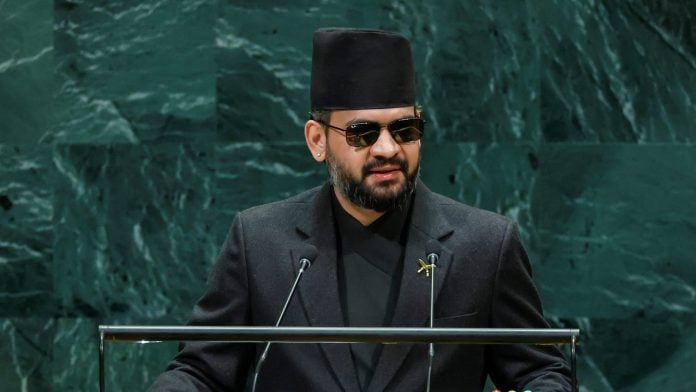
Coming from a senior minister in Prime Minister Balendra Shah’s RSP-led government, the remark was more than diplomatic courtesy. It signalled an attempt by a new generation of leaders to redefine nationalism around economic opportunity rather than grievance.
A new generation, a different political mandate
Three factors explain the timing of Wagle’s statement. First, the domestic transformation that brought the Balendra Shah-led government to power.
The Gen Z protests in September 2025 were initially driven by social media restrictions but quickly turned into a wider expression of anger against corruption and a loss of faith in a recycled political class. Shah’s government emerged as an alternative to the old style of politics that Nepal had grown accustomed to.
As mayor of Kathmandu, Shah built a following through his no-nonsense approach to governance, which frequently circulated on social media and resonated with the country’s youth.
His rejection of traditional political rhetoric distinguished him from Nepal’s established politicians, particularly among younger voters frustrated by a lack of job opportunities, political instability and corrupt governance.
Shah’s government has therefore centred its promise on reform and employment, priorities that have little to do with hostility towards India.
Economic ties make a case for pragmatism
The second factor is economic realism. India and Nepal have traditionally shared what is often described as roti-beti ka rishta—a relationship sustained across generations through cross-border marriages, education, family ties and local economies.
Approximately 62.3 per cent of Nepal’s merchandise trade is with India, with bilateral trade reaching $9.39 billion in FY 2025–26.
Furthermore, in 2024, the two countries signed a long-term agreement to increase Nepal’s electricity exports to India to 10,000 MW within ten years. This could become a significant source of revenue for Nepal.
Also Read: Balen Shah’s victory signals the fall of Nepal’s old establishment. India will have to adapt
Shah’s first bilateral visit could set the tone
The third factor is Prime Minister Balendra Shah’s first bilateral visit, expected later this year. The much-anticipated visit could build on this shift in political tone and signal that Nepal’s national confidence need not be demonstrated through political distance from New Delhi. Instead, it could be grounded in economic growth and employment.
For India, this is an opportunity to engage with a new generation of Nepali leadership and respond constructively to Wagle’s remarks.
The agenda could include the inauguration of the integrated check post at Bhairahawa, construction of the Dodhara Chandani check post, commencement of the Lower Arun hydropower project, and a petroleum pipeline from Siliguri to Jhapa.
If these projects deliver electricity, revenue, jobs and easier movement of people and goods, both countries could build a stronger foundation for their relationship—one based on substantive cooperation and diplomatic pragmatism rather than confrontation.
Old nationalist fault lines remain
However, the familiar politics of the recent past has not disappeared. Wagle’s remarks have provoked sharp criticism from Nepal’s political opposition. Kamal Thapa, a former deputy prime minister, insisted that “Nepal’s nationalism has never been based on opposition to any particular country”. Gokul Baskota, a former minister from the Communist Party of Nepal (Unified Marxist–Leninist), dismissed the statement as “intellectual bankruptcy”.
The dialogue between India and Nepal will also have to address difficult issues that go beyond diplomatic symbolism, particularly the territorial dispute over Kalapani, Lipulekh and Limpiyadhura.
India rejected Nepal’s revised political map in 2020. Discussions over the competing territorial claims will require sophisticated diplomatic manoeuvring from both sides.
Kathmandu, meanwhile, will seek more air-entry routes, easier access to Indian markets for its agricultural goods, faster implementation of hydropower projects and progress on the proposed Siliguri–Jhapa petroleum pipeline, among other priorities.
For Shah, the challenge will be delivering tangible economic gains under the scrutiny of an opposition eager to turn any cooperation or compromise into a domestic political controversy.
From concessions to opportunities
Ultimately, the test for Nepal’s new leadership will be whether it can move beyond a political culture that often measures engagement with India by the concessions made rather than the opportunities created.
This is precisely why Wagle’s statement matters. It does not mean that longstanding disputes have disappeared; rather, it suggests that there is more to the relationship than those disputes.
Prithvi Narayan Shah’s metaphor of a yam between two boulders captured Nepal’s anxieties about its geography in a different age and context. If Wagle’s words mark the beginning of a new political reality, the yam between two boulders may finally have outlived its usefulness as Nepal’s defining metaphor.
Rami Niranjan Desai is a Distinguished Fellow at the India Foundation, New Delhi. She tweets @ramindesai.
Views are personal
(Edited by Maryam Hassan)