




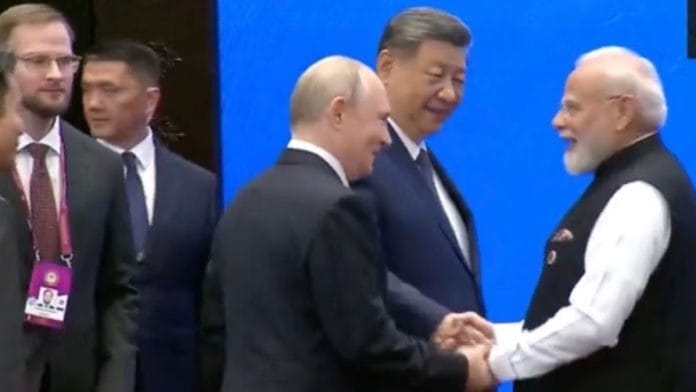

Like any other international event, the 26th meeting of the Council of Heads of State of the Shanghai Cooperation Organisation (SCO) has generated sufficient photo-ops for the government to reiterate its claim of India’s ascending status in the global arena. Such a reiteration, and rightly so, becomes all the more important in the context of Pakistan’s total marginalisation. Especially when both India and Pakistan were hyphenated during the granting of membership in 2017.
India’s exalted standing in the assembly of member countries, the forceful arguments that Prime Minister Narendra Modi made during his address, notably on combating cross-border terrorism and his call for ending wars and creating a cooperative framework for sharing technology, were all truly worth something to write home about. But as a mature and responsible emerging economy, India needs to go beyond counting admirations and assess its decisions in global forums.
At least three important aspects of the Bishkek Declaration merit deeper analysis and understanding, especially for India. New Delhi is going to host the BRICS Summit.
Intelligence sharing
The Bishkek Declaration at the SCO condemned military strikes on Iran and backed a political and diplomatic resolution in direct reference to the conflict, endorsed by all ten member states, including India. However, it stopped short of naming Israel and the United States as it had done last year.
Incidentally, India had disassociated itself from the statement by the SCO in June 2025, which had condemned “the military strikes carried out by Israel on the territory of the Islamic Republic of Iran”.
However, three months later, India signed a declaration adopted at the SCO Summit in Tianjin, China, in September 2025. It described the strikes on Iran as “a gross violation of the principles and norms of international law and the UN Charter, and an infringement on the sovereignty of the Islamic Republic of Iran”.
Emboldened by the Bishkek Declaration, it is very likely that Iran and its supporters would seek a much stronger language of condemnation at the BRICS summit. Iran is flaunting the Bishkek Declaration, especially the support for its right to develop peaceful nuclear energy under the Non-Proliferation Treaty without discrimination. It is a key tool to project solidarity and support of India, China and Russia, to secure broader geopolitical and diplomatic backing in the ongoing conflict and American sanctions. This change in stance is something that New Delhi will have to explain to its friends like the US and Israel, if not done already.
Second, the Bishkek Declaration condemned terrorism in all its forms and manifestations, and the members reaffirmed their commitment to combating terrorism, separatism and extremism. They also stressed that attempts to exploit terrorist, separatist and extremist groups for mercenary purposes were inadmissible. Yet, with Pakistan—an epicenter of terrorism—being a signatory to the declaration, it could claim to be a victim of terrorism, as it has done at several global forums. This could weaken New Delhi’s rightful and legitimate charge that Pakistan uses terrorism as a state policy.
Third, among the listed outcomes is the approval of regulations for a Universal Centre for Countering Challenges and Threats to the Security of SCO Member States. It is expected to strengthen cooperation among SCO members in dealing with terrorism, extremism, organised crime and other transnational threats, while improving coordination and information-sharing. This is easier said than done.
Neither Pakistan nor any other SCO member has done this so far, nor likely to provide actionable intelligence sharing in the future. With China’s dominant position in the SCO, its ‘all-weather friend’ Pakistan, whose single-point agenda is to oppose India in every forum, is very unlikely to give up its policy of ‘inflicting a thousand cuts’ on India through terrorism.
It is in this context that the forthcoming BRICS Summit in New Delhi assumes greater importance while flagging certain concerns. Had India disassociated from the Bishkek Declaration, it would have been the only member to do so and hence isolated at the SCO. By becoming a signatory, there will be attempts to create a perception that India’s traditional neutrality of judging international issues independently, rather than join China-led SCO or the Russia-led Eurasian Block that is one group of powers against another, is being diluted, if not totally abandoning the policy of non-alignment.
Also read: India should think twice before rolling out the red carpet for China
Balancing autonomy and multipolarity
Moving between strategic autonomy and flexible autonomy, a complete deviation from the classical Cold War-era version of non-alignment, India reserves the right to take a position based on its national interest. Yet, given the structural geopolitical imbalance of the SCO, New Delhi runs the risk of being drawn into the emerging anti-West, particularly anti-America and Israel, narrative constructed by China and Russia. Both countries are opposed to the ‘hegemony of the West’ and the supremacy of the US dollar, as witnessed in the SCO meet at Bishkek and the BRICS Summit at Kazan.
The biggest diplomatic and strategic challenge for India as the host and agenda setter of the 18th BRICS Summit will be to avert the SCO narrative from prevailing over the BRICS agenda, especially while having to deal with the US and Israel on several economic, technological and defense agreements.
India’s BRICS 2026 agenda emphasises resilience, innovation, cooperation and sustainability, suggesting that New Delhi envisages BRICS to focus on developmental and institutional cooperation and not degenerate into a forum for geopolitical confrontation.
India will have to carefully negotiate its path in the forthcoming BRICS Summit and balance between strategic autonomy and its advocacy of multipolarity to diplomatically withstand pressures from two of the strong members to carry forward the “Kazan and Bishkek spirit”.
Seshadri Chari is the former editor of ‘Organiser’. He tweets @seshadrichari. Views are personal.
(Edited by Ratan Priya)
The war President Trump launched against Iran at PM Netanyahu’s behest was illegal under international law. Despite having extended beyond sixty days, it does not have Congressional approval. Like President Putin’s “ special military operation “ against Ukraine, now in its fifth year. So, for SCO to condemn the war – observing the diplomatic courtesy of naming the perpetrators, – was the right thing to do. Very happy that India was on board with the Resolution.