




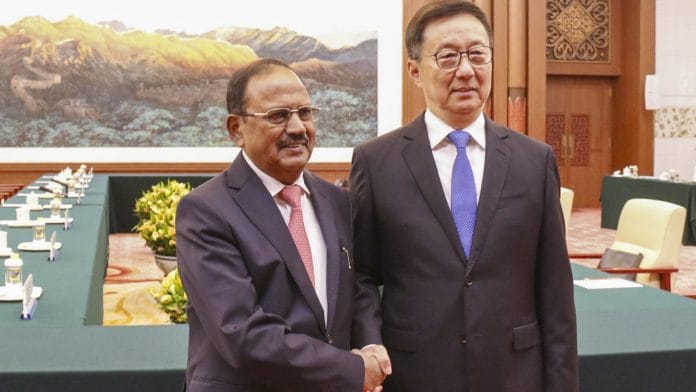

The 25th round of India-China Special Representative-level talks between National Security Adviser Ajit Doval and Chinese Foreign Minister Wang Yi in Beijing ended with an agreement to maintain peace along the Line of Actual Control, advance negotiations on the boundary dispute and strengthen mechanisms to prevent incidents and miscalculation. The two sides also agreed to work towards an “early and substantial harvest” on boundary delimitation and border management, add military communication channels, revive border trade and the Kailash-Manasarovar pilgrimage, and continue discussions on trans-border rivers and hydrological data sharing. The next round of talks will be held in New Delhi in 2027.
The core of the eight-point agreement is the need to keep the LAC conflict-free. But in 2020, it was China that breached the peace protocol. The de-escalation process produced the desired results, and though it took some time to bring the situation back to normalcy, the damage to mutual trust had already been done.
India has initiated several confidence-building measures (CBMs) to avoid confrontation with China and maintain border tranquillity so that bilateral trade is not jeopardised. New Delhi’s strategy in the continuing border talks focuses on actively pursuing diplomatic engagement and military communication mechanisms, such as the Working Mechanism for Consultation and Coordination (WMCC), to manage the 3,488-km LAC.
It is no secret that the US pushed the agenda of turning the QUAD into a security architecture to contain China with the help of the other three partners, India, Japan and Australia. This prompted Beijing to refer to the QUAD as “Asian NATO”, which New Delhi vehemently refuted as baseless. Yet India also refused to be drawn into the narrative of turning the QUAD into an “anti-China” formation. Though India’s move earned American criticism, it nevertheless convinced Beijing of India’s principled position.
Prime Minister Narendra Modi will travel to Bishkek, Kyrgyzstan, at the end of August to attend the 26th Shanghai Cooperation Organisation (SCO) summit. Among the SCO’s primary objectives is countering terrorism, separatism and extremism — three evils that would aptly define Pakistan. China insisted on making both India and Pakistan members of the SCO at the same time. Since then, notwithstanding this hyphenation, India has never put forth any condition for attending SCO meetings.
Meanwhile, Beijing continues to refer to Arunachal Pradesh as “Southern Tibet” or Zangnam and rename places there. In November 2025, Arunachal Pradesh-born Pema Wangjom Thongdok, a UK-based Indian citizen with an Indian passport, travelling from London to Japan with a scheduled three-hour layover in Shanghai, was detained for 18 hours at Shanghai Pudong International Airport and pressured to apply for a Chinese passport. The Indian Consulate in Shanghai assisted her in getting out of the situation, but Chinese officials maintained that “Chinese immigration officers acted according to regulations”, thus reiterating Beijing’s territorial claims over Arunachal Pradesh.
Also read: Trump’s China trapeze act shows why India can’t trust summit headlines
What China must explain
In this context, point number three of the eight-point agreement merits attention. While Beijing refuses to give up its highly unjustified claim on Arunachal Pradesh, it expects India to give up its decades-old position of an ‘all-sector border settlement’ and frame terms and references for an “Early and Substantial Harvest” of boundary delimitation and border management.
It is for the Chinese side to pay greater attention to upholding its commitment to the “guidance received from the leaders” of the two countries to maintain peace and tranquillity in the border areas and create an atmosphere for healthy and steady development of bilateral relations. “Following the leaders’ guidance” in the context of India-China border talks suggests that both countries must align their diplomatic and military actions with the high-level strategic consensus set by PM Modi and President Xi Jinping during top-level summits such as those held in Wuhan and Kazan, where both leaders agreed that India and China are development partners, not rivals, and pose no threat to each other.
While the political leadership is arming the PLA to the teeth and rapidly expanding its technological and global footprint, its relationship with the army follows the Maoist doctrine that “the Party commands the gun, and the gun must never be allowed to command the Party.” Beijing should explain if the 2020 Galwan incident was “guidance from the leader”.
In the context of India-China border talks, New Delhi has preferred to resolve the entire border demarcation in one go, aided by maps and the LAC. Beijing has been suggesting resolution on the basis of “low-hanging fruit” or “early harvest”, which essentially refers to dealing with less contentious areas or areas that are not disputed by either party. The fact is, after the forcible occupation of Tibet in 1959 and the ouster of the Dalai Lama, no stretch of the border can be considered “undisputed”.
The Indian government needs to come clean on its decades-old approach and not compromise on a simultaneous, comprehensive settlement across all sectors for piecemeal resolution. In any case, there is hardly any need to rush towards an early settlement until Beijing agrees to withdraw from the areas illegally ceded to it by Pakistan in the 1963 Sino-Pakistan Agreement, which India considers completely illegal and invalid.
With Beijing in no mood to share even routine hydrological data with India and with its reluctance to accept New Delhi’s olive branch, South Block should seriously consider rolling back the red carpet after the forthcoming BRICS summit is over.
Seshadri Chari is the former editor of ‘Organiser’. He tweets @seshadrichari. Views are personal.
(Edited by Prashant Dixit)
I personally feel a final settlement of the boundary question is almost impossible. As it was when Rajiv Gandhi met Deng in 1988. Better for the two countries to continue with what is undoubtedly not an optimal situation – an unsettled 3,488 kilometre long line, hazy in some places, much clearer in others. Hence talk of an early harvest. 2. India and China have to find a way to coexist peacefully. With very large volumes of trade and investment, perhaps a little travel and tourism as well.