






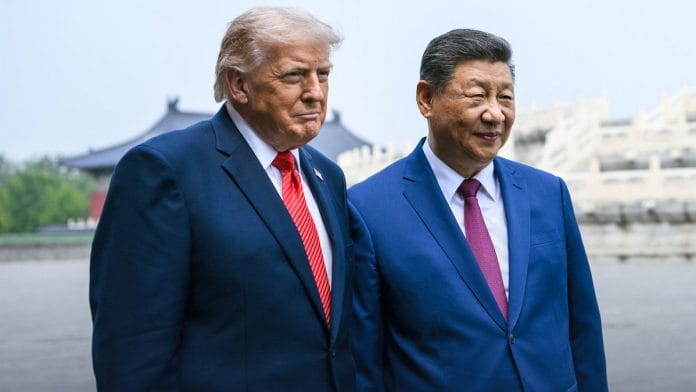

US President Donald Trump’s meeting with Chinese President Xi Jinping in Beijing was quite different from Richard Nixon’s landmark China visit more than half a century ago.
In 1972, Nixon undertook a seven-day visit to the People’s Republic of China (PRC) and met Mao Zedong, Chairman of the Central Committee of the Chinese Communist Party, and Zhou Enlai, the PRC Premier. The meeting came after two and a half decades of hostile relations since China’s establishment was announced in 1949. During this visit, the two governments negotiated the Shanghai Communiqué, an important step toward improving relations between the United States and the PRC.
Several preparatory initiatives had taken place before this visit, including meetings between Gen Yahya Khan of Pakistan and Chinese leaders to help broker a thaw between the US and China. There were also two secret trips by Henry Kissinger, then Assistant to the President for National Security Affairs, and two table tennis matches between US-China teams, earning Nixon’s visit the moniker of “ping-pong” diplomacy.
Incidentally, this visit was preceded by two very significant and historic events. One was the India-Pakistan conflict of 1971 that liberated Bangladesh. The other was the People’s Republic of China becoming a member of the UN as P5, resulting in the dismissal of the Republic of China (ROC)— that is, Taiwan— from UN membership.
Fifty-four years later, on May 13-15 2026, President Donald Trump was in China for three days. But unlike the Nixon-Mao US-China summit, it appears to be more of a personal business promotional visit, with gains and losses to the US still being calculated by friends and foes of America globally.
Also Read: Will Trump’s dance with China nudge South Korea & Japan to cross the nuclear threshold?
What did Trump’s China visit achieve?
The US President secured several business gains and strategic outcomes, according to a White House notification. It says China will buy 200 Boeing jets, with many more later, as well as “double-digit billions” worth of American agricultural goods, specifically soybeans, beef, and corn, and crude oil over the next three years.
It also announced the creation of a “Board of Trade” and a “Board of Investment” to oversee bilateral economic relations and investments in non-sensitive areas. The current 12-month tariff truce that was set to expire in November will also be extended, giving both economies breathing room. Besides these economic gains, China is believed to have been told to keep Iran out of its defence deals.
Amid all these deals, the status quo appears intact on the US position on Taiwan, with US Secretary of State Marco Rubio saying it was “unchanged” following Trump’s meeting with Xi. Taiwan’s foreign ministry thanked Washington for its support. Trump told reporters aboard Air Force One that he spoke “a lot” about Taiwan with Xi and added that on this subject, the Chinese President “does not want to see a fight for independence because that would be a very strong confrontation.”
The Chinese version, of course, is different. Beijing has said the deals are “preliminary”, but has characteristically not denied them either.
The outcome of the Trump-Xi Jinping meeting, touted as a summit, is left to inferences drawn by experts and academics in the absence of a structured joint statement, unlike the one issued after the Putin-Xi Jinping meeting.
Trump’s trapeze act
Immediately after Trump left, Putin landed in Beijing on his 25th visit to China. He reportedly had extensive talks with Xi, ending with a joint declaration, one among 20 agreements, focused on building a “multipolar world”—ostensibly meant to send a defiant signal to Trump.
While it would be tempting to conclude that Trump’s visit to China was inadequately planned and bereft of sufficient homework, it also needs to be noted that it is rooted in America’s 2026 National Defense Strategy, which clearly mentions four priority areas: defending the US homeland, deterring China through strength rather than force, increasing burden-sharing with US allies and partners, especially in NATO funding and managing Russia, and “supercharging” America’s defence industrial base.
This document does not specify what it means when it lists deterring China as a goal. Taiwan is notably not mentioned, a surprising omission since the NSS is emphatic about defending it. However, the classified Interim National Defense Strategic Guidance, published in mid-March 2025, reportedly said, “China is the Department’s sole pacing threat, and denial of a Chinese fait accompli seizure of Taiwan — while simultaneously defending the US homeland — is the Department’s sole pacing scenario.”
In its National Defense Strategy, the Trump administration has set an ambitious goal to tackle China by maintaining a “favourable balance of power” while securing trade deals and persuading China to “accept and live under” a peace “on terms favourable to Americans.”
During the first Trump term, the trade war with China fed into deteriorating security relations, a dynamic exacerbated by the Covid-19 pandemic. Meanwhile, Barack Obama’s 2014 Quadrennial Defense Review viewed Russia and China as both threats and potential security partners — two US “adversaries” now brought closer together by Trump.
From a trade and tariff war with China to a “G2 world order”, from no compromise on Taiwan to warning Taiwan against a unilateral declaration of independence, Trump’s foreign policy has been oscillating like a circus trapeze.
Also Read: PM Modi’s austerity push isn’t economic Emergency. He is preparing India for a global crisis
How India should read the new order
Considering these geo-economic volatilities and challenges, India needs a liberal industrial policy for a robust and optimally automated manufacturing sector, sufficient budgetary support for state-sponsored R&D, strong AI governance frameworks, semiconductor ecosystem support, trusted telecom infrastructure, and reliable cyber resilience partnerships. Without these parameters and technological depth, the dream of Viksit Bharat 2047 and India’s geopolitical ambitions will be difficult to achieve.
The world has moved from ideology-oriented geopolitics to individual-driven geopolitics. New Delhi has so far formulated a well-crafted and balanced foreign policy strategy to deal with the negative impacts of highly volatile global ambiguities.
However, we can no longer base future policies and political ties on summit headlines and official printouts of contesting powers and rival power blocs.
The next time a foreign dignitary visits us, we should be prepared to spell out our concerns and apprehensions candidly, and hand over the bitter truths, of course coated with chocolate.
Seshadri Chari is the former editor of ‘Organiser’. He tweets @seshadrichari. Views are personal.
(Edited by Asavari Singh)