





The portrait hung in a windowless hall, swaddled in purple velvet: Taiwan’s élite Republic of China Military Academy, earlier located in and named after Whampoa, is the cradle of modern China, but few knew of the idol that looked over this secluded temple. Ernst David Bergmann—a Berlin University organic chemist whose name was removed from a foundational textbook by the Nazis and who fled persecution in 1933—was well known as the first chairman of Israel’s atomic energy commission. He was counted by President Shimon Peres as one of the seven founders of the state of Israel, and was widely known to have sired its nuclear weapons programme.
Early in 1988, the political scientist Yitzhak Schichor was ushered into the hall in Taiwan’s Kaohsiung, and discovered the scientist had another, secret child: “No one volunteered any explanation as to why such a shrine—for this is what it was—had been dedicated to Bergmann’s memory. Needless to say, I did not dare ask.”
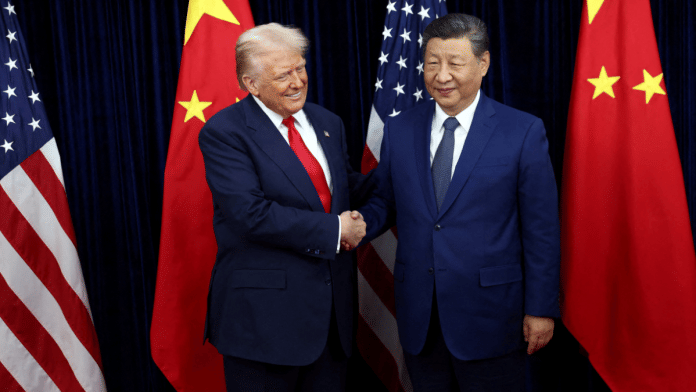
This week, on the flight home from his summit meeting with President Xi Jinping, President Donald Trump announced he had delayed a $14 billion arms sale to Taiwan, as a “negotiating chip.” “I may do it, I may not,” Trump said. The president reiterated his claims that Taiwan “stole our chip industry,” and appeared to suggest geographical distance made the island indefensible.
Few Taiwan leaders doubt what this means. The Taiwan Relations Act, passed by the United States Congress in 1979, promised to make available “such defence articles and defence services in such quantity as may be necessary.” The so-called Six Assurances made to Taiwan in 1982 promised that the United States would not consult with the People’s Republic of China on arms sales.
Taiwan, though, has long worried just how far the United States would in fact be willing to go to defend its ally. Following China’s nuclear tests in 1964, Taiwan—like South Korea and Japan—considered acquiring nuclear weapons, and came close to doing so.
Today, Trump’s efforts to secure détente with China could end up nudging these states to cross the nuclear threshold.
Also read: Tracing the story of Iran’s nuclear programme & turning points as Israel-US try to obliterate it
The logic of the bomb
Like nation-states across the world, a succession of crises has compelled Taiwan to reconsider its security environment. Eighty-five per cent of East Asia’s oil and gas transit through the Strait of Hormuz, and the war in the Persian Gulf has underlined Taiwan’s vulnerabilities. Former President Tsai Ing-wen was committed to phasing out nuclear power, and the last operating reactor was decommissioned last year. The country’s semiconductor industry is power-intensive, though, and rising global demand could see consumption rising twice as fast as it did in the past decade, experts Yu-Hsuan Yeh, Bonny Lin and Jane Nakano have estimated.
To add to the uncertainty, some experts believe the ongoing modernisation of the People’s Liberation Army—scheduled to be completed by the middle of the century—presages the occupation of Taiwan. Although the war in Ukraine has demonstrated that large powers cannot be certain of winning wars—and Taiwan’s capacity to resist an invasion is considerable—there are questions about whether a prolonged port blockade can be resisted.
From the outset, the United States used nuclear weapons to ensure the PRC could not push beyond a point. It considered using nuclear weapons against North Korea in 1950, and began positioning them on the peninsula seven years later. The PLA tested the resolve of the US between 1954 and 1958, assaulting the Dachen islands and shelling Kinmen and Matsu. The United States, historian Pang Yang Huei writes, responded by sending in aircraft carriers with combat jets capable of delivering low-yield nuclear weapons.
The PLA responded by initiating its own nuclear-weapons programme. Taiwan, in turn, began receiving intelligence from the Central Intelligence Agency on China’s nuclear programme from 1962, based on images gathered of the Lop Nur test site by spy-planes. Chiang Kai-shek, Taiwan’s military ruler, ordered an outreach to Bergmann. Israel, Schichor writes, saw many reasons to respond, including the PRC’s growing support for Arab revolutionaries.
Following the PRC’s first nuclear test in 1964, Bergmann was invited to Taiwan, and spent a week in secret meetings held at the Lalu Sun Moon Lake Hotel in central Taiwan. The discussions led to an agreement to replicate Israel’s programme by setting up research institutes focused on nuclear weapons, missiles, and electronics.
Also read: Nehru and Modi’s dilemmas are similar. Secret documents on 1953 nuclear crisis show
The ultimate insurance
Like many other emerging nuclear powers, Taiwan pursued nuclear weapons behind the façade of a peaceful nuclear power programme. Taiwan sought to procure a fuel-reprocessing plant—a critical step toward producing the uranium and plutonium needed for weapons—from West Germany and France. Through clandestine sources, the CIA learned that Taiwan’s scientists had computer-modelled components of a nuclear bomb in 1974-1975. The CIA estimated that Taiwan would be able to fabricate a “weaponised nuclear device” by 1976, experts David Albright and Andrea Stricker wrote.
Faced with intense United States pressure to roll back their programme, Taiwan sought to evade both CIA intelligence gathering and inspections conducted by the International Atomic Energy Agency. A concealed plutonium separation plant was set up at the Lung-Yuan Research Park; Taiwan also acquired the supercomputing capabilities needed to virtually test miniaturised nuclear warhead designs.
The CIA, however, had recruited Chang Hsien-yi, the deputy director at the Institute for Nuclear Energy Research, where much of this work was done. Chang was smuggled out of Taiwan in 1987, after providing information that allowed the United States to confront the country’s leadership and force the closure of the programme.
Elsewhere in Asia, other countries anxious about China were engaged in similar operations. General Park Chung-hee, South Korea’s military dictator, ordered his scientists to develop a nuclear weapon within six years, along with long-range missiles in 1971. A now-declassified diplomatic cable sent by the United States’ ambassador Philip Habib in 1974 records that the decision was driven by “increasing doubts about [the] durability of US commitments.”
America, for its part, considered giving Japan nuclear weapons in the 1950s, under arrangements similar to those made for other allies. Ever since 1967, Japan has institutionalised the so-called Three Principles, which prohibit the country from possessing, producing, or allowing the stationing of nuclear weapons. Sato Eisaku, the Prime Minister who stewarded the Three Principles, however secretly ordered officials to study the feasibility of acquiring nuclear weapons, and signed a secret treaty that allowed the stationing of United States strategic forces in extreme circumstances.
Also read: 25 years after 9/11—Trump’s new counter-terrorism doctrine reveals an exhausted America
An uncertain future
The case against such plans has also long been evident. For one, the PRC might be compelled to go to war if one of Asia’s advanced industrial democracies were to seem about to cross the nuclear threshold. The real-world willingness of countries like Taiwan to use nuclear weapons, knowing that certain annihilation would follow, also remains untested. Finally, Taiwan has means to deter attack other than its nuclear capabilities: Tech entrepreneur Morris Chang founded TSMC, which now produces an estimated 90 per cent of the world’s super-advanced semiconductor chips, in 1987, one year before the nuclear weapons project was shut down.
Elements of these calculations, of course, are in constant evolution. Trump has pushed hard for Taiwan’s advanced semiconductor production to be moved to the United States. This would reduce American vulnerabilities—but at the cost of increasing Taiwan’s existential anxieties. And, of course, events from Ukraine to the Persian Gulf are forcing countries to reassess the risks they face, and how to respond to them.
“Every time Xi tests Taiwan without consequence, and every time the United States reveals its lack of stomach for economic pain,” scholar Eyck Freyman argues, “the more emboldened Xi will feel to push harder.”
Asia’s threshold powers are considering whether to push back—and how. The growing reluctance of America to risk fortune and blood to defend distant allies could end up making wars not only more likely, but unimaginably more lethal.
Praveen Swami is Contributing Editor at ThePrint. His X handle is @praveenswami. Views are personal.
(Edited by Theres Sudeep)
That is my belief. Will not say, fear. Nuclear weapons create both deterrence and peace. With all that has gone wrong between India and Pakistan, they have prevented full scale war since 1971.