




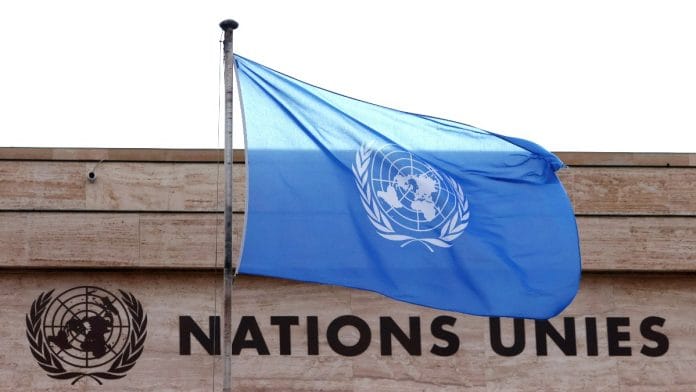

International human rights law after World War II was intended to ensure that the rule of law prevails globally; with the support of multilateral institutions and, where necessary, ensure a rule-based international order.
It is sobering to recall that the human race invented slavery, indentured labour, the Holocaust and fought two consecutive world wars. When Mussolini overran Ethiopia (then Abyssinia), Emperor Haile Selassie appealed to the League of Nations in 1936, but no help came. He left the assembly in Geneva, predicting the intergovernmental organisation’s rapid downfall.
The United Nations was built on the ashes of the League and must not perish.
At a time when human rights—humanitarian law and the multilateral institutions they represent—and the funding required for giving succour to human suffering—are mocked and ridiculed by United States President Donald Trump and his MAGA clique, a reappraisal of human rights law and their institutions appears essential to safeguard and nurture the future of humanity.
India is an original signatory to the 1948 Universal Declaration of Human Rights (UDHR). While still under colonial rule, India contributed to the drafting of the UDHR, which began in February 1947. India’s representative, Hansa Mehta, played a crucial role in ensuring gender neutral language. Rather than the phrase “All men are born free and equal,” Mehta insisted that it begin with “all human beings,” which was no mean achievement for that time and age.
Widely accepted as the basis of international human rights law, the UDHR enshrines the principle that human beings are born equal in dignity and rights, principles underlying every culture and civilisation, religion and philosophy from antiquity till today. These rights are referred to as Universal Rights.
A post-January 2026 view of humanity
With Trump 2.0, multilateralism took a huge hit. The European Union initially seemed to cave in and even now appears to be internally confused with regard to its policy toward President Trump and his antics. The result is a deep and polemical divide on dignity, justice and equality—principles at the heart of the UDHR, the Vienna Declaration and Program of Action, and other related human rights instruments.
The UN has lost credibility because it failed to defend its Charter and maintain international peace, security, enjoyment of human rights and fundamental freedoms for all. The hitherto international guarantor of human rights and the land of dreams—the United States—has turned its back on its own creation. Deterrence lost its meaning. The clouds of war now jostle with weaponisation of tariffs, external assassinations and seemingly endless conflicts, which, in the view of many, should never have occurred.
In today’s disorderly world, the Preamble of the United Nations Educational, Scientific and Cultural Organisation’s Constitution sounds a warning bell:
“Since wars begin in the minds of men, it is in the minds of men that the defences of peace must be constructed.”
Such specialised institutions like the UNESCO were also among the many humanitarian missions mocked by Trump, who has quit it and refused to pay the backlog of US dues.
In retrospect, the world of 2026 is very different from 1993, the year the VDPA was adopted. One is convinced that today, the VDPA, adopted in 1993 after a gruelling 11-hour nonstop negotiation that concluded successfully at 4 am, could never have been adopted. Trump and the MAGA base would never accept that all rights—economic, social and political—are intrinsically interlinked and come as a package.
In 1993, as Secretary to the Drafting Committee of the World Conference, under the charismatic chairmanship of Brazilian Ambassador Eduardo Paes Saboia, I was privileged to witness the intricate negotiations that led to the adoption of the VDPA. It “reaffirmed the principle of indivisibility, interdependence and interrelatedness of all human rights.”
The ideological pillars of the human rights system within the UN had made a dramatic shift, one that was hoped would never be coloured by Cold War politics again.
Alas, in 2026, new challenges emerged since a certain someone in the White House regards human rights as a mechanism to establish political and economic control, especially over emerging markets. A Cold War 2.0 looms over us.
Also Read: India-EU agenda can fundamentally alter global geopolitics—if Europe stands up to Trump
Debating human rights
The human rights debate in the West has become increasingly polarised with the rise of populism, racism, and jingoism. The conflict has resulted in an increasingly toxic argument between the sovereignty of the individual versus the sovereignty of the nation.
India believes that democracy, tolerance, and pluralism are the best guarantees for the full realisation of human rights. It is through democracy that individual and collective rights are best reconciled. Development is imperative to achieve the fullest democratisation. The right to food, shelter, and clothing is as important as political rights, including the right to vote.
At the core of India’s approach is the conviction that development may not be a sufficient condition for the full enjoyment of human rights, but it definitely enables the betterment of human life.
In a dialectical context, the evolution of a multi-faceted and multi-dimensional relationship between the West and the “Global South” has become far more challenging. The transactional approach of Trumpism only highlights what is good for them. It rejects that for developing countries, the right to food, shelter and clothing are as important as political rights, including universal adult franchise.
A once unequal partner, destiny will ensure that the Global South plays an increasingly dominant role in ensuring the centrality of human rights in an increasingly asymmetrical and divided world. This seems much more improbable today.
Also Read: India must stop being the ‘gentle elephant’. Modi’s Europe tour marks a strategic shift
India and the future of humanitarianism
What should India do? What are India’s foreign policy options in such a challenging international scenario? Is there a way forward? Is the problem ideological?
While India, for excellent strategic reasons, may continue to shy away from “alliances,” we have become part of a rapidly increasing number of “arrangements” of differing purpose, cohesiveness, and geographic extension. Each arrangement comes with obligations that impact India’s foreign policy options.
India may need to rethink its position on alliances and so-called “strategic partnerships.” In doing so, she needs to focus on her core national interests. India needs to firmly combat China’s efforts to trap her in her sub-region, so that she can play her legitimate role as an emerging power, including in the UN.
One option is that India must continue to urge “Vasudhaiva Kutumbakam” or the world is one family to reconcile the bitterly divided world disorder, as India’s gift to the world.
It flows from Swami Vivekananda’s message from when India was under the colonial yoke. He said:
“India for thousands of years peacefully existed.
Even earlier, when history had no record and tradition dared not peer into the gloom of that intense past,
Even from then until now, ideas after ideas have marched out from her,
But every word has been spoken with a blessing behind it and peace before it.
We, of all nations in the world, have never been a conquering race, and that blessing is on our head
And therefore we live.”
Ultimately, truth and justice must prevail to ensure the enjoyment of human rights and fundamental freedoms for all. This must be India’s message to the world in the present global disorder, for there is no better alternative.
Bhaswati Mukherjee is a retired IFS officer. She has served as India’s ambassador to UNESCO, Paris, and the Netherlands. Views are personal.
(Edited by Insha Jalil Waziri)
The word “human rights” has been interpreted by those in the west (especially Europe). Funnily enough they have started to realize that which is why they are stopping immigration.
Human rights on a macro level can be pushed by our country. On a micro level we have to deal with our own internal security issues which is not something the “human right” groups like.
India itself is very sensitive to tutorials on human rights from the UN and other globally credible institutions.