







New Delhi: At Ambawatta One in Mehrauli, Delhi arrives in chauffeur-driven cars.
The class-laden conversation begins at the valet parking point itself.
Near Ensemble, one of the country’s oldest multi-designer boutiques, founded by Tarun Tahiliani and Sailaja Tahiliani in 1987, a young woman asked an older man which Mercedes he had just bought.
“430,” he said.
“You got the 430?” she asked. “We are also considering either the Mercedes 630 or a Range Rover.”
Mehrauli has long been associated with the Qutub Minar, the archaeological park, and old congested Lal Dora settlements. In the 2000s, the first phase of gentrification happened along the edge of the neighbourhood overlooking the Qutab—with Olive, Tamarind Court, Thai Wok. That didn’t end well. In fact, it ended in a murder—widely remembered as the Jessica Lal case.
Then came the second spurt, through the 2010s, when Mehrauli’s luxury map began to fill out beyond restaurants. The same corners of it now mean another kind of Delhi outing: bridal shopping, Sunday brunch, design stores, coffee, bars, courtyards, and restaurants with a view. Ambawatta One and the internally connected Qutab Garden complex include Manish Malhotra, Anita Dongre, Tarun Tahiliani, Seetu Kohli Home, Ralph Lauren Home, and Fendi Casa, among others. One Style Mile has Sabyasachi, Olive Bar & Kitchen and The Grammar Room.
A new address
Mehrauli today is the fastest-emerging IT spot for the young. It is the latest address for the partying Delhi elites who had abandoned Hauz Khas Village for its slow descent in the past decade. The weekends are packed with food, music, and dance. The cuisine ranges from Armenian to Thai to modern Indian, and the majestic Qutab Minar view is on everyone’s menu.
By evening, the bridal-shopping crowd gives way to dinner reservations, birthday groups, and people headed to bars. The lights come on across the compounds, and the clothes change too: heels, dresses, shirts meant for a night out on the town.
The complex reeks of class—not just because of the Mercs.
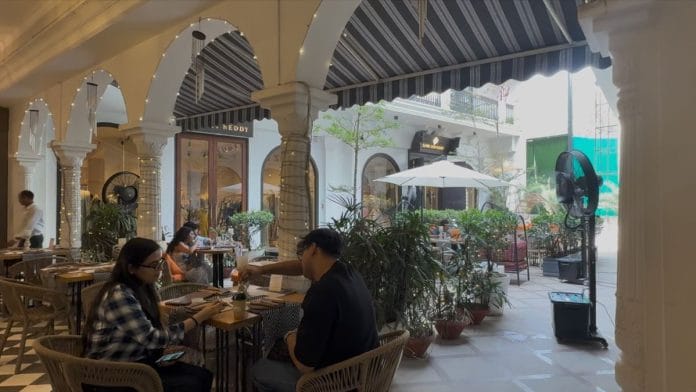
At Ambawatta One, it is easy to lose track of where you are in the compound. It is a casual and seamless ivory-white space aesthetic that blends high-end restaurants with higher-end designer stores. A corridor opens into a courtyard. A staircase leads to another row of stores. Embellished clothes sit behind glass. A café appears at the end of a marble-floored passage. At some point, a turn that seems to lead out brings you to another store instead.
There are other instructions built into the space bearing a not-so-subtle ‘keep out’ message. At the gate, a sign says two-wheelers are not allowed inside. Tens of scooters are parked in a lot, but outside the boundary wall. Inside, a washroom sign says: ‘Men’s washroom only for guests’. The complex is designed for lingering, but not everyone moves through it in the same way. In fact, not everyone can get in.
Hauz Khas Village in its heyday had a looser, more improvised feel. Ambawatta One works differently. It does not make luxury look accidental. It is polished, guarded, and clear about who it is built for.
Kriti Sharma, an entrepreneur with her own hair care brand, explains the appeal. The 34-year-old, whose family lives in Chattarpur, first came to Mehrauli to eat at Olive.
“It’s one of those iconic restaurants that’s been there for the longest time,” she said.
Later, Sharma shopped at Sabyasachi for her wedding outfit, Pernia’s Pop-Up Shop for other pieces, and now visits Ambawatta One for multiple brands. She likes the area because it contains the whole outing: shopping, food, coffee, drinks, and a place to sit.
“I love that you don’t need to leave the place,” she added.
Also read: On Delhi’s pavements, women sleep in shifts. Survival leaves little room for rest
‘A wonderful secret’
Before the designer map filled in, a woman sat under a tree with a sandwich and a Coke.
She was Delhi’s ace designer with an eye for ambience and real estate. But more so, for ‘potential’. She is the quintessential finder of quaint spaces that could be turned around and made into chic elite hubs. She did it first with Mehrauli, and then with Hauz Khas Village.
Bina Ramani’s tryst with Mehrauli began in 1985, when she returned to India after decades in New York and London. Delhi, she said, was still a city where people went to Connaught Place to shop. South Extension was considered far. Bars were mostly inside hotels.
“At the time, there was no boundary wall,” she told ThePrint. “Anybody could walk into the Qutub complex from any part.”
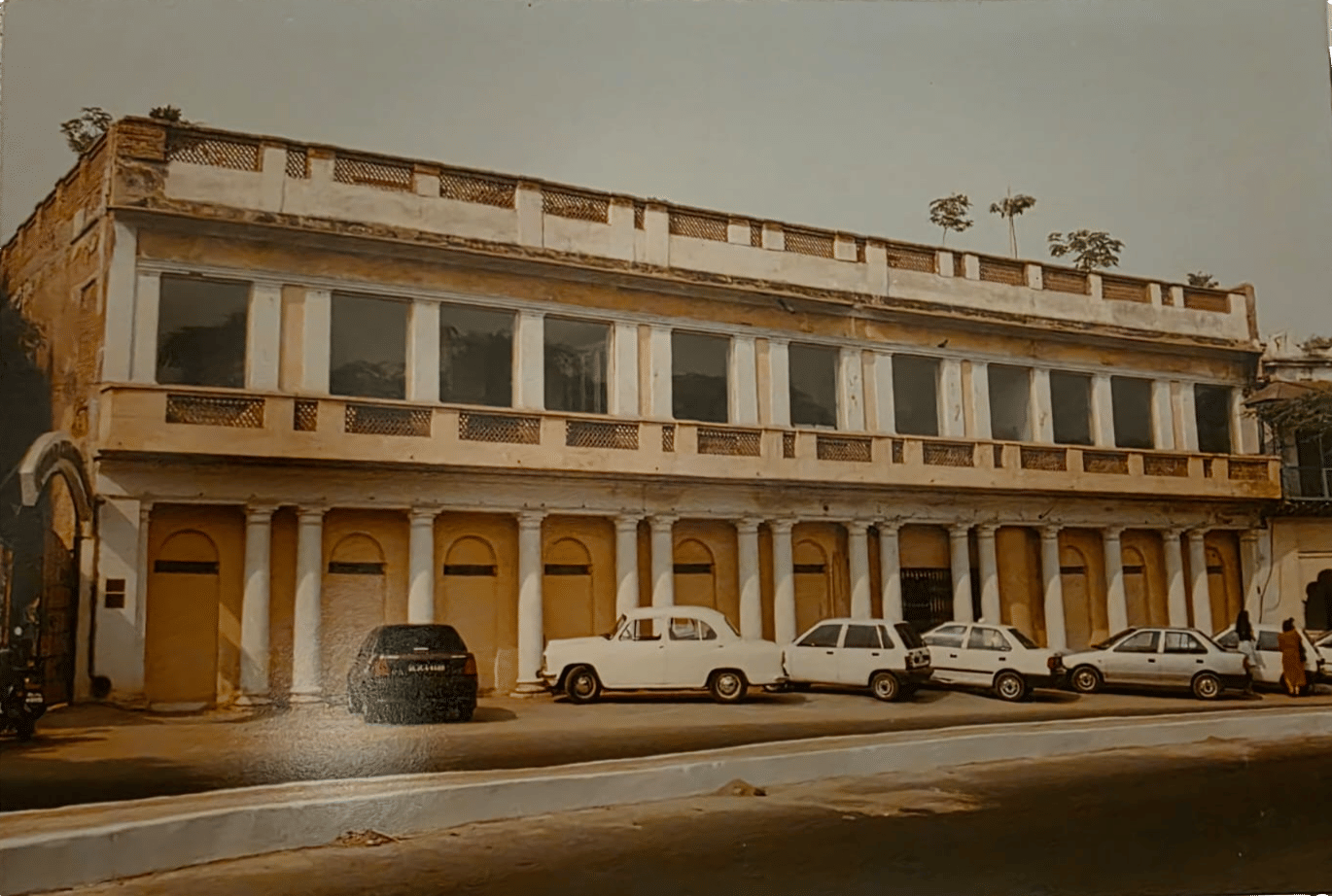
She kept returning to the area in her ‘little red Maruti’, drawn to the shuttered windows of the building opposite.
“I don’t know why I got obsessed with that area of Delhi. I would take a sandwich and a Coke and sit under the tree, especially in the rainy season. It was so romantic. It was taking me back to some past life,” she added.
The windows held her attention. “I was thinking one day some window will open, and I’ll find out what’s behind. I seemed to know of some life behind there.”
Through a caretaker, she met Diwan Chand Gupta, part of the family that owned the building. Gupta tried to dissuade her. “Nobody goes here. It’s haunted,” Ramani recalled him saying.
But Gupta showed her the property: a British colonial-style colonnade and a haveli. He also saw something familiar in Ramani’s plans.
“You’re reminding me of my father. He was a thinker like you. He was always ahead, coming up with ideas,” Gupta told Ramani.
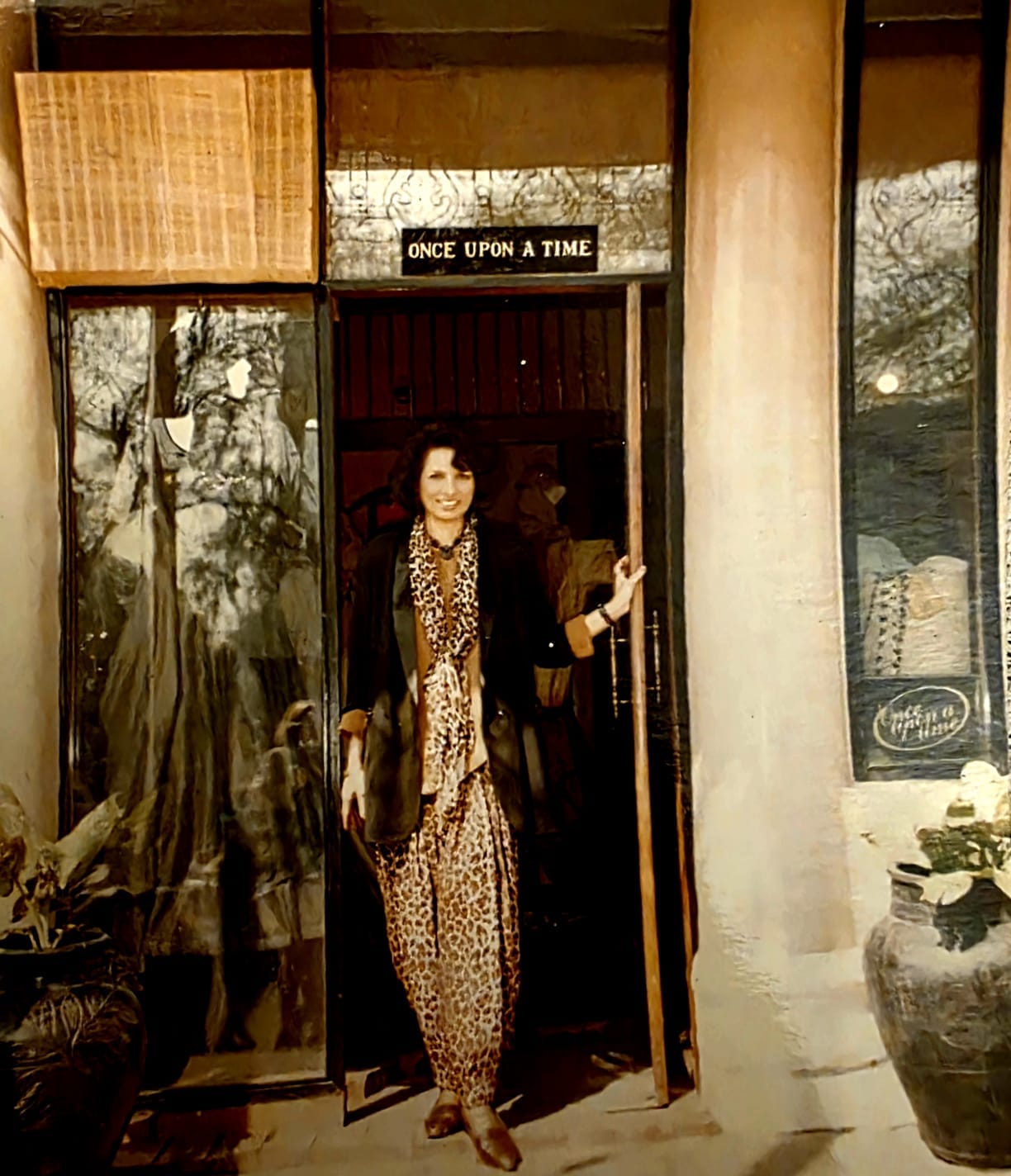
The rooms he opened for her were not ready for retail. The floor, she said, had at least six to seven inches of pigeon droppings. “It was filthy, and you couldn’t breathe in there,” she said.
But there were antique carved doors, old windows between rooms, and a charm she could see through the bird faeces.
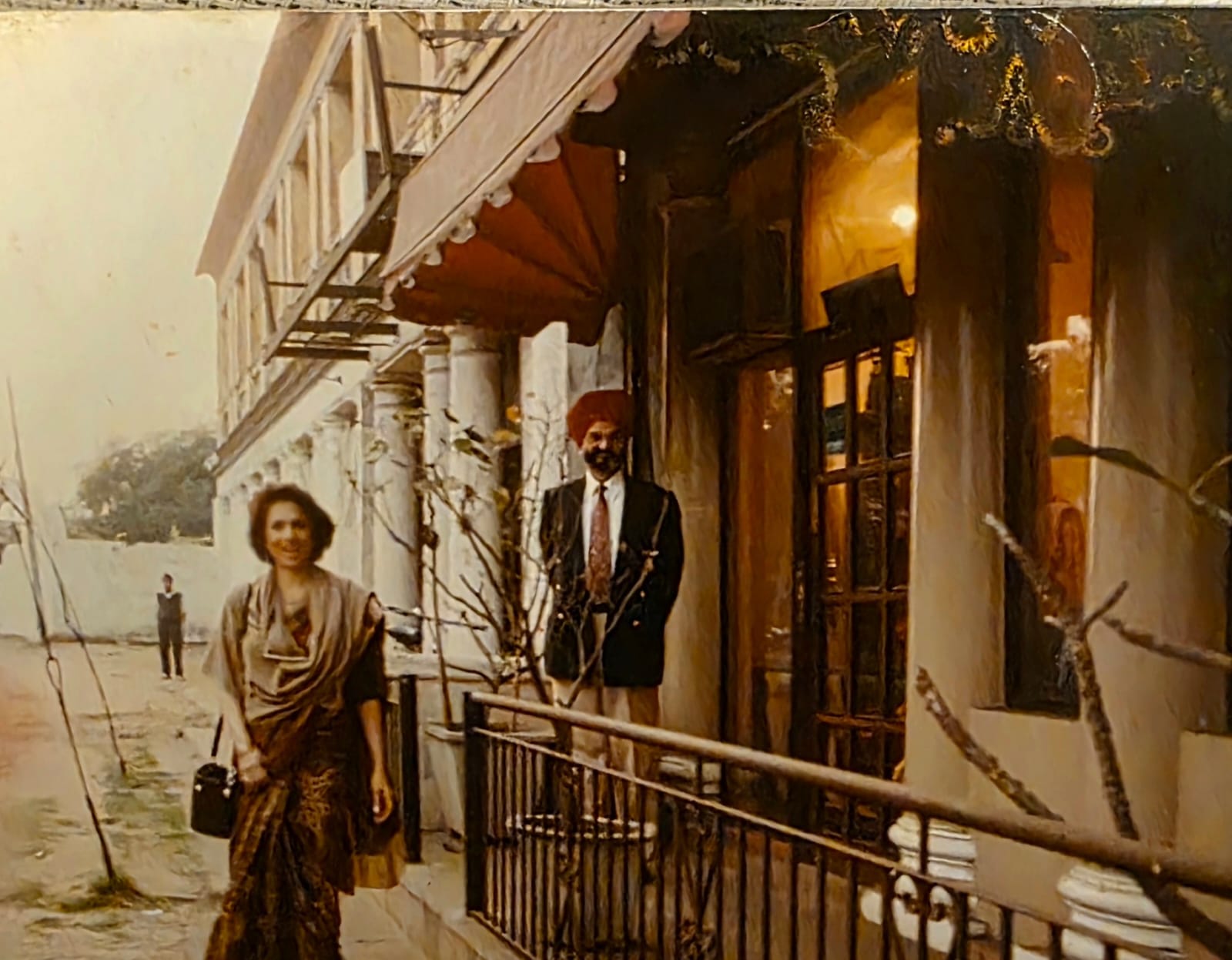
On 1 January 1987, Ramani opened Once Upon a Time. She made clothes using old saris and Indian textiles, and put them on handmade stands topped with carved cow and horse heads.
“Everybody was shocked and alarmed that, oh wow, she’s making Western clothes out of brocade. They’d never seen anything like it,” she said.
On the third day of being open, she recalled, Sonia Gandhi and Jaya Bachchan walked in with Sunita Kohli. Wives of diplomats began making the trek. The French and American circles in Delhi found their way there. So did the city’s social set.
One American ambassador’s wife was blunt about how strange the proposition was. “Would anyone go to the Statue of Liberty to go shopping for a dress?” Ramani recalled her asking.
“She was really shocked that I could dare to believe that I could draw clients to the dead end of Delhi, near a lost ancient relic, the Qutab Minar,” the designer added.
The early evenings Ramani described were a kind of Indo-European salon. Diplomat wives brought wine and cheese. Music played. People shopped, lingered, and returned.
“We were really encased in a big wonderful private secret,” she said.
A Delhi habit
The private secret did not stay that way for long. Tamarind Court Café made the outing linger. Customers could shop, eat, listen to music, and sit under the trees. Before the luxury compounds arrived in their current form, Thai Wok made Mehrauli part of Delhi’s nightlife. The area was still far from Delhi’s main circuits, but the distance had now become part of the point.
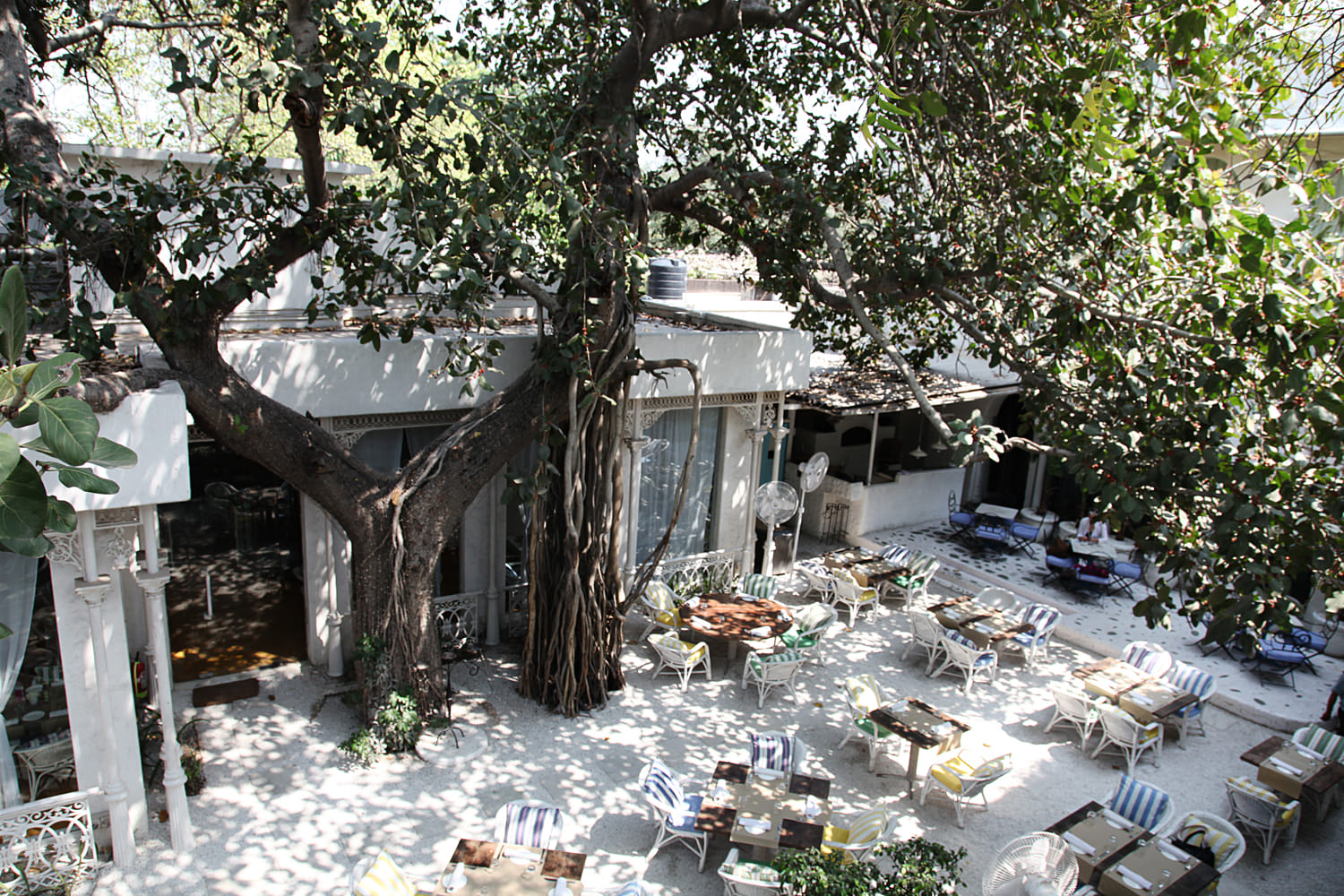
When AD Singh, founder and managing director of the Olive Group, first saw the Mehrauli property, he was already running Olive in Mumbai. The Delhi site had space, old walls, and a large tree at its centre.
“The property was stunning. It’s special for a Bombayite; we’re so starved for good space here in Bombay,” he said.
Olive was not the first restaurant to try the area, Singh said, but it changed how Delhi saw Mehrauli.
“Every single table at Olive would have had some of the most interesting, some of the most powerful people in Delhi city,” he said, recalling those early years.
For many Delhiites, this was how Mehrauli became familiar: not through a designer appointment, but through a meal. A long drive for dinner, a Sunday brunch under a tree, a birthday celebration, a drink with the Qutub Minar nearby. The restaurants taught Delhi to make the trip.
Shyna Kumar, 25, a cryptocurrency trader who lives in Sainik Farms, remembers going to Olive with her parents when she was in school. Jaidev Pant, a 25-year-old creative consultant, also first knew Mehrauli through Olive.
“It was an iconic cultural landmark in Delhi,” he said.
Olive still carries memory and status, but the newer Mehrauli has more entry points: a wedding fitting, a café plan, a table at The Grammar Room on a rainy day, or a Saturday spent window-shopping through stores one may never buy from.
For wedding shoppers, the attraction is concentration. Ridhi Sharma first came to Mehrauli in 2014 to shop for her sister’s wedding. It didn’t have as many stores then, she said, but it was already the destination for leading designers. Since then, she has shopped at Sabyasachi, Ambawatta One, and The Kila, mostly for weddings.
Saira Majithia, a 25-year-old who runs her own business, knew Mehrauli first through a school trip to the Qutub Minar. In early 2024, when she got engaged, she returned to the area to buy her engagement outfit from Rimple and Harpreet for about Rs 1 lakh. She was soon back with family members shopping for other functions.
“If you want your designer, it’s all there,” Majithia said.
Also read: How Delhi’s ‘Viklang Basti’ lost everything in a fire and fought to get new wheelchairs
The view becomes value
As Mehrauli changed, the old walls, the courtyards, and the proximity to the Qutub Minar became more than atmosphere. They became part of the value.
For Seetu Kohli, an architect who branched out into interiors and furniture, luxury has rarely been separated from the character of a city.
“In Paris, you go to Champs-Élysées, or you go to Bond Street in London or Madison Avenue in New York—there’s a lot of city vibe, the city soul. Luxury without character, without soul would not really be luxury because what you’re buying is an emotion. It’s just not a product,” she said.
To Kohli, Mehrauli offers what a mall cannot. “Nowhere else in Delhi can you have a shopping complex which is overlooking the Qutub Minar. It is so beautifully Delhi.”
The setting matters to brands, too.
“We also have a lot of learning from Europe and the European luxury brands on how character and heritage is so important to sell even contemporary luxury,” Kohli said.
In her view, the newer buildings have not simply imposed a contemporary look on the area.
“The new buildings reference the past through the design borrowed from the old buildings. It just merges so beautifully,” she added.
But the language of heritage can make the transformation sound more deliberate than it may have been. Architect Ayesha Hussain, 35, is sceptical of how neatly that language fits the newer Mehrauli. The area may now be sold as a heritage setting, but she does not think every restaurant or store necessarily arrived because of a careful conservation impulse. According to her, the first attraction may have been more practical: older properties, lower rent, and large spaces. The heritage look came with cheap real estate.
The narrative came later.
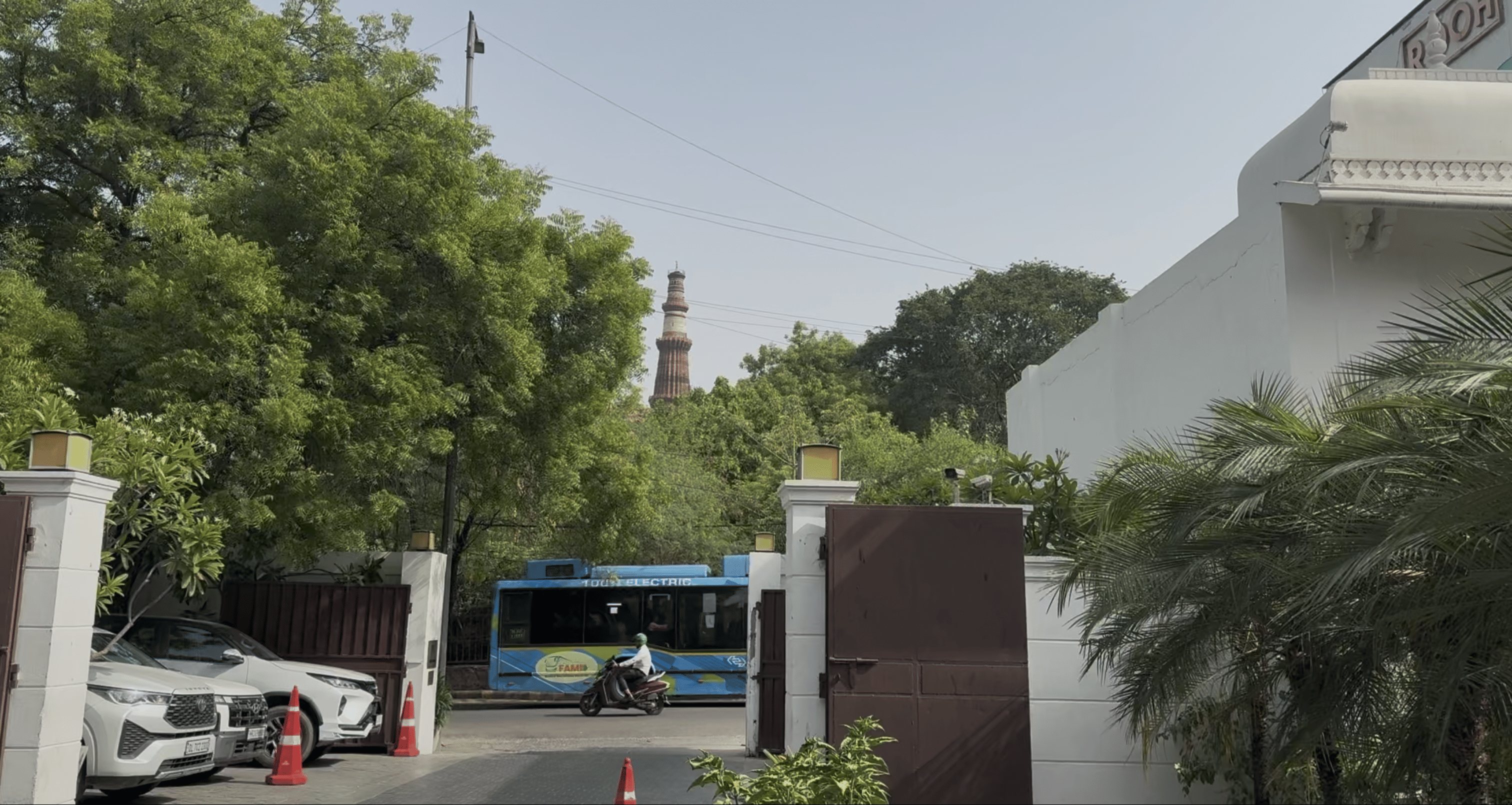
Hussain grew up with another Mehrauli. Her mother, conservation architect Smita Makhija, worked in the Mehrauli Archaeological Park and led heritage walks there, which Hussain would join as a child. The archaeological park, she said, has improved with conservation work. But as a resident now, she sees another side of the change: more buildings, more congestion, and by-lanes that have become harder to navigate.
The restaurants and stores, she said, are often tucked inside complexes, so the expansion can happen without immediately announcing itself.
“Suddenly there were like fifty things there,” she said of Ambawatta. “I didn’t even realise when that happened.”
To Hussain, the high-end stretch remains separate from the neighbourhood around it. “It’s a very small pocke; a self-contained world. It has nothing to do with our neighbourhood.”
Even Kohli does not see coexistence as accidental or effortless. Delhi, she said, cannot simply remake its older areas by flattening them.
“We cannot redevelop the city like Bombay. It would be blasphemous to do that to Delhi,” she said.
That does not mean congestion should be preserved as character. Kohli said safety concerns in older areas must be addressed. Her answer is to reduce pressure on neighbourhoods that cannot keep absorbing more people, cars, and construction, while allowing newer parts of the city to take more of that growth.
“The old lives with the new so beautifully. That’s the charm of Mehrauli.”
Also read: The city of kebabs and nawabs, Lucknow is the new party capital
Many doors in
Olive now signifies all the many versions of Mehrauli. It’s the old destination restaurant, a present-day brunch address, the meal between shopping appointments, and a working kitchen tied to the neighbourhood around it.
For Dhruv Oberoi, now head chef at Olive Qutub, the restaurant’s first impression was physical.
“The whole idea of a large courtyard, followed by a glass house at the end, multiple rooms in one restaurant, was really different. It felt very luxurious at the time. It felt international,” he said.
There was no large sign announcing the restaurant. Singh did not want a hoarding. Oberoi got lost trying to find it.
“You have to cross the dirty roads and then enter this mansion-like restaurant. It felt like a dream,” the chef said.
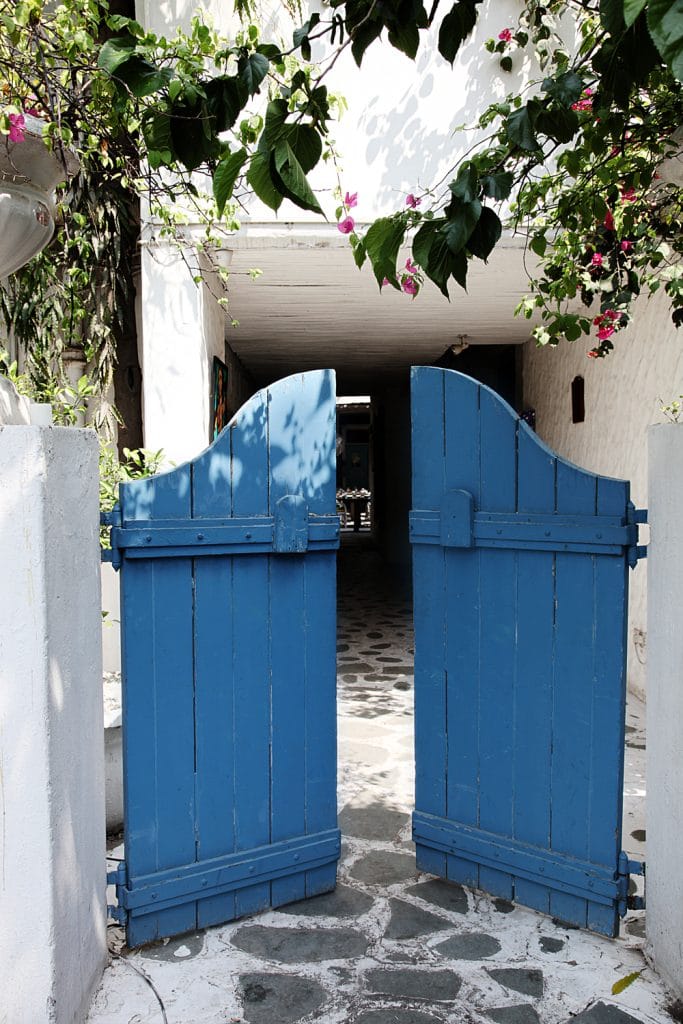
Oberoi lives in Mehrauli, and sees the restaurant’s relationship with the area as practical. The menu now uses more local ingredients, he said. He sends chefs and the purchase team to the local sabzi mandi (vegetable market) around 7 am to see what leaves, vegetables, and fruits are in season. Some of his staff members stay in the Mehrauli belt and check the mandi too. According to Oberoi, local sourcing is cheaper, fresher, and gives younger chefs a way to feel the ingredient before cooking it. When a vegetable cart crosses Olive’s blue door, he tells the team to stop it and pick up a few kilos of whatever looks best.
Years later, he said, there is still ‘nothing like’ Olive Qutub’s location. Mornings have improved because of shoppers, and high tea has become one of the busiest parts of the day.
“I’ve seen people here come to shop, but they eat at Olive,” he said.
For shoppers, diners, and residents, Mehrauli now means different things depending on the door through which they enter. Pant has never shopped there, though he knows people who have gone to Mehrauli for bridal wear. He thinks much of the shopping is ‘very overrated’, and that better quality can be found in Shahpur Jat or smaller parts of the city. Kumar is more willing to browse.
“I feel like the vibes are nice; I also love to go window shopping over there,” she said.
Pant is less romantic about what the area has become. “Now I feel like there’s too much traffic. There’s only restaurants which look really pretty and can sell because of their proximity to the Qutub, but now they’re no longer the same.”
Even then, Olive remains his favourite “because of the status that it holds, and it never disappoints”.
For Kumar, Olive and The Grammar Room remain the draw. “Grammar Room, because sometimes you just need to go there on a rainy day when the weather’s nice,” she said.
New Mehrauli has certainly announced its arrival, but it has not replaced the old. Outside the compounds, the more organic and uncurated Mehrauli carries on: crowded, congested, historic, lived-in. Visiting tourists to the Qutub Minar stop for samosas, sugarcane juice, and packets of chips from stalls near the entrance. Residents move through the by-lanes around the archaeological park, the dargah (shrine) and the mandir (temple). Autos call out ‘metro, metro’. A bhelpuri stand sits outside Ambawatta One, competing with the Miso Chilean sea bass at Swan and Smoked Baingan Cornets at ROOH.
(Edited by Prasanna Bachchhav)