






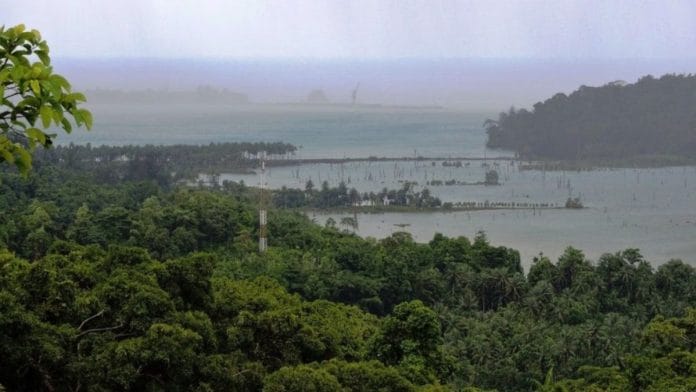

All hell broke loose after the Leader of Opposition Rahul Gandhi visited Great Nicobar Island and made a video criticising the massive deforestation that will result from the building of a container transshipment port, airport and power plant project. Expectedly, self-appointed nationalists accused the Opposition of hindering ‘development’ and undermining national security, seeking to drown out reasonable discussion of costs and benefits.
This whining could not be more off the mark. The reality is that the project for the ‘Holistic Development of Great Nicobar Islands’ has marginal military utility. Why do I say this? Because I did something shocking: I read the actual project documents.
Search for the terms “defence”, “military”, “naval” or “dual-use” in the January 2023 Expression of Interest document about the transshipment project, and you get… nothing. The March 2021 Environmental Impact Assessment report only mentions a “defence apron” at the associated international airport, stating that the defence area will be 5.6 per cent of the total. The November 2022 Environmental Clearance says that any defence facilities will be restricted to the western tip of Galathea Bay. It’s what some people call a nothingburger.
Those raging at the Congress party for ‘opposing’ national security should realise that Congress governments built much of the defence infrastructure in the Andaman and Nicobar Islands, including INS Baaz in Great Nicobar. The airfield currently houses helicopters and Dornier Do-228 reconnaissance aircraft, but is being extended to 10,000 feet. It will then be used as a staging point for Su-30MKI and Jaguar warplanes and P-8 Poseidon reconnaissance aircraft flying east into the Strait of Malacca.
The defence facility was built after clearing 45-50 hectares of land, and now, we are told that a staggering 6,500-plus hectares of priceless old-growth forest are to be cleared for the commercial project.
Remember, existing airfields like INS Kohassa in the Andaman Islands and Air Force Station Car Nicobar can also deploy air power southwards into Malacca. A “dual-use” commercial airport in Galathea Bay adds very little in military capability, but will inflict immeasurable ecological damage.
Negligible benefits, and costs beyond quantification — not just for the fragile and unique forests and coastlines, flora and fauna, but also for the indigenous people and ways of life, worthless as all this may be for the greedy, short-sighted deal-makers in Delhi.
Also read: Why India needs the Great Nicobar Project—new great games in the Eastern Indian Ocean
No contribution to national security
Now you might be that armchair admiral who says: Who cares about the facts? I want it all! So let’s hear what actual admirals have to say. Former Navy Chief Admiral Arun Prakash said: “There is room to bolster, expand and reinforce the existing military presence and infrastructure… without significantly disturbing or disrupting any of the valuable ecological or anthropological assets of the island”. He added that islands to the north of Great Nicobar have the potential to be developed for military use.
There is a deeper problem that was flagged by the former Chief of Staff, Andaman Nicobar Command, Rear Admiral Sudhir Pillai. Without essential elements such as a “joint command architecture, without the chokepoint doctrine, without the maritime strategy document that specifies what Great Nicobar is for”, he argued, any infrastructure on Great Nicobar Island “is a platform without a theory”. Can you see the immense folly of all this?
Some people fantasise about India throttling Chinese sea lanes of communication by blockading the Strait of Malacca using capabilities apparently housed at the non-military base in Galathea Bay. Edward Fishman, author of the book Chokepoints, describes a chokepoint as “a gateway so critical to international trade” that “blocking it can bring an enemy to its knees.”
Malacca is hardly a chokepoint by this standard. Chinese shipping can use the Sunda and Lombok Straits if Malacca is blocked. Indeed, the shallowness (25 metres minimum) of the Malacca Strait means that ships larger than the Malaccamax size (20 metres draft) are already forced to use the straits of Lombok and Makassar. Which in turn, will limit the utility of Galathea Bay as a transshipment terminal. And any unilateral military action could also bring India into conflict with Indonesia, Malaysia, Singapore and Thailand, which together govern the Malacca Strait.
Do we need expanded military capabilities to deal with growing Chinese power? Certainly. Will a transshipment terminal and a civilian airport increase India’s ability to choke China economically? Hardly.
In fact, there is no guarantee that a transshipment port built at high financial and ecological cost will actually succeed. Galathea Bay is an isolated outpost far removed from other Indian ports and industrial centres, as retired naval officer Abhijit Singh has written. It lacks the connectivity that other transshipment ports like Colombo, Vizhinjam and Vallarpadam in Keralam, enjoy. One could argue that this is the private investor’s risk to take, but the environmental tradeoffs and proposed Rs 12,320 crore government subsidy make this a national — in fact, planetary — and not merely a private concern.
In short, the Great Nicobar transhipment port and airport project makes practically no contribution to India’s national security. Yet it is being sold to the country under the cover of strategic interest. The environmental cost, the islanders’ united appeals and the wider opposition are being disregarded, even as huge subsidies are proposed for the Modi government’s cronies. It is the duty of the Opposition and all responsible citizens of this country to oppose this act of pure destruction.
Amitabh Dubey is a Congress member. He tweets @dubeyamitabh. Views are personal.
(Edited by Saptak Datta)
While Rahul Gandhi critiques the Great Nicobar project as an ecological ‘crime,’ it raises a fair question: did he utilize a private jet for this trip? To align the Congress party’s ‘pro-environment’ claims with action, would leadership consider transitioning to electric vehicle convoys and installing solar panels at the INC headquarters? Advocacy is most effective when policy criticism is backed by personal and institutional accountability.
Just like Congress built great infrastructure in Himalayas for our armed forces to counter Chinese, they also built great infra in Andaman and Nicobar. Such great infra that even Myanmar has built a bigger airstrip which Chinese use on Coco Islands just north of Andaman.
Rahul Gandhi ne bola hai toh sahi hi bola hoga bss repeat krne lgte hai…No research no analysis.