




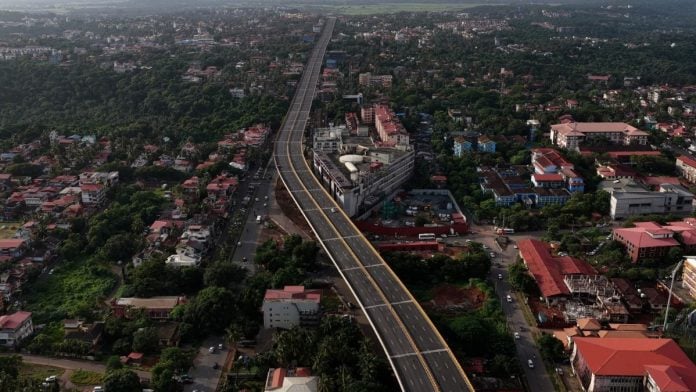

A rally of supercars rumbled across Goa’s Porvorim elevated corridor on 9 September. Neighbourhood WhatsApp groups were on fire: plans were frantically made to carpool to the new Rs 641-crore flyover that had been under construction since 2023. For the first few days, the 5.15-km stretch was open only to pedestrians and hosted lively performances on the ground, with drone shows lighting up the sky.
The celebrations made sense. Few infrastructure projects have been as awaited as the six-lane flyover that serves as a crucial link between south and north Goa on NH-66. One of the purported reasons for the elevated corridor was to improve road safety on the Porvorim stretch, which witnessed 238 accidents, including 22 deaths, between 2022-24.
On 11 September, the Goa BJP Instagram handle announced the flyover open to traffic with a snazzy video featuring aerial shots of Chief Minister Pramod Sawant driving on tar so fresh it was still gleaming. The accompanying caption was: “The elevated corridor is open, the jam is history, and the road to Panaji is a straight run. This is what delivery looks like.”
Twenty-four hours later, a scooter rider and a car passenger were dead at the sole exit point on the flyover toward Porvorim, forcing the government to ban two-wheelers from the flyover entirely. The CCTV footage of the accident is brutal: A speeding Baleno crashes into an Activa behind a stalling truck, hurling the rider in the air, killing him instantly.
That same evening, we were stuck in the resulting jam for over an hour, as Rohan Khaunte, Porvorim MLA and tourism minister, beamed down from a hoarding and congratulated us on our new flyover. We crawled toward an exit that did not exist, only to have to drive all the way to Panaji – eight kilometres ahead – to be able to take a U-turn.
A flawed corridor
The tragic accident was only the beginning of the flyover’s woes. Within its first two weeks, the corridor has witnessed four major accidents and 580 cases of overspeeding. Vehicle restrictions and the abrupt closure of access points have actually worsened traffic conditions in an area that was already plagued by confusing diversions and inadequate signage.
Last week, a short spell of rain caused severe waterlogging on the corridor, forcing workers to smash through the new concrete barriers to let the trapped water out.
If Goa’s political establishment has been eager to claim credit for the flyover, the response to owning its failures has been less than enthusiastic.
Goa PwD Minister Digambar Kamat, whose department is responsible for the construction, was assuring reporters in August that there was “no need to panic” over the project’s timeline as final testing of the corridor was underway. After the crash, Kamat said the accident was the result of rash and negligent driving, and urged reporters not to paint a target on his back.
This despite the fact that the state’s traffic department had written a detailed letter to the PwD cautioning them that proper signage and channelisation of traffic were needed at the entry and exit points, where the elevated corridor merges with the service roads, to avoid accidents. Roland Martins, convenor of GOACAN, an NGO that works on consumer and civic issues, and a member of the North Goa District Road Safety Committee, even said that the body was never taken into confidence on the corridor.
Neither was Khaunte. In the days before the launch, the minister had conducted an interview on the flyover with a Goan news outlet and spoke about the trust that the people of Porvorim had reposed in him. But days after the accident, he said that he was not consulted over decisions about the flyover.
In another interview, he sided with his constituency and suggested that angry Porvorkars, who had been complaining about their access to the corridor, were merely airing out their sentiments on social media. He, too, subtly turned the conversation toward citizen responsibility, lane discipline, and rash driving, stating that he had once spotted a Ducati speeding like in a sequence out of Dhoom.
Also read: Goa has a Ganpati problem — Omkar the elephant keeps coming back
‘Project only benefited builders’
The state’s response now is to hurriedly cobble together a technical team brought in from IIM Nagpur to resolve the crisis. The institute had signed an MoU to build traffic simulation models in parts of Panaji and is now being called upon to diagnose an issue of highway geometry. It prompted AAP leader Valmiki Naik to say, “An engineering defect cannot be handed over to a management school.”
The flyover’s compounding failures fall along a tidy continuum. The design flaws that are now causing fatal accidents were poured into its foundations.
At a recent meeting, Khaunte pointed out that the original project report called for a 45-metre footprint, which would have been wide enough to provide ramps. So why had the state acquired only 25 metres?
Ganpat Sidhaye, a retired engineer who once headed the Goa PwD’s National Highways division, said that the acquisition likely stalled over buildings that had been allowed to come up in the highway’s setback area.
“The contractor has been working with severe constraints,” Sidhaye said. “But has anyone examined the contractor’s scope of work? Have traffic safety audits been carried out? The whole project has only benefited builders. When there is no land available, who can make a bridge?”
The biggest flaw, urban planner Tahir Noronha said, is the extremely short distance provided for vehicles entering the highway to accelerate and merge. Noronha said that the Indian Roads Congress guidelines prescribe roughly 200 metres of parallel lane for joining traffic to pick up speed and another 50 to merge. By his estimates, Porvorim’s “ramps” allow about 50 and 25 metres.
“Here, traffic is neither achieving the speed of the highway nor getting enough time to safely merge,” he said.
Compounding this, a road meant for traffic speeding at 100 km/hour will now suddenly have to be constrained to a limit of 65. On top of that, six lanes from the elevated corridor are being forced to funnel into Atal Setu’s four within 300 metres, and the bottleneck overlaps with a busy junction/intersection, adding another set of conflicting traffic movements at essentially the same location.
Noronha understands that land acquisitions for infrastructure projects are always tetchy. “But the long-term result of compromising on highway design is loss of human life,” he said. And that loss is always uneven. “Car drivers are usually safe in a collision, but two-wheeler riders are far more exposed to serious or fatal injury.”
Speaking at the flyover’s inauguration, Nitin Gadkari, Union Minister of Road Transport and Highways, said that the highway had “immense emotional and economic significance”. He also promised that in October, he would travel the entire stretch between Mumbai Airport and Goa by car, “and personally inspect every kilometre of the completed corridor”.
That impending journey – the people of Porvorim hope – ought to make their flyover safer. For cars at least. Those on two-wheelers can find their own way.
This article is part of the Goa Life series, which explores the new and the old of Goan culture.
Karanjeet Kaur is a journalist, former editor of Arré, and a partner at TWO Design. She tweets @Kaju_Katri. Views are personal.
(Edited by Saptak Datta)