




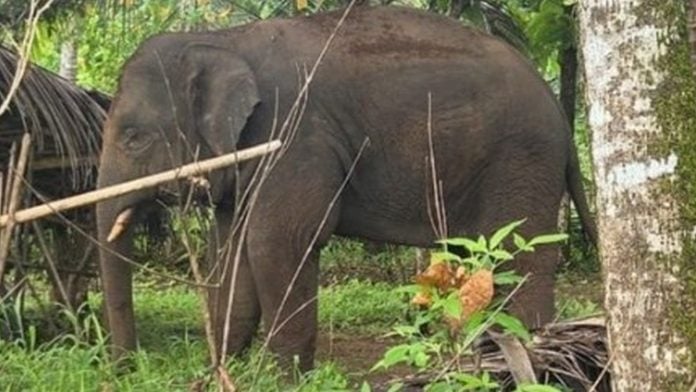

Ganeshotsav began in Goa last week. Families gathered around creeks, rivers, and ponds to immerse and bid farewell to the idols of Lord Ganesha that they’d brought home a few days prior. But a day after the immersion, the deity returned to land and ventured on to the highway near Tamboxem — in the form of Omkar the elephant.
Traffic came to a complete halt on the stretch of National Highway 66 that passes through the tiny village abutting the international airport at Mopa. Forest department workers guided the elephant back into the thicket, luring him with bananas and other fruits. Trucks idled and bikers climbed onto the raised median, holding their phone cameras aloft. They were all trying to catch a glimpse of Omkar, a ten-year-old tusker in search of a home.
Over the last few months, Omkar has become a regular beat for local Goan channels. Since 2025, when the elephant was separated from his herd in Maharashtra’s Sindhudurg district, he has crossed between the two states several times. The lone sub-adult male has chosen to walk along the banks of the Terekhol River, which runs along the Maharashtra-Goa border, setting off panic in the small villages that dot the landscape.
In Sindhudurg’s Morle village last year, a 65-year-old cashew farmer named Laxman Yashwant Gavas was hurled in the air by Omkar, who then trampled his chest. Gavas had gone to collect cashews from his plantation in the early hours; he died on the spot. The death resulted in an eight-hour standoff between the villagers and the forest and police departments. Morle’s people wouldn’t allow officials to take Gavas’ body for post-mortem unless they were assured that Omkar would be caught.
The farmers in Maharashtra’s southern coastal districts and Goa’s northernmost Pernem taluka, where Omkar has also flattened cashew and areca nut plantations, are understandably unhappy. “We cultivate the land, take out loans, and nurture trees for eight to ten years… only for the elephant Omkar to come and destroy everything in a single night. What are we supposed to eat?” one told The Herald. “How long will the compensation last? Who will compensate us for years of hard work?”
But for those whose lives and livelihoods are not threatened by him, and who have followed the breathless reporting of his movements mainly via Instagram, Omkar’s shenanigans offer a sliver of joy. They welcome his sightings and leave comments chanting “Ganpati Bappa Morya!” under his videos — and, in a display of utter cluelessness, stop to take selfies with him in the middle of the road.
Also Read: Goa’s Marathi language row is back. The real battle is over who gets to define Goan identity
Why Omkar keeps coming to Goa
Everyone involved in this story hopes for a good outcome for the young elephant. But no matter how you spin it, Omkar is a challenge, especially in a state that does not have a native elephant population. As far back as November 2025, the Bombay High Court had ordered his capture and temporary relocation to Vantara. But in the intervening 10 months, that has proved much harder to execute.
Jiss K Varkey, the Deputy Conservator of Forests in the North Goa Division, described to me in detail the challenges facing the department. Varkey’s department first received information about the elephant through drone sensor data from Maharashtra. At the time, Varkey admits, they “had no idea about the animal, how it behaves, its movement patterns, and attitude toward humans”. Nevertheless, they deployed 24×7 rescue squads in two batches of 50 people each.
The squads camped at Mopa, where they sighted a panicky Omkar very close to the airport’s compound wall. Even alerting the villagers and securing schools was a problem because of low network coverage in the area. “Despite being in a non-elephant landscape, we could drive the animal back to Maharashtra on the second day,” Varkey told me. “But villagers in Maharashtra sent the animal back to Goa in no time.” This has happened repeatedly. In November, Sindhudurg locals were seen bursting firecrackers to drive a very frightened Omkar away.
Since then, the Goa team has tried to give the animal enough rest before guiding it back across the border. Omkar has begun to respond to some of the rescue staff members, who feed him bananas and sugarcane. A few days ago, the elephant showed up on a narrow village road in Patradevi, right outside a cluster of rural homes, where rescue staff were seen gently coaxing him with fruit offerings.
Varkey is cautiously proud of what his team has achieved. “A wild elephant has entered Goa after 20 long years,” he said. “No staff members in the department have faced such a situation before or had any experience with this. But we monitored the animal effectively and prevented any untoward incidents.”
Also Read: Goa beyond beachrot—inland hotels are the next vacation frontier
The elephant in the room
Despite the frenzy over his movements, Omkar’s behaviour is entirely expected. Elephant expert Dr N Lakshminarayanan told me that among large mammals like elephants, gaur, and sambhar, young males between the ages of 10-12 years tend to “disperse”. Before that, young bulls remain with their natal herds. Over a decade during the dispersal phase, the animals widen their range and look for a large area to settle down, which gives rise to a fairly complex set of behaviours. “The problem is the age, not the animal,” Dr Lakshminarayanan said. “Lots of variations in behaviours are usually observed — that is the norm, especially in high-density areas.”
According to him, Omkar isn’t an anomaly; plenty of young bull elephants across the country are displaying the same behaviour. Elephants are common in central Karnataka, but infrastructure projects like hydroelectric dams have splintered herds, some of which have moved northwards towards Goa and Maharashtra. However, the Western Ghats narrow in the north, the forest thins out, and the deciduous cover that the elephants prefer gives way to evergreen landscapes. The density of human population also adds to the anxiety.
None of these are ideal conditions for Omkar. For now, the animal has to wait to see whether his parent state will have him back. The trouble with elephants is that they have no idea of political geography, and where one state ends and the other begins. Several villages on either bank of the Terekhol have tried to teach him, but he is yet to learn the lesson. That’s the elephant in the room no state has been able to address.
This article is part of the Goa Life series, which explores the new and the old of Goan culture.
Karanjeet Kaur is a journalist, former editor of Arré, and a partner at TWO Design. She tweets @Kaju_Katri. Views are personal.
(Edited by Asavari Singh)